By Sheela Jaywant
I had not seen Jesus’ photograph in anyone’s house before. He was Goanna’s god; you know, some worship Shiva, others Vishnu, or Hanuman or Manguesh/ Subramanium/ Durga/ whoever. Up on the wall, framed in a picture, like the others, He wore no jewels, no silk clothes, no colourful mukut on His head, had no weapons or musical instruments in His hands, no animals or trees around him. The “photograph” showed His face drooping, a halo around the head, eyes closed; not in good health, I thought. No garlands, no bright flowers, no rice, no coconut, no halad-kukum, no incense burning before Him, nothing cheerful. A simple, austere god, like Shiva. But Shiva had a sliver of the moon, a tiger-skin, the Ganga and a snake adorning him. He had the bull, Nandi, for company, too. I took my chappals off my feet and did a longish namaskar to Jesus. He wore only a loin cloth. Like Gandhi. A quote came to mind: Einstein had said on Gandhi’s 70th birthday, “Generations to come, it may well be, will scarce believe that such a man as this one ever walked upon this Earth.”
Like Krishna, I reminded myself, Jesus was born at midnight, with cattle for company, in a shed, to lowly parentage.
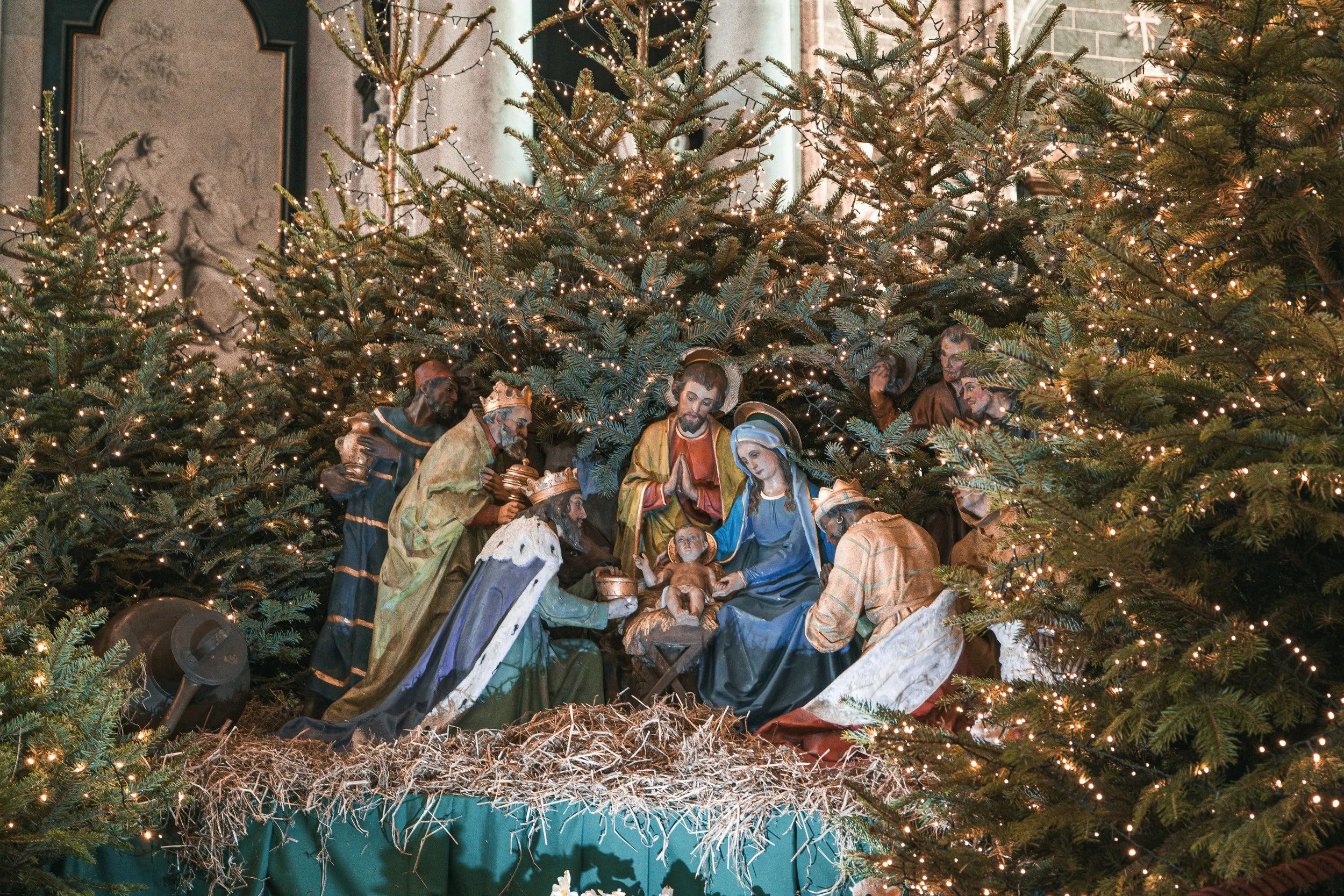
On another wall, on a shelf covered with a lace cloth, was a statuette of Jesus as a baby, cradled in his mother’s arms. Again, similar to Bal Krishna. Instead of a divli, before Him was a candle burning in a cut-glass bowl, a frayed, well-thumbed bible kept alongside it, much like our Ramraksha chapbook at home. No sandalwood dot on the statue’s forehead or feet, no tulsi leaves, no bundle of grass, no brass or silver utensils, not even a shiny ribbon tucked anywhere for gaiety.
Goanna called him Yeshu; I told her Yeshu was short for Yashwant, a hot classmate. We giggled.
“Come,” she urged, pulling me towards the car, “We’ll be late for Mass.”
It was almost 23:45 hours; I had worn a silk sari, an altered, borrowed blouse, tied my hair into a bun and worn a mogra faati as instructed by my Aiee. “It’s like our Ramnavami or Janmashtami,” Aiee had told me, “Their holiest feast; you must not wear jeans, ok?” Goanna and her family were dressed formally, too, in shiny dresses and fancy jewellery.
Inside the church, everyone stood quietly in their places. Like at our muhurt, the Service, as they called it, started on time. The priest told us the story of Jesus’ birth. Saib, he called the Lord, and Mary, Saibini or Mai. My attention went to the high ceiling, the paintings of winged angels and hallowed saints on the walls, the carved altar, the way the young girls and boys who were participating in the celebration neatly held their napkins, and how the people repeated some prayers or sentences, turned from side to side and said to their neighbours, “peace be with you and with you.” The vessels, silver or gold, weren’t shaped like our lotas or thalis. Later, Goanna told me their names: chalice, retables, dossals, reredos.
No wooden paats on the floor; during our visits to the temples, the bare-chested bhatmaams did their jobs sitting cross-legged in front of the idols. A married couple might participate in the proceedings, so to say, but the rest of us chatted and stood around envying what someone else wore, discussed the forthcoming exams (yea, I have cousins of that ilk, nerds, I tell you), or prices of the newest phones in the market. I mean, a god’s birthday meant good eats, right? And gadding with cousins, friends and neighbours. Prayers were a minor part of the deal, best left to professional bhats.
Here was some quiet singing, unlike our vigorous aartis. Though the choir led, everyone knew the words and joined in throatily. Someone was playing the organ in a corner, not centre-stage like our harmonium players. No tabla, no zhanza nor cymbals. The hymns were soothing, pleasant, gentle. Allelu a-aleluia, ave Bai Maria, mostly in Konkani, were sung in parts, too, with the sopranos, altos and basses well-coordinated. I should have recorded it; but, haa, in those days there were no cellular phones.
When the ceremony was over, I wanted to join the queue for prasad. “Stay where you are,” Goanna insisted, “We are receiving not prasad, but communion, bread and wine, the body and blood of Christ. You cannot come. Wait here.” Curious, I stood on my toes and stretched my neck to see exactly what people were chewing or swallowing. All I saw was a white disc dipped in red liquid disappearing into people’s mouths. They stood in a queue and when their turn came, stood before the priest doing aah with open mouths, tongues out, eyes often closed. No outstretched hands, no crowding, very orderly, almost like they were at school assembly. I recalled what we did at home during pujas: licked the runny panchamrut off our palms and wiped what remained on our hair, if we weren’t carrying a hanky.
The moment Mass was over, it was like any Hindu celebration. Everybody rushed to the tables laden with food and soft drinks outside, patting backs, shaking hands, asking about relatives, colleagues and neighbours, jobs, promotions, pregnancy news, transfers, car prices, servants, renovations, worship was over, Jesus forgotten. I followed Goanna and her parents and siblings through the crowd, nodding at those they nodded at, smiled with them, all the while mechanically chanting not merry but Happy Christmas. If I were to wish in an Indian tongue, it would be Jesus Jayanti. Shubh Jesus Jayanti? The sound and feel of it jarred. Whilst most of the congregation stayed back to play games or dance, or so I was told, we went back to Goanna’s home.
Goanna and I were classmates in school. I was spending the December vacation with her, through the Christmas season. Oddly, both our mothers admonished us individually that we were to be on the best of behaviour with each other, not quarrel or say anything hurtful, make sure the other was comfortable and “adjust.” Which was why Goanna was annoyingly, cloyingly attentive towards me every godamn moment.
When we got home from church, yawning, Goanna nudged me and said, “Don’t you sleep, now starts the fun.” So many relatives. One or two of the men wore kurtas, the others wore ties, long-sleeved shirts or coats. I didn’t remember my uncles dressed like that outside their workplaces. The women wore saris, at least some of them, but not the heavy silks my mother and aunts wore. These saris were light and transclucent, with shiny sequins or embroidery on delicate designs, elegant and graceful. Even those who were in dresses had an air of style and sophistication. All of them had double names like Betty-Veronica, Frank-John, Louis-Marshal, Joey-Fatima, even though they were referred to as Budu, Disco or Bones (as one skinny cousin was called); just as my cousins had pet-names like Naktya (flat nosed), Zaadya (fatty) and Bebko (frog). On the table were unfamiliar goodies: curly kalkals, little marzipan shells, cashew barfi rhomboids and cake. In the savoury section were one-inch square cheese and cucumber sandwiches, sannas and sorpotel, fried fish, shredded chicken with mayonnaise, stuffed eggs, every single thing that we would never dream of having on any of our Gods’ days. Why did our Gods restrict themselves to a no garlic, no onion fare? Not that I cared, good food was good food.
And then, I took a slice of what they called “salt meat.”
“Don’t,” one aunt said to me, “That’s meat.”
“I eat meat,” I said, taking a bite of a slice. It. Was. Delicious. The best cooked flesh ever. I took another piece and blinked at Goanna, suggesting its superlativeness. There was a brief, uncomfortable silence; Goanna looked at her mother, one of her aunts held my hand and guided it away from the plate. I shook it off and took yet another helping. The moment passed, and the chatter continued. I had taken a fourth piece of the meat before the plate was discreetly removed from the table. I did not give any thought to this incident until later.
Along with the others, I got several gifts: a pair of earrings, two packets of hair clips, a book, a fountain pen, a purse, some stickers. My mother had thoughtfully packed gifts for Goanna’s mother: a ceramic dish, a set of spoons, and a bunch of real-looking plastic flowers, a hamper of laddoos, shankar pallis, chaklis and chivda.
Unlike in the church, here children were running around, poking their fingers where they shouldn’t; women clustered in one place, dashing in and out of the kitchen, looking busy, adjusting their blouses or saris; men stood together, glasses in hand, laughing uproariously at heaven knew what.
There was no toe-touching, no overwhelming presence of any murti. The decorations and the cards strung across the room were a far cry from our kandils, but the festive look, the fairy lights, the cheer, was the same as at home.
Before I knew it, the week flew past. On the day I was to return, Goanna’s mother took me aside, sat me down and in a very gentle tone told me that the meat that I had eaten was beef. It was inadvertent, they had tried to discourage me and finally taken it off the table, she said apologetically. I recalled the taste. Delicious! And immediately felt a sense of guilt. I was Hindu, my mother was a cow—sorry, the cow was holy, considered to be like a mother.
“We have prayed for you,” Goanna and she assured me. “You did it innocently, ignorantly, so it’s not a sin.”
Easy for you to say that, I thought. I have done dharm-bhrast. I have defiled myself, my religion. Tears stung my eyes, but I stood there quietly, even said my goodbyes sombrely.
All the way home, I wondered what I should do. I could ask Jesus to help; but He hadn’t been able to save Himself, I thought with teenage logic, His father had to bail him out, how was He going to save me from this dharm-sankat?
At home, there was a lot of curiosity. What did you do? How was Christmas? Did they like our gifts? Show us what you got. What did Goanna wear? Did you go to church? At midnight? Did you hear the carols sung? Did you join them? And last of all, what did you eat?
Finally, when asked why so glum, I blurted: I ate beef. They made me eat beef. They called it a meat sandwich. And then, with typical defiance, raised my chin and said, “So? So, I committed a crime, yes?”
The reaction from my eldest uncle and his wife, the most conservative of the clan, was instant and took me back. He grinned, and my aunt stroked my shoulders comfortingly.
“You went to their house, they shared their food with you. It was their feast. Had they come here for Ganapati or Holi, what would we have done? We’d have shared our food with them. It is a privilege to have guests. You could have avoided it, true, but you were unaware and blameless. No crime committed, nothing to worry about. Go have a bath, say your prayers.”
That was that.
It’s been a long time since I celebrated any religious festival. These days, I forward ecards on WhatApp irrespective of who’s revelling in what.
Sheela Jaywant is a translator, humour columnist and fiction writer published in numerous journals, magazines, newspapers and anthologies. She is the recipient of several prizes including most recently the Fundacao Orient Short Story Competition.
Banner image by Mustafa Turhan downloaded from Unsplash.com