“The ancient protective spirits had fled, chased by the ugly spectres of alcohol and violence. That’s when the deaths started. Newborns were the first to succumb. Then the men complained of pain and exhaustion. Their abdomens swelled above skeletal frames, their eyes yellowed, their blood thickened. When they died, they left behind insurmountable debts; hungry ghosts for the women to exorcise. ”
By Cordelia B. Francis
Verek’s eyes searched the horizon for the slightest sign of rain. Her old dog Balu crouched next to her, calm and alert.
The horizon was a flat line. It shimmered in the afternoon heat. It had been this way, unchanged for years.
The day Verek’s husband and son died, along with most of the men of the village, was also the day the land and the sky drained of colour.
The doctor at the health centre said it was alcohol poisoning. But the women knew it was the pain of emptiness and loss.
It had started when the mining company arrived in their village, offering them jobs, Rs. 5,000 a month, and brand new cooking utensils. By the time the villagers realised it was an unequal exchange, the land had been scarred, scraped and burnt.
It was across this alien wasteland that Verek stared at the white hot sky. She licked her dry lips, remembering the taste of the cool sweet water from the sacred spring, now choked with chemicals.
The ancient protective spirits had fled, chased by the ugly spectres of alcohol and violence. That’s when the deaths started. Newborns were the first to succumb. Then the men complained of pain and exhaustion. Their abdomens swelled above skeletal frames, their eyes yellowed, their blood thickened. When they died, they left behind insurmountable debts; hungry ghosts for the women to exorcise.
This was the circle of misery in Verek’s village.
The contractor of the mining company did not waste time. The debt collectors arrived in plumes of dust, furious to be sent to this dry meagre land. They shouted at the women through parched lips and shoved a few of them around to show they meant business before quickly jumping back into their air-conditioned Scorpio and driving off towards the tight-lipped horizon.
Like the others, Verek sold her goats to chip away at the debt. If the rains arrive, they have a chance to harvest millets, gourds and fatten their herds for better prices at the local market.
Balu’s old eyes watched her face darken with worry. He whimpered softly.
“Hmm, all is well, Balu,” she said. “But, it will be better when the rains come.”
Each morning, when Verek rose at dawn, Balu would be by her side, waiting for the Parle biscuits she’d share with him. After a cup of strong, sweet tea, she’d grab her wooden staff and with the old hound at her heels, they’d take the herd out, traveling further each time, in search of grazing grounds.
Today, she had returned home early. She was tired. Without the men, and with her daughter-in-law, Suman, still bedridden, her work had doubled. But more than the back-breaking tasks, it was the soothsayer's words that weighed heavy on her mind.
Verek turned her attention to the clay pot hidden under Suman’s makeshift bed. Even though its outline was barely visible in the dark corner of the khop, Verek was familiar with its shape.
“Tsk, see that pot Balu. The seal is as unforthcoming as the horizon. I think the old witch filled it with rocks instead of salt. Just another cheat, like that contractor.”
“Where is the rain, Balu? The rain that will wash away all our problems.”
The old mangy dog, hot and hungry, looked to her for the answer.
Verek grumbled under her breath. For now, she’d clean out the goat pen and collect the manure for sale at tomorrow’s market.
As the sun set without a fanfare of colour, she heaped the last of the nutrient-rich pellets into a plastic sack. Then she put on a pot of boiling water to make ragi porridge for dinner. In the distance, electric lights twinkled in the homes of the higher-ups of the mining company. Verek’s village, with its mounting bills and debts, lay shrouded in darkness.
From the bed, her daughter-in-law moaned in her sleep.
“Suman, wake up. I’m making porridge for dinner.”
The young woman struggled to open her eyes.
Seeing Verek, she asked, “Why did you do it?”
“Shh, I’ll get some water,” Verek tried to sooth her.
“No, I'm not thirsty… not for water,” the young woman answered, clutching her pregnant belly.
“I want the truth.”
“What truth, Suman?” Verek asked, gruffly.
“I saw you that night when the contractor’s house caught fire,” murmured Suman.
“Tsk, you are talking nonsense. Fires break out in this area all the time. Look how dry everything is,” Verek pointed out.
“That’s what you say. But that day when the soothsayer arrived with the pot of salt, I heard you ask her for the remedy to help a barren woman get pregnant. You were talking about me, nah?”
“Sometimes, when I think back to that night, I’m not sure what I saw. But then I remember seeing Balu. He follows you like a tail.”
“I saw you, too, Suman, running into the night, carrying the bag the contractor gives you when you visit him.”
Suman stared at Verek. They both knew the punishment for adultery. A ring of fire through which the woman, not the man, has to jump through to prove her innocence.
Verek stared at the bubbling pot of porridge. “What does it matter now? She said. “There are no men left in this village. No one will light the ring of fire.”
“But what about murder?” Suman whispered accusingly, her face contorted in the dim light of the chulha.
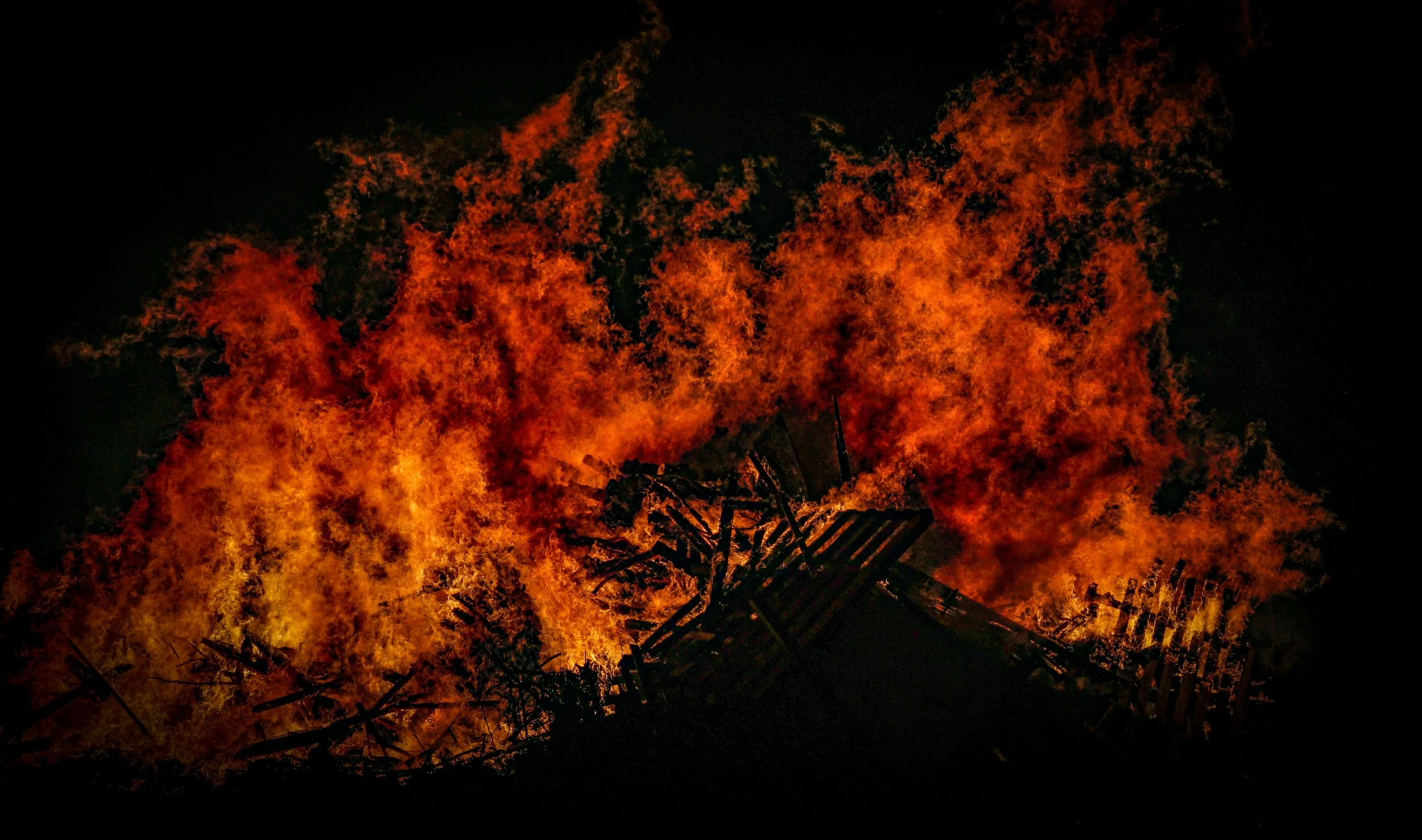
Verek recalled the blaze. The soothsayer had told Verek to light a tiny spark, at the corner of the straw roof, just enough to kill a few insects, free their souls so they seek rebirth as human beings.
Verek was already halfway home when a piercing scream froze her in her tracks. When she turned around, she saw the flames dance mockingly over the contractor’s small house, and a figure, a woman holding something, surreptitiously flee the burning house. Balu pressed himself against her bare calves, his eyes, like hers, gleaming. It was only when they got home that Balu sniffed out the bag with its contents of biscuits, rice, dal, chocolates, and Lay’s chips.
“It was you, no?” Suman asked. “What were you doing so far away from the village?”
“I told you, I was coming home from the health centre. I took the long route home to think and to mourn. What else can an old woman do whose husband and son are dying?”
Suman hooked a tired arm across her forehead. The police too had questioned them. And, in the presence of each other, both women had conspiratorially admitted to being asleep in their khop at that late hour.
“I’ll bring some water,” Verek offered, standing up. She stopped briefly to stir the pot of porridge. The fire crackled. She disappeared into the kitchen behind the now empty buffalo pen.
When she returned, Balu was sniffing under the bed. He’s probably found a packet of biscuits, Verek thought to herself.
“Here, drink. It is hot and sometimes the heat brings bad dreams with it,” she said. Then she felt a crunch underfoot. She grabbed a piece of firewood from the chulha and held it aloft. In the bright glimmering light, a small mound of salt had spilled out from under the bed.
Verek knelt down and pulled out the clay pot.
“Look, Suman!” she cried with relief. “The seal has broken. Soon, the rains will arrive.”
Suman closed her eyes. Verek saw her face relax into the countenance of the young woman she was.
Verek stirred the porridge again, this time slowly. Balu stood next to her, watching her face, waiting for the words he loved to hear.
“All is well, Balu. And now, all will be better.”
Cordelia B. Francis is an associate editor at Comixense Magazine. Her short stories have been featured in Muse India and the João Roque Literary Journal, and she is also published in The Greatest Goan Stories Ever Told (Aleph). She won the Fundação Oriente Short Story Competition 2012, and her work has also appeared in the anthology Shell Windows. She has written a series of short comics booklets promoting a holistic understanding of global health that includes environmental, social and gender issues. She hosts the newly launched podcast From The Rocking Chair, which crafts intimate portraits of Goa, capturing its people, culture, and ever-evolving landscapes.Previously, she worked as a journalist with Femina in Mumbai and O Heraldo in Goa.
Banner image by Zoltan Tasi downloaded from Unsplash.com