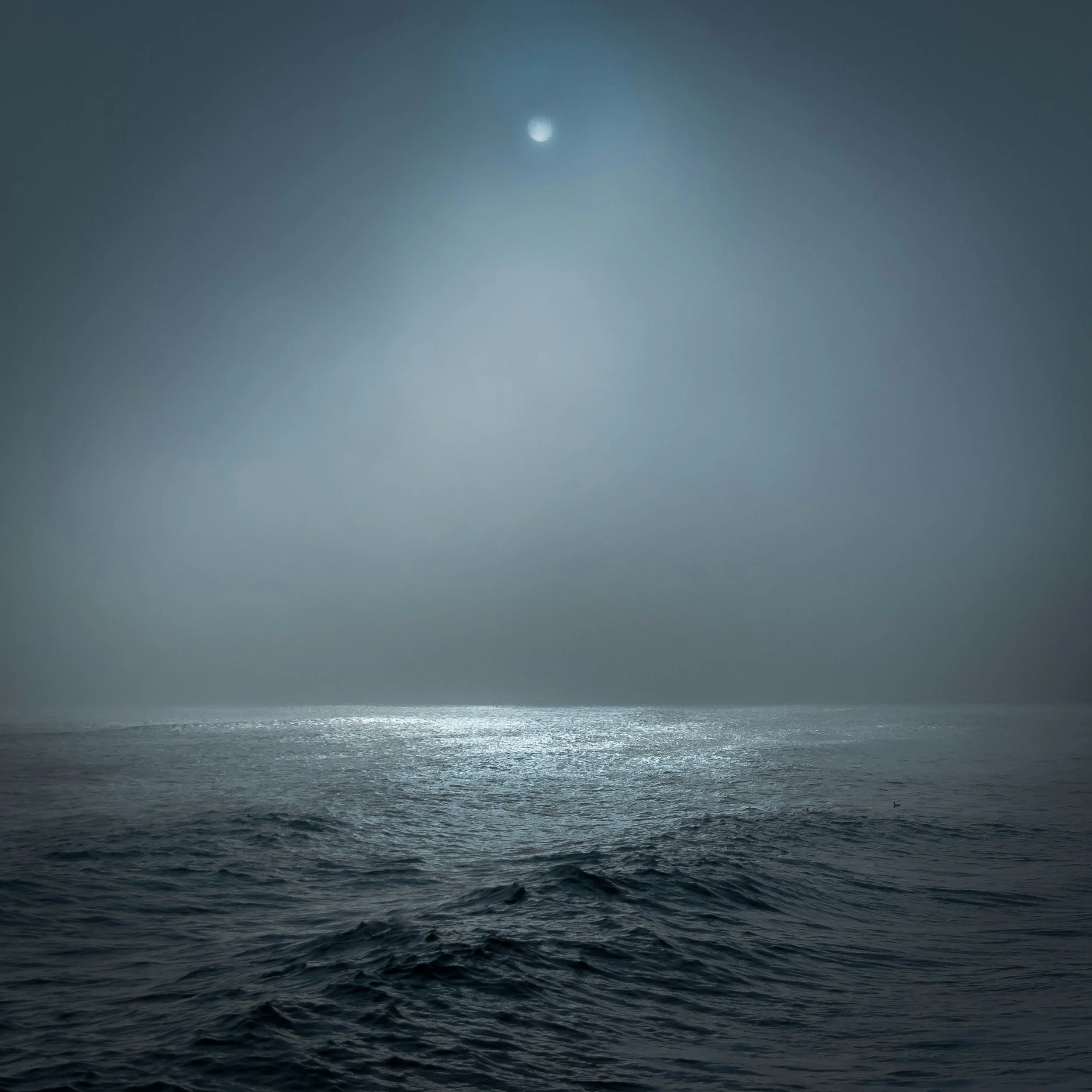
“The sea does not ask me to explain myself. It does not need me to arrive with a coherent account of what has happened or what I intend to do next. I can stand at its edge and let the waves break against my legs. ”
By Saachi D’Souza
There are two precious images from when I was a toddler. In one, I’m holding my father’s hand; our backs are facing the camera, and he’s walking me into the sea. I like to believe these were some of my first steps in this world. We would visit Goa, our ancestral homeland, and Dad would hold me as I learnt how to walk (no, wade) through water. I don’t know the real story of my first steps, but it’s nicer to imagine them in water. In the second image, I’m settled in my mother’s lap; we’re smiling at the camera, and the sun is setting over the sea in the background. I’m delighted to be held in my mother’s arms and to hear the gentle sounds of water.
My earliest experiences since birth were with water. There was no separating the two; I was joined at the hip, my insides filled to the brim with it. I am—as we all are—water.
I learnt how to swim very early. My dad insisted it was a crucial life skill. It wasn’t lost on me that to be threatened by water required living near vast measures of it. In a swimming pool, it is finite. You can see where it begins and where it ends. I was too young, of course, to know or feel the ground beneath the pool. I’d see my dad hold his breath, and in seconds, be able to push himself to the deep end. Sometimes he would hold my hands and take me with him. I became a swimmer in the way some children become readers: by discovering a place they could return to, over and over, and never tire.
But a pool is not the sea. In the sea, there is no visible end, no tiled boundary to tell you where your world stops. I could float on my back and look at birds flying overhead. Sometimes, watching them glide across the sky while I lie suspended in the water, I feel as though I am flying with them. My body is now something buoyant, held up by a force I did not have to understand to trust.
My mother wanted to name her first daughter after the Zuari river. My parents would go on walks along its banks, and I imagine that, even before I was born, the river had become part of their shared life. I sometimes wonder what it would mean to have been named after a river. To carry within my name a geography that existed before me and will, if we allow it to, exist long after me. Instead, I was born on the day of a thunderstorm. I arrived, pun intended, wet.
It seems almost inevitable, then, that water would become the place I return to when I cannot quite make sense of myself. When I moved back to Goa four years ago, I went to the sea after signing the lease for my apartment. It was a small ritual: I had committed to a life here, and I needed to meet the water that would punctuate my days. Since then, I have gone to the sea on days that have marked something important and days that have meant nothing at all. On difficult days, I go to disperse myself in water. On joyful ones, too. I have gone after moments of uncertainty, after small victories, when I have felt lonely, when I have been too full of feeling to sit still in my own house.
The sea does not ask me to explain myself. It does not need me to arrive with a coherent account of what has happened or what I intend to do next. I can stand at its edge and let the waves break against my legs. I can swim until the noise in my head quietens. I can watch the horizon and remember that the world is larger than the immediate circumstances of my life.
I have sometimes thought of this as a private kind of love: the kind that requires no declaration, no exchange, no witness. Water is there; I go to it. I return, and it receives me. But I am beginning to question what it means to describe this relationship as private when the water I love is part of a living, interconnected system, increasingly threatened by the ways we have chosen to live. Whole industries now see the sea as their private love, too.
In Goa, monsoon arrives with an almost theatrical force, flooding fields and roads, filling wells, swelling rivers and transforming the landscape in a matter of days. Rivers cut through settlements and fields; creeks and wetlands hold water long after the rain has stopped. It is easy to mistake this abundance for permanence, to believe that because water is everywhere, there will always be enough of it. But abundance is not the same as security.
In February 2026, Down To Earth reported on Goa’s worsening water crisis, arguing that the problem was not simply a shortage of rainfall but a failure of governance. Unregulated development, pollution, the degradation of wetlands and khazan lands, and pressure on rivers and groundwater have altered the relationship between communities and their water sources. Residents have reported drying wells, disrupted seasonal patterns and damage to livelihoods that depend on functioning ecosystems. The crisis is not always visible as an empty tap. Sometimes it appears in a well that no longer lasts through summer, a field that cannot be cultivated as before, or a river whose water can no longer be trusted.
And in March, reporting by The Goan estimated that Goa was facing a daily water-supply deficit of 65 million litres. Despite the state’s claims of universal household tap connectivity, residents in expanding urban areas were experiencing repeated disruptions. Nearly a third of the state’s roughly 6,000 kilometres of water pipelines were reported to be more than four decades old, with leakages and contamination exposing the limitations of a system that measures access to water partly through the existence of a tap.
This contradiction is unsettling. A state can be surrounded by water and still fail to ensure that people have reliable access to it, like Mumbai, where—coincidentally—I was born. A household can have a connection without having a dependable supply. A beach can look inviting while its water quality tells another story. What appears to be a natural resource problem is also a question of infrastructure, planning, inequality and political priorities: whose needs are anticipated, whose are postponed, and what kinds of development are permitted to proceed without adequately accounting for the water they consume or contaminate?
The problem extends beyond drinking water. A 2025 study examining riparian ecosystems along the Sal and Zuari rivers found that human disturbance and water pollution were associated with declining plant diversity. The researchers identified 126 plant species across the study sites, while their analysis showed that disturbance and turbidity were significant factors affecting plant composition. Water pollution, in other words, does not remain confined to the water. It changes the life that grows along its edges, the habitats those plants sustain and the ecological relationships that depend on them.
And then there is the sea, which we so often treat as the final destination for everything we do not want to keep on land. In June 2026, reports on Goa’s pollution-control data described persistent faecal contamination in the Mandovi river. The Goa State Pollution Control Board found that contamination had exceeded permissible limits at most monitoring locations over the preceding decade; the proportion of monitoring stations reporting exceedances reached 95.83 per cent in 2025–26. Some recent measurements showed improvement, but the longer record was difficult to dismiss.
These facts sit uneasily beside the water of our imagination: as a place of safety, freedom and delight. They also complicate the idea that loving a place means loving its landscape. To love a river cannot mean loving only the river as it appears from a bridge, at sunset, or in the photographs we take when the light is right. It must mean acknowledging what enters it, what is taken from it, what has been built over it and what happens to the people and other species who depend on it.
I am not sure when I began to understand the difference between loving water and assuming it would always be available to me. Perhaps I have not fully understood it even now. I still go to the sea seeking something uncomplicated. I still want to believe that I can arrive with all my accumulated anxieties and leave some of them behind in the water. There is comfort in this ritual, but there is also a violence to this thinking. I want water to hold me, to absorb me, to make room for me. What am I willing to do to ensure that it can continue to hold everyone else?
It is tempting to describe ourselves as extensions of water. We are made largely of it; our bodies depend on its circulation, our survival on its availability. Rivers move through landscapes in ways that can resemble the movement of blood through a body. Their channels swell and narrow, their flows change with the seasons, and their health depends on countless relationships beyond what we can see. The metaphor is seductive because it collapses the distance between the human body and the natural world. It suggests that damage to a river is not separate from damage to ourselves.
Perhaps the more useful thought is that I am not an extension of a river because the river is an extension of me. I am an extension of it because I have never existed outside the systems that sustain me. The water in my body does not make me the owner of water. It makes my dependence on it impossible to deny.
I think about this when I float on my back, watching birds overhead. The feeling of flight comes from surrendering to something I cannot command. I can move my arms, adjust my body, and decide when to turn around, but I cannot make the sea behave according to my wishes. I have to trust the water without confusing trust with control. There is a difference between being held by something and possessing it. Or, holding something and having ownership over it.
Goa is consistently mired between development and exploitation. Land is valued for what can be built on it, rivers for what can be extracted from them, coastlines for the economic activity they can accommodate. Wetlands become obstacles to construction; seasonal rhythms become inconveniences to be managed. Water is treated as a resource that can be diverted, supplied, drained or replaced, rather than as part of a system whose relationships cannot always be reconstructed once they are broken.
A river’s flow is, at its most basic, not a measure of strength (though the strength is palpable). Water can be abundant and polluted, moving and dying; a wetland can hold water while being stripped of the ecological functions that make it valuable. Sometimes, the absence of water is the most obvious warning. At other times, its presence conceals the damage.
I have spent much of my life understanding water through movement: the waves that carry me forward, the currents that make me adjust my direction, the monsoon that changes the landscape. But water also teaches me about limits. There are things that cannot be replenished at the speed at which they are consumed. There are losses that cannot be undone by waiting for the next rainfall. There are relationships that require care long before their deterioration becomes visible.
I return, finally, to the thought of my mother wanting to name her first daughter after the Zuari. I wonder what she saw in the river, and whether she understood that the name she imagined would connect a child to a landscape in ways neither of them could anticipate. I wonder, too, what it would mean to inherit such a name now, when loving a river requires more than recognising its beauty.
I did not get the name. But I have the photographs, the memories of being led into the sea by my father, the feeling of my mother's arms around me as the sun disappeared behind the water. I have the days I have returned to the sea since moving back to Goa, carrying versions of myself I could not quite reconcile, and the strange relief of floating until I could inhabit my body again. These are forms of love, even if they are not enough on their own. They tell me why water matters to me, but they cannot tell me what I owe it. For that, I have to look beyond my own reflection.
I want to keep swimming. I want to keep looking up at the birds and feeling, for a moment, that I am moving through the sky. I want the Zuari to remain more than a memory passed down through my family, and Goa's rivers to remain more than names on maps, views from bridges or backdrops to a life lived beside the sea.
Love, I am learning, cannot be only the pleasure of returning to something that has always been there. It must also be the willingness to notice when that thing is changing, to ask why, and to accept that our attachment to it places demands on us. The water has held me through childhood, through departures and returns, through ordinary afternoons and days I could not bear to sit alone with myself. I cannot promise to repay it for any of this. But I can stop treating its presence as a given.
I was born on the day of a thunderstorm. I arrived wet. For much of my life, I have understood this as a small, charming coincidence, another reason to believe that water and I were always meant to find each other. Perhaps now I can understand it differently. To belong to water is not to be promised its permanence. It is to be implicated in its future.
The river does not owe me its flow. The sea does not owe me its embrace. If I love them, I must learn to live with that truth—and to do what I can to ensure that they are still here, changing as rivers and seas do, long after I am gone.
Saachi D’Souza is a freelance writer and editor based in South Goa, India. Her work explores themes of gender, cultural identity, climate and society, often exploring these topics through the lens of food, film, and community narratives.
Banner picture is by Conrad Ziebland and is downloaded from Unsplash.com