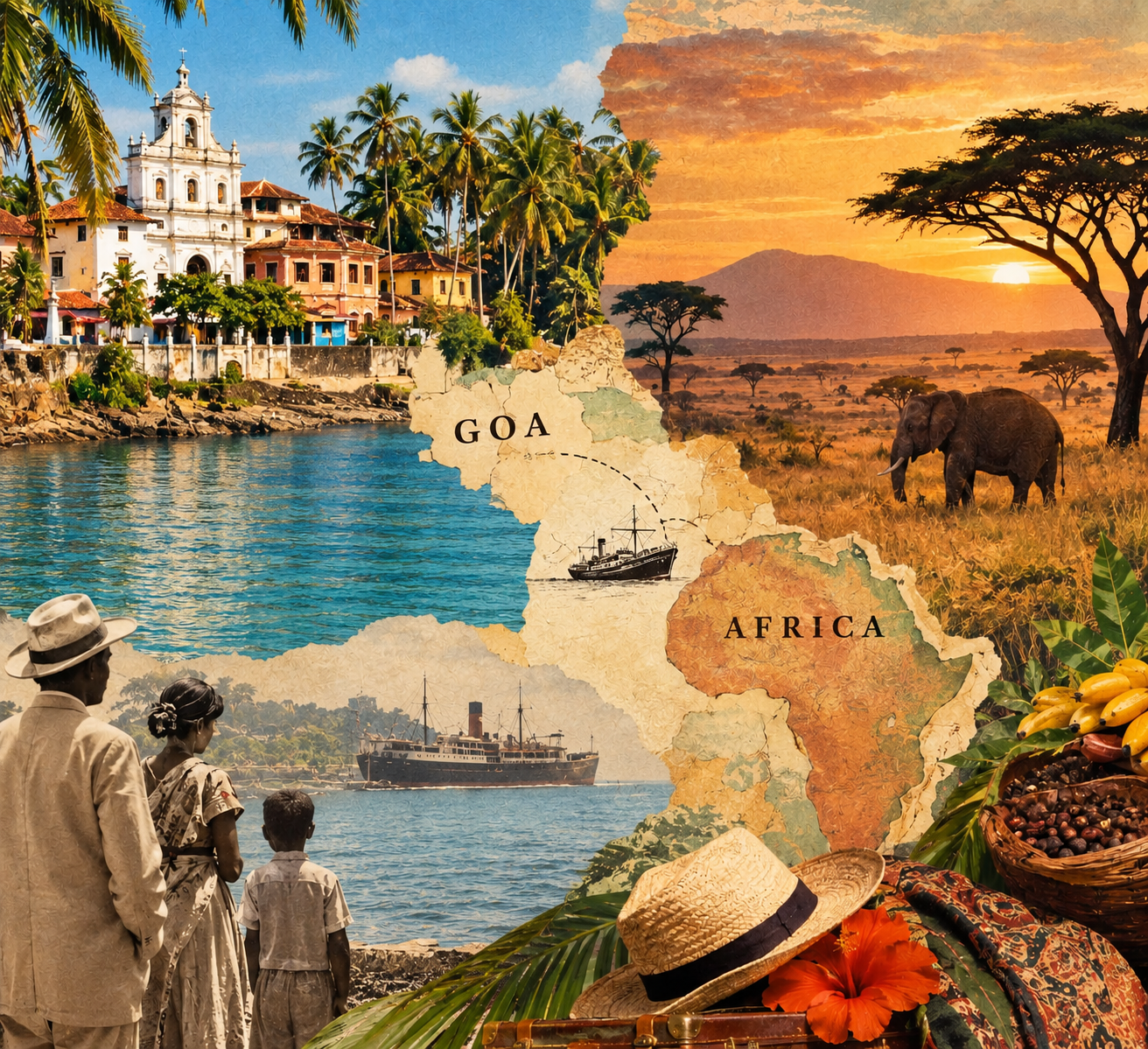
“For generations, on both sides, my family have been crossers of continents. It is these stories my parents gave me”
by Selma Carvalho
R. Benedito Ferrão is an Associate Professor of English and Asian and Pacific Islander American Studies at William & Mary, Virginia, US. Additionally, he is the Dr Thomas Tam Visiting Professor of Asian American Studies at the City University of New York’s Asian American/Asian Research Institute. His publications include Goa, Portugal, Mozambique: The Many Lives of Vamona Navelcar, which accompanied an exhibition he curated at Fundação Oriente in Goa, and The Girl Who was the Color of Nothing: A Children’s Story for Adults which he co-published with the artist Maria Vanessa de Sa.
From Ferrão comes a scholarly work of exceptional brilliance, rigour and relevance to the twenty-first century, a century defined by mass migratory movements of peoples across the globe. Across Continents: Writing Goans, Making Worlds (University of Michigan Press, 2026) is an investigation into a sense of self derived from the concept of nationhood. In this exploratory journey, fundamental questions arise: What is a nation, how does one come to belong to a nation and do our definitions of nationhood fall short of articulating the full breadth of the national experience? Ferrão is of the opinion that for Goans identities are nebulous or perhaps put more precisely, fluid. So, where can we search for answers as to what constitutes the Goan experience? Ferrão seeks answers in the literary representations of Goans in well know novels such as M. G. Vassanji’s Book of Secrets, Roger King’s A Girl from Zanzibar, Salman Rushdie’s Midnight’s Children and Margaret Mascarenhas’ Skin. Here in conversation with Ferrão, we find out more about his thought-process and scholarship.
SC: You begin the book with the controversial premise that Goan “identities are irreconcilable with the idea of nation—they are always at odds with such constructs.” Hence a more accessible route to examining Goan identity is literature that brings “to the surface the kinds of stories that [fall] between continental division.” You also begin the book by letting your readership know that this is not just an academic investigation for you. It is the lived experience of trans-nationalism which has prompted you to arrive at your conclusions. Can you tell us a little about your own trajectory of encountering foreign lands as home and how that has shaped you?
RBF: As a Goan born outside Goa to a parent who herself was not born in Goa, “home” was at once the location of our existence and multiple elsewheres over several generations. Thus, foreignness was an intimate part of our identity rather than an aberration. In the living memory and experience of my family in the homeland and the diaspora, Goa has only ever been a land that has situated, imbibed, and negotiated with foreignness as a Portuguese colony and then a region annexed by post-British India.
As I note of my parents in the acknowledgements in Across Continents, which is dedicated to them: “For generations, on both sides, my family have been crossers of continents. It is these stories my parents gave me ... I saw [them] … face discrimination as migrants, I saw them fight back … [This] taught me the importance of social justice, something that permeates what I do as an academic.” It is in orality that Goans and other migrants have chronicled their heritage and travails.
In my monograph, I contend that Goans have navigated continental displacement and political regime change across empires, dealing with the fickleness of nation and state by conceiving subjectivities unbeholden to just one geopolitical location.
“When viewed only through a post-British Indian lens, we lose much of how Goanness should be understood as having been produced through a longer history of Indian Oceanic and lusospheric influences. ”
SC: In both your work and mine, we keep coming back to Africa as having played a role in forming the Goan consciousness. Personally, I am of the opinion that the role Africa has played has not been adequately acknowledged. Of course that change in self-perception started in Bombay. You quote Metcalf as stating British India gave its residents a chance to “imagine their own identities in new ways.” We know this happened to Goans who moved to British India, and then to outposts of British East Africa. You dwell quite extensively on Roger King’s A Girl from Zanzibar. You write of the Goan character in his book:
Marcella, although Goan, was not born in Goa. Her dislocation from Goa, the demise of her Goan father while she was a child, and her knowledge of her Arab mother late in life and only after the woman’s death, indicate the character’s already existent distance from her geographic and ethno-biological origins...Raised as a Goan by a family of that background in Zanzibar, Marcella’s mixed-race ancestry bears little consequence to her sense of self…
Can you expound on your conceptual framing that one’s sense of self has little to do with genealogy or geography.
RBF: Well, as we discover later on in King’s novel and in my analysis of it, Marcella’s identity does in fact come to be of significant consequence! Despite her ambivalence about, and sometimes disavowal of, her heritage, how the state racializes her comes to matter in spite of what she may think of herself. At other times, Marcella is absolutely aware that her background, which manifests in how she looks, can be of expedience and she is happy to lean into this.
Nonetheless, the distinction to be made is between a character’s self-conception and how political and social machinations play out precisely because of their Goanness. In my investigation of novels where Goans are displaced between or connect multicontinental settings, it is these characters’ Goan subjectivities, peculiarly, through which such works of literature parse ideas of belonging, the lack thereof, or relationship to the nation. I note that this is because the Goan is always in excess of the nation as a subject often in possession of multiple citizenships and histories of movement.
I agree with you that the African heritage of Goans is understudied. In Across Continents, I offer that this is because Goan identity has been contemporaneously pinned to the modern Indian nation-state. When viewed only through a post-British Indian lens, we lose much of how Goanness should be understood as having been produced through a longer history of Indian Oceanic and lusospheric influences. It is heartening to see new writing – in different genres – by Goan writers, including your latest work on Zanzibar, which challenges such narrow conceptions of Goan subjectivity and history. Now, if we can only get people to read, teach, and engage more publicly with such material!
“I conjecture that the souring of relations between the two writers may have influenced Vassanji’s disparaging depiction of Goans. ”
SC: Keeping with Africa, we move on to Vassanji’s characterisation of Goans in his writings. You put forward interesting points regarding Vassanji’s The Book of Secrets. In it, two entities emerge. There is Pius Fernandes, a Goan in East Africa unmoored from other diasporic Goans. Juxtaposed against Fernandes is the conjured up community of the Shamsis, who rely on their exclusion as a form of self-identification. On the face of it, it would seem Vassanji might treat two simultaneous and similar alienations sympathetically. But Vassanji in fiction as in lived experience, elevates the Shamsis/Khojas as being more authentically Indian, drawing the core of their identity from Hindu beliefs. Throughout the colonial East Africa interlude, Goans were othered and more importantly perhaps, they othered themselves. What are your thoughts on Vassanji’s characterisation of Goans?
RBF: Yes, it is rather odd that Vassanji sidelines Goans as consistently as he does in his fiction when, as you rightly say, both Goans and the made-up Shamsis (who stand in for Ismailis/Khojas – Vassanji’s own community), are of minority origins. Even as Vassanji wants his readers to believe that the Shamsis have a claim to Indianness because their nascence is allegedly upper-caste Hindu, the Ismailis have a Muslim heritage which is also true of Goans.
Clifford Pereira comments on the author’s occlusion of Goans in his JRLJ essay, making comparisons to the historical presence of Goan communities in some of the locations Vassanji writes about. Pereira points out, as I do, that Vassanji’s representations of Goans can be demeaning, as if the author is loath to seek out their complexity, choosing instead to portray them as one-dimensional, snivelling, colonial lackeys. Through his research, Pereira counters the suggestion that Goans were lapdogs of the colonizing English by providing several examples of figures like Eddie Sadashiva Pereira and Pio Gama Pinto who were involved in the East African anticolonial struggle.
So, why is Vassanji as belittling of Goans? My book indicates that this may have to do with a split between the novelist and the late Peter Nazareth. The two were once friends, having shared a similar trajectory as East African-born South Asians who came to live in the American continent and became writers. Vassanji was even instrumental in having one of Nazareth’s novels published; in turn, Nazareth had been supportive of Vassanji’s career. In a 2021 interview I conducted with Nazareth for Scroll, he recalls this past friendship and the subsequent rift; he was also critical of Vassanji’s writing in our exchange. I conjecture that the souring of relations between the two writers may have influenced Vassanji’s disparaging depiction of Goans. In one instance, there is a character who is not Goan but is definitely meant to be seen as odd. An Elvis afficionado, the fictitious person has shades of Nazareth in that he was a scholar of the King of Rock and Roll.
“To this day, embedded in our language, are derogatory ways of referencing Blackness. These Konkani/Marathi/Portuguese terms equate darkness of skin with low intelligence, lasciviousness, and unattractiveness; they are also casteist. Blackness is how we index difference.”
SC: Still further investigations into the Africa/India connection leads us to Margaret Mascarenhas’ Skin. Here we encounter the uncomfortable and rarely spoken about South-Asian, and in this case Goan, complicity in the East African slave trade. You write, “Mascarenhas’s novel functions as an archive, recounting a history of violence, but also survival.” Inevitably there is a layering of human hierarchies based on skin colour— “Skin suggests the coexistence of multiple racialized consciousnesses.” Can you elaborate on this concept of racialised consciousnesses in the context of movement of peoples from Africa to Asia, and also how Goans perceived this African-ness.
RBF: A big political debate in the last few years in the United States, one that has centred on education, has been about Critical Race Theory (CRT). Ironically, those who consider CRT to be responsible for “wokeness” fall into the very trap that this theory warns about and that is the belief that vigilance around race and racism is exclusively tied to skin colour. Rather, what CRT demonstrates is that race is constructed and institutionalized by sociopolitical systems, including legal and educational ones.
Following this, to be racially conscious means that one is aware of a history of the construction of difference. Multiple differences can exist simultaneously, in intersection, relation to, and also in contestation of one another: Indigeneity, Blackness, immigrant identities, white supremacy, and so on. This is not something that applies to America alone, especially when we consider that colonialism, slavery, and contemporary immigration and globalization are all about the transfer of peoples across continents.
After so many centuries of Portuguese colonialism, the Indian Ocean slave trade, and within the present milieu of the rise of fascism in Goa and India, how we regard difference has as much to do with knowing the past as with understanding that its impact continues. To this day, embedded in our language, are derogatory ways of referencing Blackness. These Konkani/Marathi/Portuguese terms equate darkness of skin with low intelligence, lasciviousness, and unattractiveness; they are also casteist. Blackness is how we index difference. Why do such notions persist? Surely we cannot just blame colonial European attitudes for the persistence of such ideas if they continue to be operational now! Simultaneously, the Black presence in Goa has not vanished. It is as much a part of our history as it is of our present day. To say this differently, Blackness in Goa is not just an archive; it cannot be separated from how we take cognizance of our current moment.
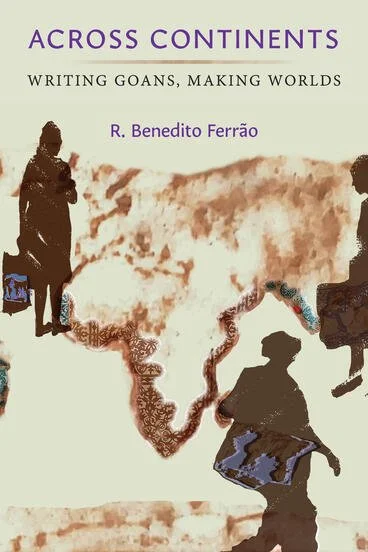
Across Continents: Writing Goans, Making Worlds is available for purchase from the University of Michigan Press or on Amazon.
Selma Carvalho is the author of Guts, Glory & Empire: The Epic Story of Goans in Zanzibar, 1865-1910.
The banner image is AI generated.