By Heta Pandit
The book Objects and Memories from Goa (The Heritage Network, 2026) is written by Pournima Kerkar and translated by Heta Pandit. Here, reproduced by permission is Heta Pandit’s dedication.
The book is dedicated to all the men and women in my family who hung on to objects, houses, and memories.
Memory is History
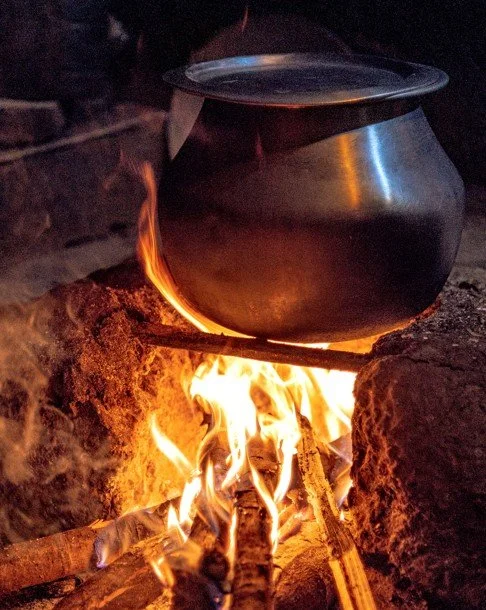
Nothing in our home ever got thrown away. My mother Manijeh, her mother Tehmina and her dad Rustomjee, grandmother Goolbai and grandfather Pallonjee were born to hoard things. We grew up surrounded by pots and pans (dated 1924 in which Goolbai had made her first biryani as a bride); a single emerald earring that Tehmina had fashioned out of a broken necklace (because it was quite de rigueur to wear one earring, considering the fact that the other ear was always covered with the end of her sari); wood-fired boilers used to heat up bathwater when it got cold and misty in the monsoons in Panchgani.
When Tehmina passed on, opening the copious wooden chest (petaro) by her bedside was like entering a magic cave. It was a horde of Pears soap, sandpaper gloves used to shave off unwanted hair from legs and hands, silk stockings, buttons and clips, cards embossed with Christmas greetings. Everything in her days came from England. Copper pots, brass pots, jugs in pink (for pink lemonade) struggled for space in our crockery cupboards along with lace doilies and embroidered cloths meant for lining serving trays.
My mother’s first rattle was of bakelite, perhaps a wonder material back then. The little spotted ceramic cow that had kept her company right through an illness was her most prized possession. As children, we did not have to look too far for inspiration. We had only to look at Goolbai’s black and white picture on the wall and sit like she did, perfectly poised in her Parsi gara sari, a teapoy by her side perhaps waiting for the proverbial afternoon glass of sherry. The chair was right there, under the photograph. It still is.
What was it that made them hang on to these objects? Was it a sense of thrift, a throwback from times that were difficult? Perhaps, yes. Was it a sign of wanting to leave a legacy, a memory by association? Yes, perhaps. We still refer to the armchair in the photo as “great grandma’s chair”. We give the photo a look, a glance filled with love that says, “I wish I had known you. Now I only know your chair”. That chair must have been like a throne for some. Goolbai commanded respect in a household where all the men of the house were at work in Aden and it was Goolbai who ran a tight ship back home in Siganpore village.
The family owned mango orchards and wheat fields back then. They say that she would dress up in her formal saris (a new one every day) and head out to the fire temple in the village in an ekka (a one-horse cart) driven by her trusted Magilal. The fire temple ride was just a ruse. She was actually on an inspection of the farms and orchards, the vegetable patches and the level of water in the wells. When the baskets laden with farm-fresh vegetables were brought in, Goolbai would instruct the farmhands to leave them on the floor of the back porch. The front porch with the gardens and ornamental fountains were for visitors. She would then sprinkle the fresh produce and the baskets with sacred water “to purify” the vegetables and mitigate any profane effects that the family might suffer from the “touch of the non-Parsis”. Every staff member of her household belonged to the faith.
The painters who came to refresh the walls, the carpenters who were called in to make new pieces of furniture or restore damaged pieces, the stable boys and the gardeners were all second or third generation “known to the family”. Long before the days of emojis and emoticons, there was very little verbal communication between my great grandmother and the people who served her household. They simply knew what was expected of them. One will never know if they went back home at the end of a long day and shared their stories.
Now before anyone should think that we were brought up in an atmosphere of such bigotry, let me tell you that this story (instead of being swept under the Persian carpet, like most families might have done) was repeated to us as children. It was made clear that this was an abomination and that caste-based prejuidices were unethical practices, to be recognised as such and to be spoken out against. We were perhaps the only household in Officers Colony where we grew up that thanked the sweeper who came to clean our bathrooms at the end of the day. We were perhaps the only family that handed her salary in the hand and addressed her as “Ba” or, Mother.
The stories, however, are embedded in the objects, photographs, drawings and sketches that we have inherited today. If they had not kept (in folds of saris, old muslin and tablecloths) picture postcards sent by my grandfather Rustomjee to his only daughter from far away Aden, would we have even felt the anguish and pain of a father who lived an expatriate’s life away from his family? If well-thumbed copies of the Zend Avesta had not been wrapped in velvet and stored with sheaves of tobacco leaves, would we have known what staunch believers they had been?
Goolbai had five sons and two daughters, a small family for the times she lived in. In a bid to be fair to each one of her children, save one, she had set aside Rs 40,000 for every one of them. Seventy five years ago, this was a tidy sum of money. She had, in her wisdom, also mentioned (in a letter addressed to them) that the one child who did not want the money could take the Siganpore house instead. Rustomjee went to his 11 year-old daughter for a consultation and asked her what she would like. The money or the house? Manijeh may have given it a minute and then replied. “Money gets spent but houses remain forever.”
In every object that we use and inherit, there is a story. It is the story of our family, our community, the land we live in and a lifestyle that our ancestors once lived. Collectively and individually, these objects make up our histories. Objects are memories.
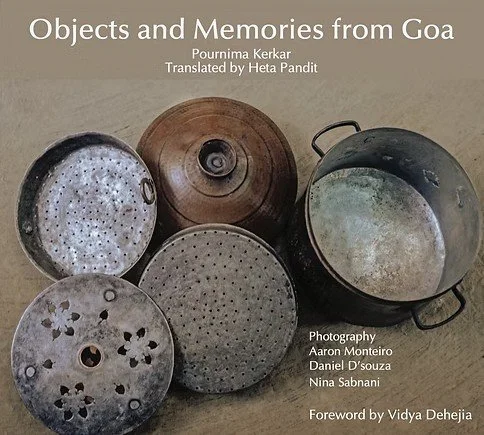
Pournima Rajendra Kerkar is an Indian author, folklorist, researcher and teacher who writes about the eco-cultural heritage of Goa and neighbouring regions. She is a member of the State Level Steering Committee for implementation of National Education Policy 2020.
Heta Pandit has written eight books on Goan heritage, Houses of Goa, Hidden Hands—Master builders of Goa, Dust & Other Short Stories from Goa, Walking in Goa, Grinding Stories Songs from Goa, Grinding Stories Retold, Stories from Goan houses, Walking in Old Goa and Walking with Angels. Her autobiography There’s More to Life Than a House in Goa was released at the Goa Art & Literature Festival. Heta is a Homi Bhabha Fellow and a founder member of the Goa Heritage Action Group.
All featured photographs from the book have been reproduced with permission. They are copyrighted and cannot be reproduced elsewhere. Objects and Memories from Goa can be purchased from here.