By Selma Carvalho
Although the book grew from the paper I delivered at the State University of Zanzibar in 2022, titled Shorelines: The role of Goans in developing the port of Zanzibar, it is also a culmination of fifteen years of research into East African Goans which began with my first book Into the Diaspora Wilderness published by Goa, 1556 in 2010, and then as head of the Oral Histories of British-Goans Project (2011-21014), funded by the HLF UK and archived at the British Library St. Pancras. Once I had decided to write the book, immediately arose the conundrum of sources and their objectivity. To echo Thomas R. Metcalf in Imperial Connections the historiographies of the colonised have been no less Eurocentric than that of western civilisation.
While the role of the Indian peninsular in transoceanic trade and political engagement has been robustly interrogated foremost by Metcalf and J. S. Mangat, and to varying degrees by other writers, the documentation of Goans is sparse. Paucity of Asian sources for this history meant largely and inevitably I had to rely on Eurocentric sources. There was a marked absence of Goans in both British and South Asian political discourse, despite Goans engaging extensively with the sultanate and empire during this period.
I did find relevant information amongst the Foreign Office papers at the National Archives, Kew, namely the British consular dispatches and correspondence from Zanzibar during the period 1865-1910, under investigation. Nothing here could be accessed through a catalogue or a search engine typing in the words Goan or Goanese. The algorithm was not configured to detect these words. This meant trawling through the entire Foreign Office series starting with FO84, and working my way through FO107, FO2, and FO881, in the hope of getting lucky. And I did get lucky often.
One of the most influential sources to bear on this work was the Zanzibar Gazette, on whose pages were accounts of weddings, funerals, farewells, births, deaths, sketch biographies in obituaries, and ship passenger arrivals and departures. In some instances, I lifted chunks off its pages to preserve as much authenticity as possible. Particularly descriptions of Goan weddings and funerals were so richly detailed, with a deep sense of ceremony bordering on pageantry, that they must surely have been a spectacle in Zanzibar. It was the first glimpse into lives rich and varied, nuanced and complex, and at least nominally, racially integrated and yet segregated. Although the editors of the Zanzibar Gazette had been British, and yet again, it was a European lens through which we were viewing Goans, here at last was a historiography capable of articulating emotion, the sort often denied to non-European actors. Since my research work began a decade ago, at the time, I was able to access physical holdings of the Zanzibar Gazette (1892-1915) at the British Library, St Pancras This facility is no longer available, the paper is now digitized and paywalled. In the process of digitization, the advertisements have not survived, and an important documentation of Goan history is lost. Other relevant documents pertaining to Zanzibar previously held by the India Office at the British Library are now digitized by the Qatar Digital Library and available for viewing online.
The forty interviews which comprised the Oral Histories of British-Goan project (2011-2014) and now archived at the British Library, became a Goan source which gave voice to Goans who had lived in East Africa and after decolonisation emigrated to Britain. Subsequent to the project, interviews with family members and access to their personal photographs intensified, and so the most pertinent field research I did took place post-project. I have interviewed the descendants of almost all major families featured here with a few notable exceptions like Luis Antonio Andrade and João Pedro Souza. Family histories provided a backdrop but were susceptible to misremembering. Despite its many failings it is an important aspect of Goan historiography, for misremembered histories with all their apocryphal stories provide an understanding of Goan diasporic mythologies.
I have included family history with great caution. If it was a general impression of the person or an event that had survived through the generations, I have included it, qualifying it as family lore. I have included anecdotal stories, only to interrogate them against contradictory or substantiating evidence. But I have not included stories which were improbable, irreconcilable with contemporaneous events, and at times discounted by evidence to the contrary. These stories float in the ether of Goan folklore and in some measure this book attempts to set the record straight. Data was collected from gravestones, family photographs and visits to the villages the main personalities hailed from, which then made it possible to establish firmer timelines and topographies. Many family trees have been reconstructed from scratch by me by accessing baptismal records from Goa Archives, visiting cemeteries, the obituaries registered at the Consulate of Portugal in Zanzibar (1885-1900) and with the invaluable input provided by genealogist Richard D’Souza whose own work is of tremendous importance.
I have not dwelled extensively on the political manoeuvring in the region, much of which involved Portugal, Germany and Britain who dominated the East African coast with their imperial ambitions. This telling centres Goans, and I limited myself only to those aspects of world history which invariably intersected with that of the Goan colony.
Finally, it was at the Biblioteca e Arquivo Histórico Diplomático Ministério dos Negócios Estrangeiros in Lisbon, that I would find the only surviving nineteenth century voices of Goans in Zanzibar. Here amidst the well-preserved wooden boxes and files was almost a Pompeiian preservation of how Goans lived in Zanzibar, the quarrels they had, the estates they left behind, their obituaries, registration of contracts, and most significantly their quasi-political role within the Portuguese consulate of Zanzibar. Here they existed not as someone else’s perception of them but as blood and bone, kith and kin. If at times, the level of detail feels overwhelming it is only because so rarely do Goan historical figures of the past come to life as vividly as they did by chance of the MNE Lisbon archive. I felt the need to be a generous disseminator of this wealth of information. It was important to me to preserve as much of their own thoughts, aspirations, moralities and motivations, as I possibly could.
The period between 1865-1885, before the Portuguese consulate in Zanzibar was established is still largely unexplored. During this time, the affairs of the Goan community were overseen by the British consul John Kirk. Undoubtedly, Kirk would have dispatched reports either to the governor-general of Mozambique or the ministry of foreign affairs in Lisbon. Kirk would have handed over his files to the first interim Portuguese consul Joaquim Almeida. These files have yet to be located if they have survived at all, and when they are, they will add greater depth and dimension to this time period. In a last bid attempt, I travelled to the National Library of Scotland to research Kirk’s private diaries and letters. Surely, Kirk would have written something about Goans during this period, but alas I found barely three minor mentions pertaining to Goans. I set about reading the letters, diaries or publications of early European inhabitants of Zanzibar such as Bishop Tozer, Steere, Elisabeth Jacob and captain Fraser. Digitised versions of the original documents are housed with the British Library, which can be accessed through an institution or if you ask nicely. Sadly, nothing of particular interest materialised. Europeans had led lives segregated from Asians.
Other documents which will flesh out this story include dispatches, diaries or letters kept by the French Catholic Mission and the German consulate in Zanzibar. Also, the tiny American merchant community in Zanzibar which dominated mid-century might have in their despatches or letters left some impression of Goans. Subsequent investigations will confirm my recounting of events, while also challenging them, but that is how documentation advances, it needs a base on which one can build. Failure to achieve 100 percent accuracy should not stop us from putting to paper that which we know already.
Unfortunately, I could not use much secondary source material to validate my own research because it did not exist, the history of Goans in Zanzibar has not been written about. I have used liberally descriptions of Zanzibar town left to us by European travellers and administrators. Although these are scoped through a Eurocentric lens, in the main I did not feel the need to discredit them. As far as actual descriptions of Zanzibar go, they are no different than a modern-day travelogue or documentary, where an objectivity is possible when people report what they see. I have spent a major part of my life in the Arab world and the descriptions did not feel unfair. I am grateful for the academic works of Norman Bennett, M. Reda Bhacker and particularly William C. Bissell’s Urban Design, Chaos, and Colonial Power in Zanzibar (Indiana University Press, 2010), whose research on Britain’s engagement in Zanzibar acted as a check on my own.
When thinking of how to lay out the book, I thought it best to follow the lives of a few individuals as they unfolded, their rise and decline as it were, and chronicling these lives in a fashion that was almost novelistic, the history of Goans in Zanzibar and that of the South Asian-Africa interlude itself would unfold. I did not want to entomb an academic dissertation in a book, although much more is needed of that too, but rather write about the full breadth of human emotion: marriage, births, death, loss and success, stories of men and women who mourned for their infants, were decorated for their valour, who had sung in church choirs, planned weddings, and built cultural institutes where they danced the old Goan country dances. It was as much an attempt at cultural conservation as it was at documentation and interrogation.
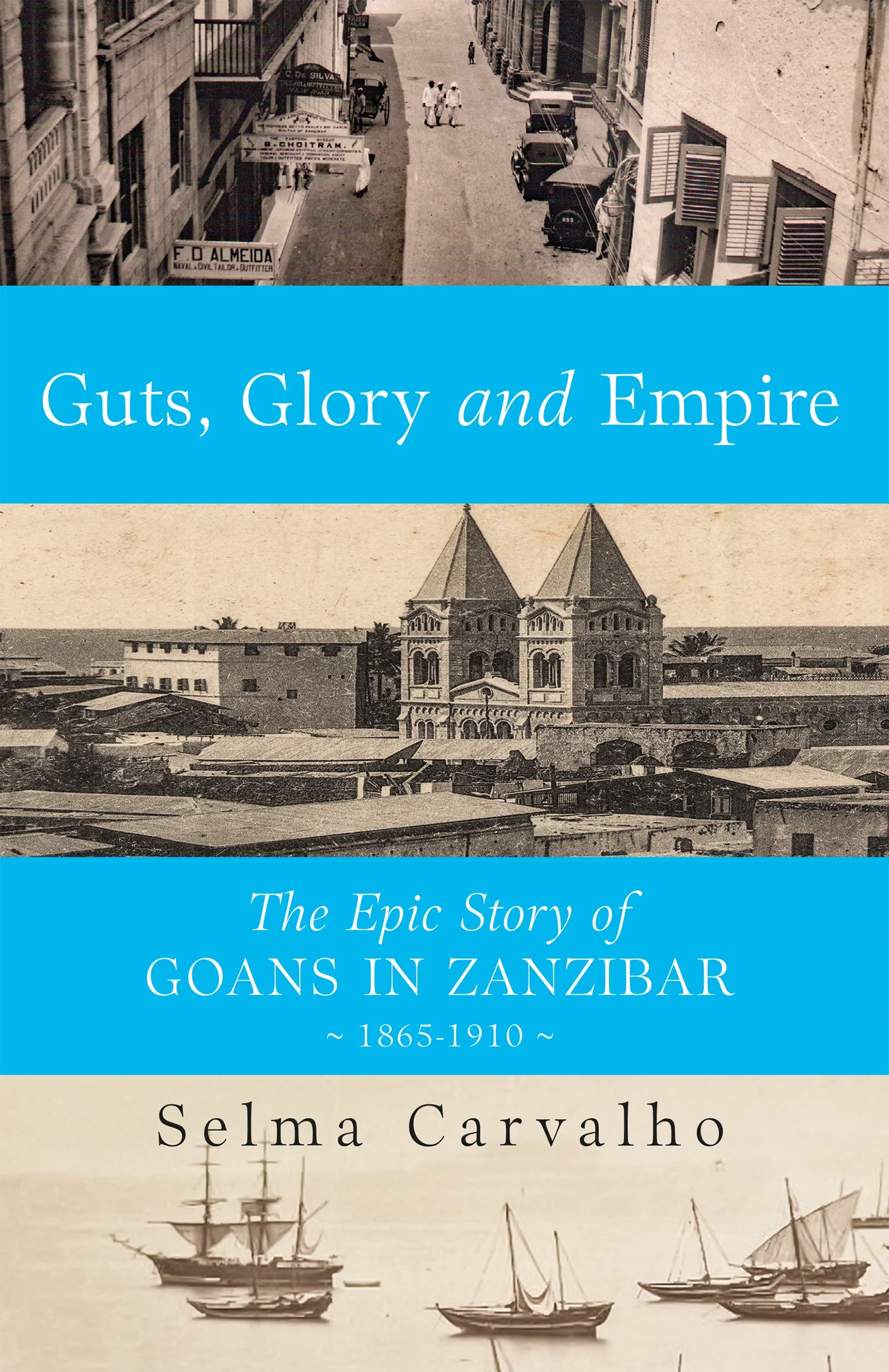
Guts, Glory and Empire: The Epic Story of Goans in Zanzibar, 1865-1910 is available for purchase in all leading Indian bookstores across India, and on Amazon India. For international sales please contact Dogears Bookshops Margao at emailus@thedogearsbookshop.com
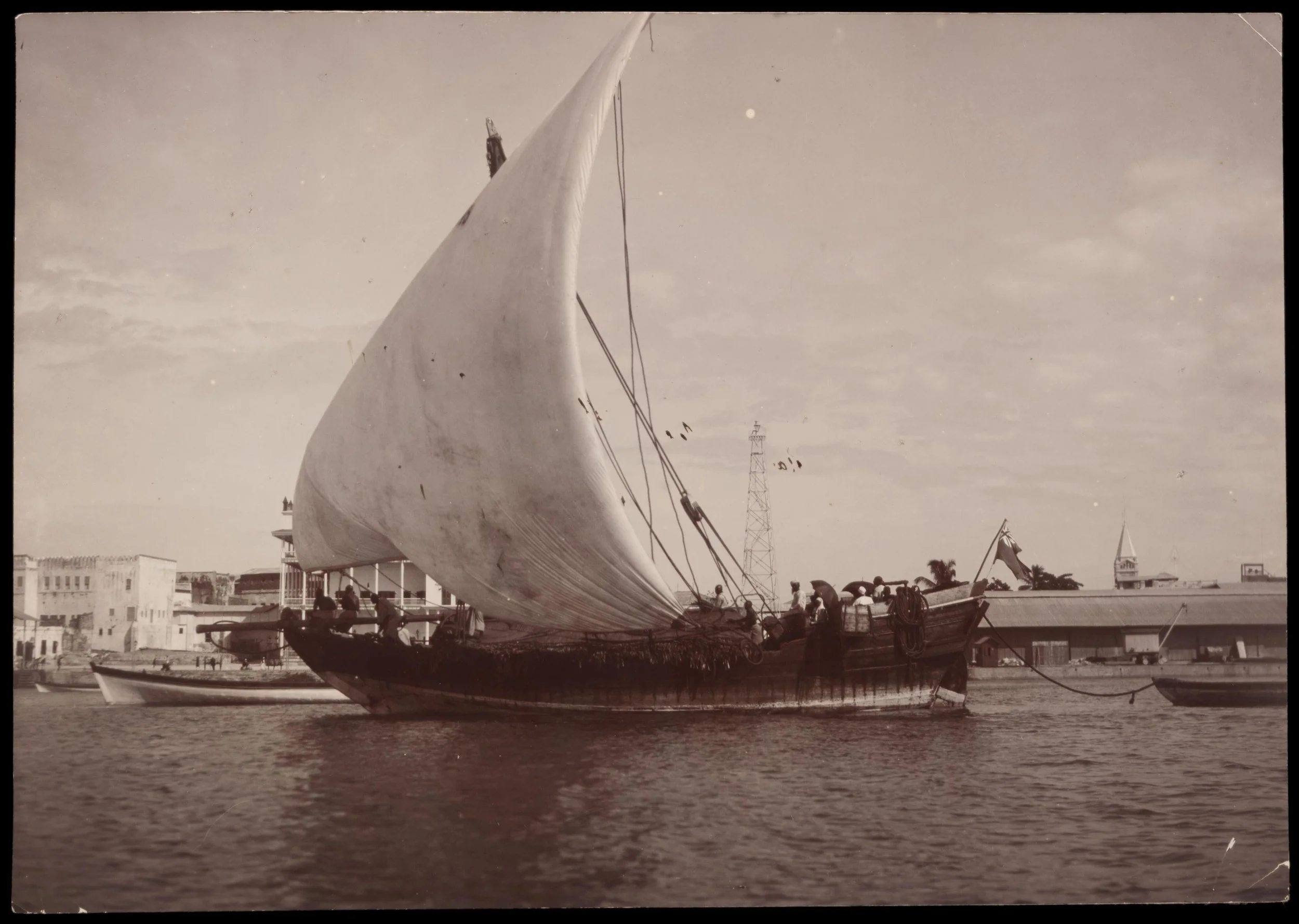
Banner image of Indian dhow to Zanzibar, Winterton Collection, Northwestern University.