By Selma Carvalho
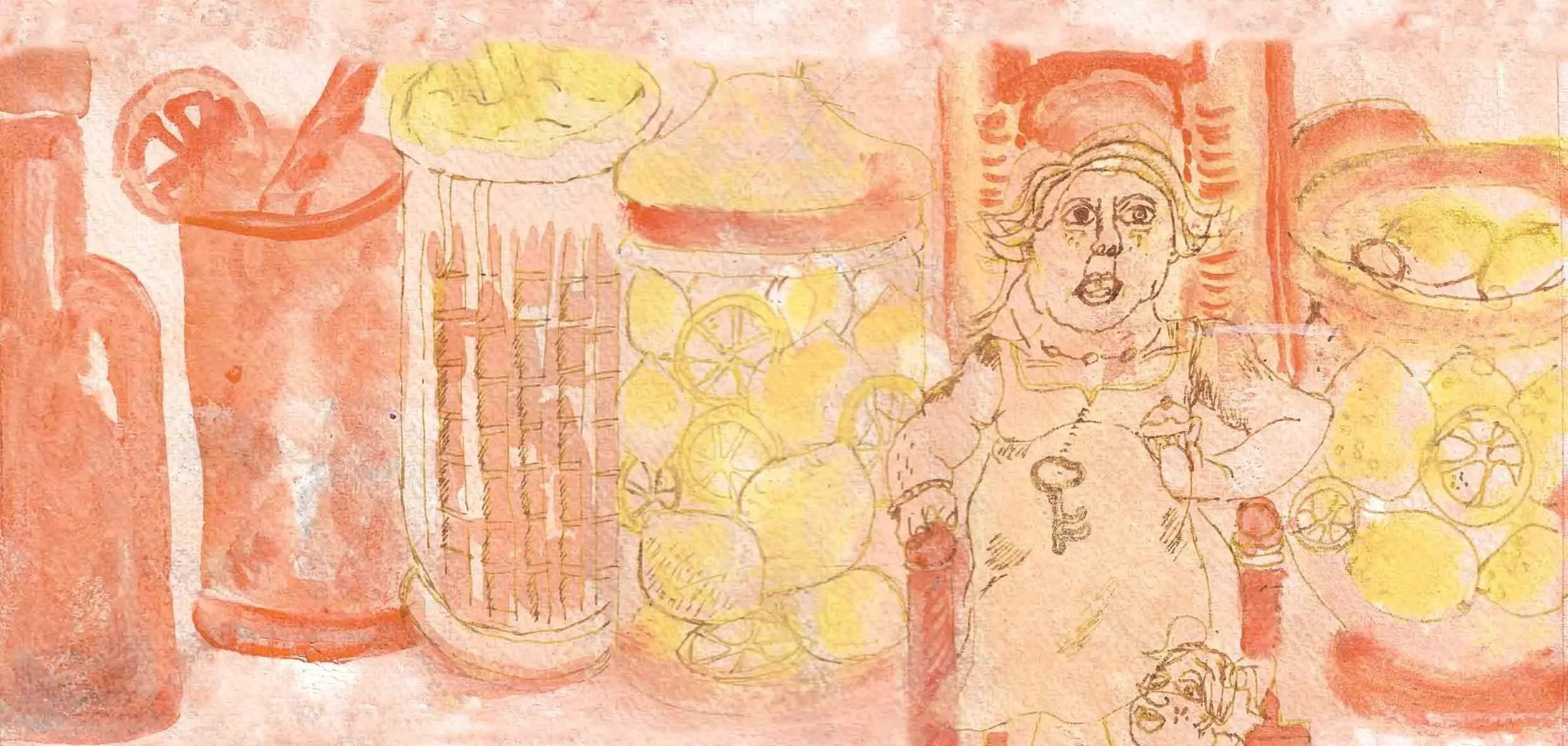
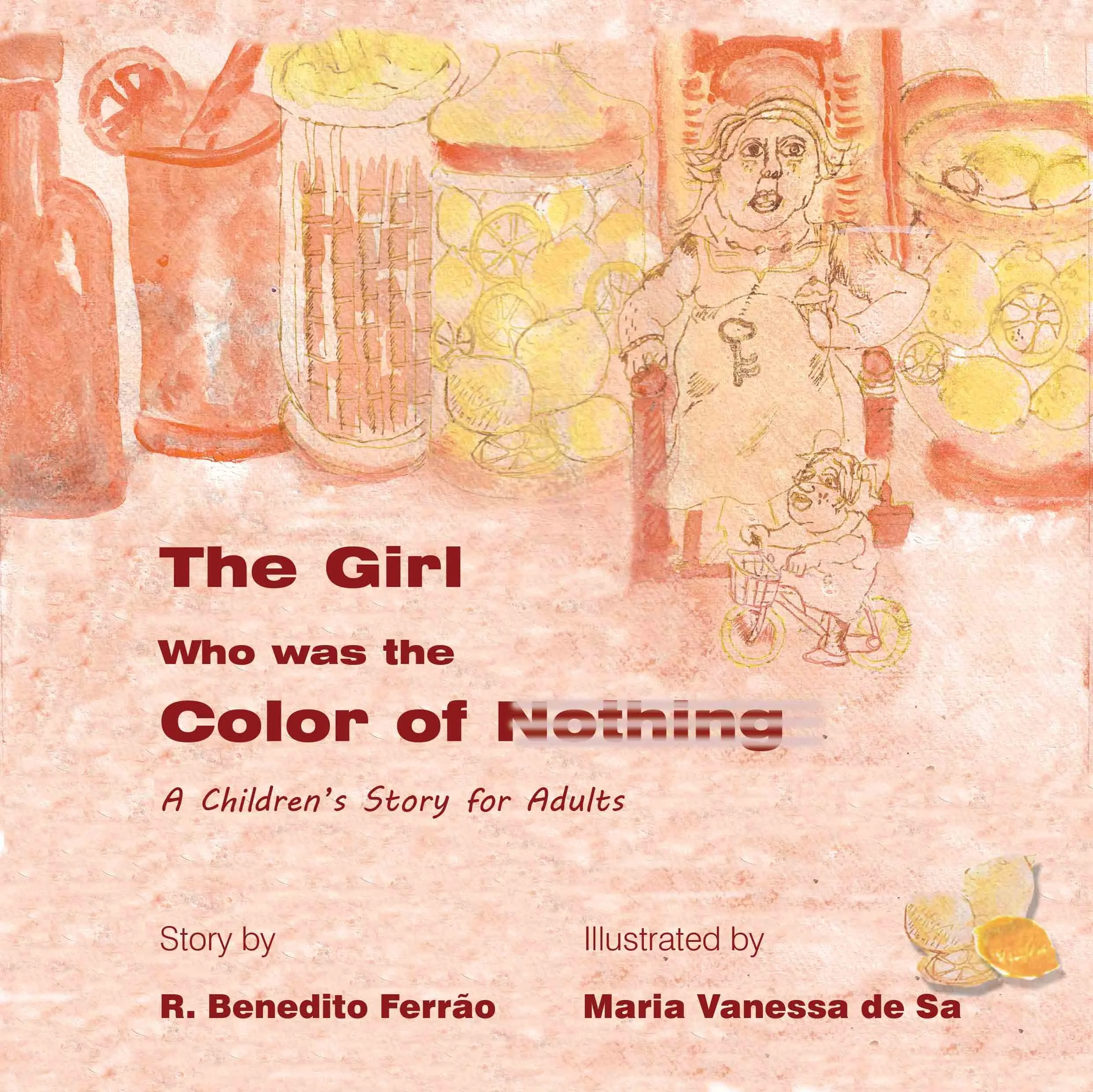
The Girl Who was the Color of Nothing is a marvelous, newly released book written by R. Benedito Ferrão and illustrated by Maria Vanessa de Sa. This morality tale is as instructive for adults as it is for children, addressing our deepest fears and prejudices surrounding skin colour. Here, in conversation with Ferrão, we delve into some of the thought processes that went into the telling of this tale and what the story hopes to achieve.
Selma Carvalho: This is a remarkable book and a seminal offering in the Goan book market. It’s a morality tale for both children and adults, described as “a children’s story for adults.” How did the concept emerge and the subsequent collaboration between Maria Vanessa de Sa and you.
R. Benedito Ferrão: Vanessa and I have worked on a couple of different graphic narrative projects with other artists (Vamona Navelcar and Angela Ferrão) and, at a juncture, thought about doing something that would bring together our own storytelling and visual art ideas. I wrote The Girl Who was the Color of Nothing with this potential collaboration in mind. This was integral to my thought process as I developed the story, being familiar with Vanessa’s stylistic oeuvre; in a way, it was a reverse ekphrastic process.
Having the benefit of knowing an artist would bring colour to my words got me thinking about pushing the notion of colourism to its ironic extreme – the colour of nothing. What colour is nothing? And, moreover, what does it mean to be this colour? These questions are central to this story as readers discover.
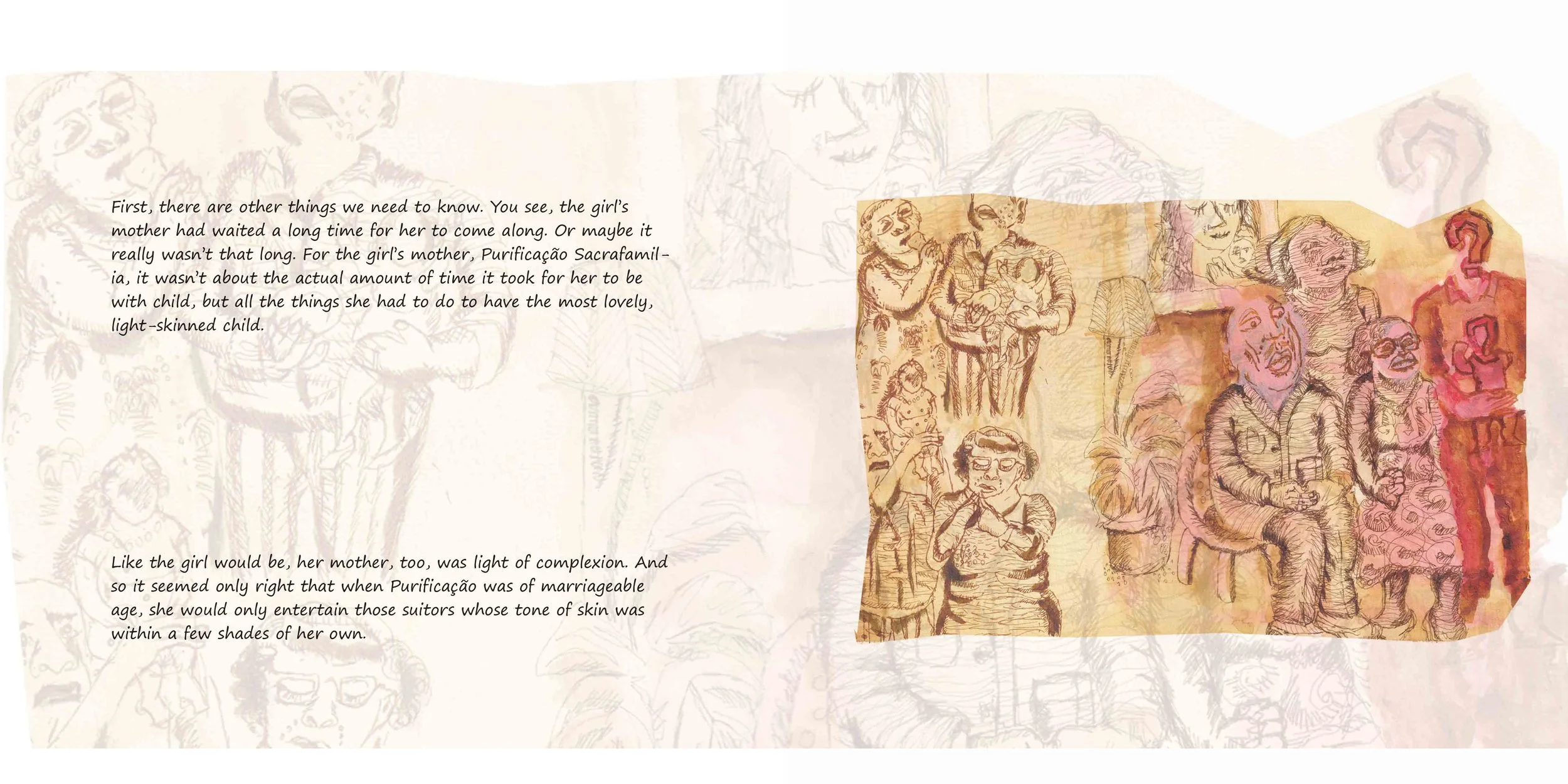
SC: Right off the bat, I want to say how much I enjoyed the humour in the book, which really elevates it to the next level, while shining a spotlight on our worst prejudices. Did you set out to create these hilarious characters, particularly the suitors that appear for the hand of the fair Purificação? (I kept wishing there were more suitors.)
RBF: Thank you so much! Humour is notoriously difficult to render, isn’t it? So, it really is nice to hear that it works in the book. Indeed, I wanted there to be an obvious satirical element in the story and the suitors provide the perfect opportunity to demonstrate some real and very wild things one has heard of, or seen, in society. While I wanted readers to have a laugh at these figures (and maybe at themselves), I also hoped to point out the ludicrousness of what the characters subject themselves and others to. This is why the second half of the book brings back some of the occurrences from the first half, but in less funny ways.
I did think of adding maybe one more suitor, a chap who uses reflective devices to render the illusion of light skin, only to have his hide fried. Maybe he will show up in something else I write.
SC: You weave in the story of “Our Lady of the Snows,” into the narrative which lends that exquisite, magical, surreal quality to the story. Can you briefly tell readers the significance of this story?
RBF: It is one of my favourite parts of the book. In the fourth century legend, a childless couple in Rome pray to be blessed with offspring. The Virgin Mary comes to them in a dream and intimates that she will answer the spouses’ prayers if they build a church in her honour. They are to await a sign that will indicate to them where the edifice should be constructed. Rome famously has seven hills and on one of these, the Esquiline Hill, it snowed on the 5th of August. Surely this was the miraculous sign the couple were meant to witness, for summery August is far from a snowy time in Italy.
Now, history tells us that possibly the first artistic representation of the Virgin to be brought to the subcontinent from Europe was A Nossa Senhora das Neves. That image was delivered to Cochin.
The idea of snow appearing in the summertime is magical enough, but the thought of snow in the tropics (by way of this avatar of the Virgin and missionizing efforts) was even more captivating. In the book, therefore, snow is synonymous with lightness of skin and impossibility.
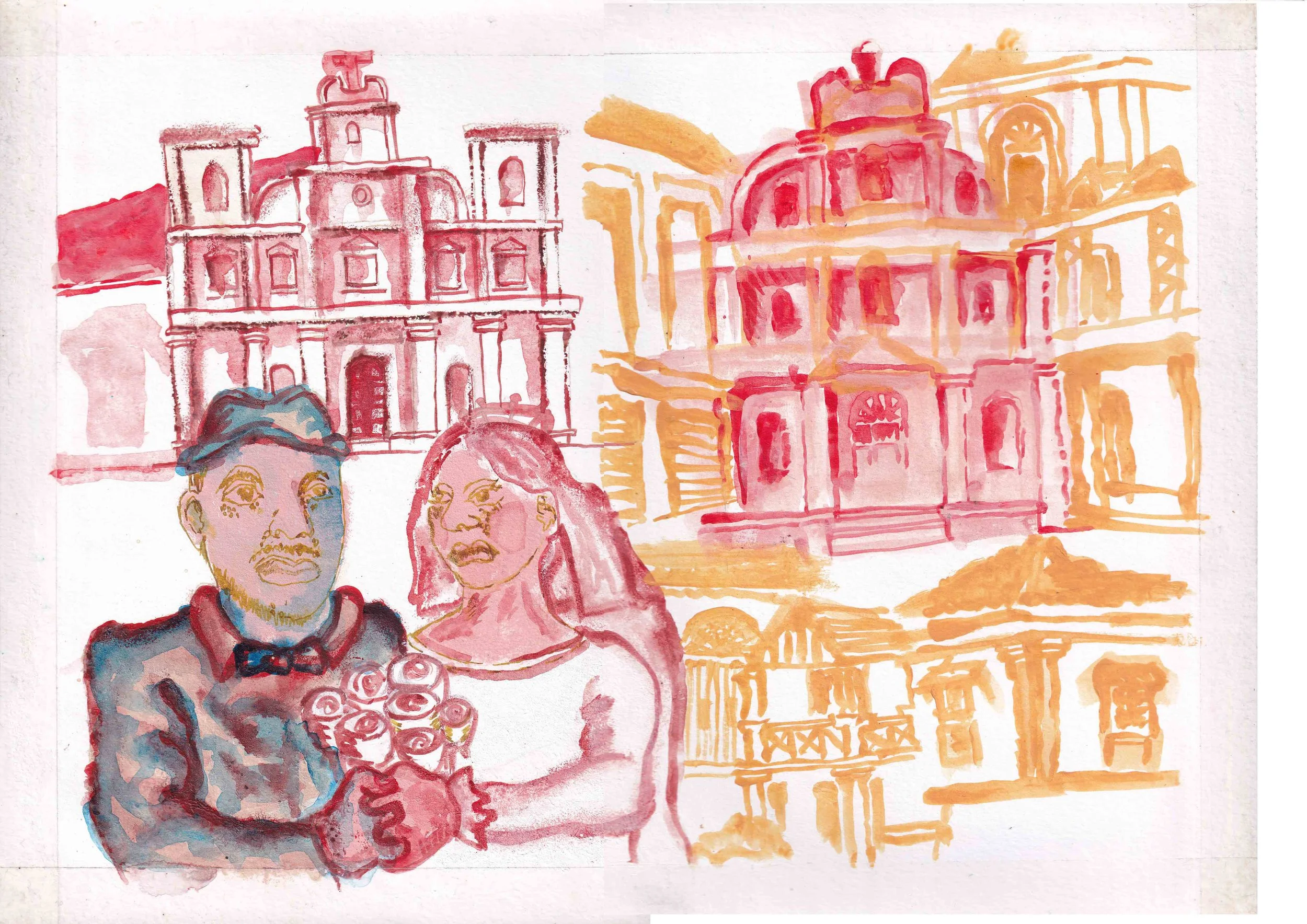
SC: The Church of our Lady of Snows is located in Raia. Was it deliberate or coincidental that the story is set in Raia? South Goa is dominated by Chardos but Raia is home to a pocket of South Goan Brahmins. It is fertile ground for the prejudice of colourism to flourish.
RBF: Great question. The setting is Goa but with no direct revelation of this possibility. Yes, as you rightly remark, Raia is the location of Goa’s own Our Lady of Snows (which, interestingly, is not referred to as The Snows). But there is also another such church in Pallippuram, Kerala, which was once part of Portuguese India and, as I explain above, is quite directly tied to this version of the Madonna. At the same time, there is a mention of seven hills in the book, a symbolic feature that layers Goa with geographic references to Rome and Lisbon. So, with these traces gestured at in the story, I wanted to create a mystical site, a Goa demonstrative of cultural, religious, and historical influences from elsewhere remade locally.
Now, to answer your question more directly, in The Girl, anxieties around colourism also reveal trepidations about caste and its ambiguities. And so, when we see the Sacrafamilias, the clan in the tale, being so beholden to preserving the appearance of one, it discloses to us how far they will go to maintain the fiction of the other. Both caste and colour are precarious in the book. They are always on the verge of being undone on a whim, the knowledge of which forces those who derive power from these fickle formations to act as repressively as they do.
SC: Colourism—the practice of favouring lighter skin within a dark-skinned population—is prevalent not just in India but throughout South Asia and Africa and particularly amongst the African and Asian diasporas of the west. Its evolutionary genesis has not been convincingly explained. You have hinted at it being tied to affluence in Goan society. Would you care to hypothesize as to how it came to be tied to success, affluence and desirability in Goan society in the first place?
RBF: Certainly, colourism is a widespread phenomenon and your question about the connection between it and classism is apt. I would venture that darker skin has been readily tied to manual labour, especially types that occur in the sun-drenched outdoors. In turn, this suggests that dark-skinned people must be genealogically of working-class backgrounds. In the Goan context, this would mean those who work(ed) in the fields and, more historically, colourism may be tied to serfdom – the legacy of mundkar-bhatkar pasts. By contrast, those who are light-skinned are presumably of more elite stock, people unaccustomed to the kind of toil that would expose them to the elements. As a consequence, to be desirous of fairer complexions, either for oneself or in another, is tantamount to a craving for a life of ease and privilege.
SC: The fair Purificação’s husband, Alvo Branco, makes a revelation about his family, but it is ambiguous. Has this been left ambiguous for a particular reason?
RBF: Yes, Alvo Branco makes a claim to a possible Portuguese heritage as an explanation for his light skin, but then later recants saying he is not entirely certain if this is so. There is a deliberate irony here in that we know quite clearly what the backgrounds are of the previous suitors who come a-courting. The same is not true of Alvo who turns out to be the most eligible. In fact, all he has to do to prove himself is to hint at a European lineage. Where the others have demonstrable wealth, all Alvo has is the colour of his skin. He could have been Portuguese, but is unlikely a patrician.
SC: Colour prejudice renders us all invisible, and I loved how you drew the analogy to its full conclusion with the ending. Can you speak briefly to the invisibility one encounters in Goa because of colourism.
RBF: Something that I did not want to do with this book is dwell on beauty. No doubt, skin tones are linked to beauty standards. But they are also tied to class and caste. These matters convey themselves in the text to complicate the usual depictions of colourism as having to do with attractiveness alone.
I like that you characterize such prejudices as invisibility for they render a person unseeable for all of who they are. Over the course of a person’s life, the tone of their skin will change, their appearance will alter, and age will play itself out on the dermis. But these are all markers of a life lived. A person’s complexion is unrevealing of their talents or their promise and, so, to be invested in this alone erases all that is deeper than our ever-inconstant skin.
R. Benedito Ferrão is an Associate Professor of English and Asian & Pacific Islander American Studies at William & Mary (Virginia, USA) and the author of Across Continents: Writing Goans, Making Worlds (University of Michigan, 2026).
Maria Vanessa de Sa is an artist and urban designer currently with Ochre Design Group. Artwork from this book were featured in her first solo exhibition at Gitanjali Gallery, of the same title.
The Girl Who was the Color of Nothing is supported by the Han Zhang and Jinlan Liu Foundation. It is available to buy here.