By Selma Carvalho
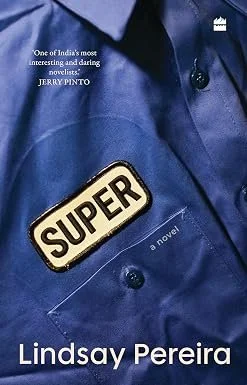
Lindsay Pereira’s fourth book is titled Super (Harper Collins, 2026), a pun on the word which the protagonist Sukhpreet Gill is fond of using to express appreciation but is also a job commonly undertaken by immigrants in North America, that of superintendent or maintenance man of a block of flats, the popular contraction being “super.” In Super, at once, we are plunged into the world of Baudelaire’s flâneur, this time not the flâneur of unknown cities and towns, but the flâneur Sukhpreet, who floats above his own life and examines it both intimately but also from a distance. This detached watchfulness is exquisitely rendered by Pereira—unsettling, thought-provoking and intimate. Here, Pereira and I engage in a nothing-is-off-limits conversation about ethno-religious politics, the middle-class Indian and writing the immigrant.
SC: Sukhpreet Gill and his love interest Harneet Kaur exemplify the great Indian dream of migrating to the west. Sukhpreet inhabits the lower-end of the middle-class spectrum, cash-poor and marginally asset-rich. His family owns a parcel of land which can be mortgaged to make possible immigration. Harneet occupies what Jane Austen would recognise as the edges of genteel respectability. Her father was dismissed from the Indian army on account of ill-health and then forced to become a teller at the Punjab National Bank. Nonetheless, the family have squirreled away a tidy sum of money, enough to get Harneet to a good university, perhaps in Birmingham or Toronto. The university student route is the gateway to the west for Indian parents. Many of these universities are bogus, they depend on the income generated by international students, but their qualifications are worthless.
You present a stark picture of disintegrating familial ties (“Her aunts, uncles and cousins were now scattered across the globe, turning up only at weddings or funerals…), broken dreams (“It was unimaginable, the gap between what he had been shown in Chukhiara and what this had turned out to be.”), alienation (“They had no interest in who he was, only in what he represented as an employee of a firm that offered them housing.”), and a tremendous loss of the self (“I worry that I will forget who I really am.”). These characters represent the middle-classes across India from the Punjab to Andhra Pradesh, their parents sculpting their dreams where the pinnacle of achievement is an escape from India. What were the thought-processes that went into situating the story in the Punjab and Canada?
LP: The idea came from a news report about a funeral home in Toronto, which was responsible for the repatriation of human remains from Canada to India. These were mostly the bodies of young people from the Punjab, and I found that the numbers had climbed significantly between 2018 and 2022. I couldn’t find a lot of information on why these people were taking their lives and, as a journalist, it pointed to an aspect of the immigration story that wasn’t being fully told. That is when I began thinking about a novel.
Another thing that pushed me towards this was a documentary about international students and what it cost families from the Punjab to send young people abroad each year.
I also looked at news reports on immigration from India to Canada and found that, of 226,450 visas approved by Immigration, Refugees and Citizenship Canada (IRCC) in 2023, around 1.36 lakh students were from the Punjab. The IRCC doesn’t track international students by their home states, so the numbers came from visa processing agencies in India. The same reports quoted an annual outflow of Rs 68,000 crore from the region, all towards international education.
These were alarming statistics, pointing towards a narrative that was not being told. I wanted to try and draw attention to what felt like an indictment of these two countries, for different reasons. It’s also why I felt that setting my story anywhere else would render it inauthentic.
SC: The protagonist Sukhpreet contemplates, “When did India become a land where Sikhs were not welcome, and was this an imagined slight on their part or based on a real fear of their displacement?”
This sense of displacement is echoed by the Christian community in India. In 2015, you wrote a prescient column on Scroll, lamenting the ease with which the Catholic Secular Forum takes offence and its overreach in seeking censorship of that which they deem offensive. This is a view I totally endorse and had voiced similar concerns at the time. But Indian politics is increasingly tinged with ethno-religious nationalism. You give voice to your anxieties about its perniciousness in your novel The Memoirs of Valmiki Rao (Penguin, 2024). In your opinion are the fears of those that exist on the periphery in India imagined or real or perhaps both?
LP: There is nothing imaginary about the fears of displacement, disenfranchisement, or even old-fashioned bigotry, all of which have emerged across India over the past decade or so.
In February 2026, Human Rights Watch published a report documenting how the Bharatiya Janata Party-led government has normalized violence against religious minorities, marginalized groups, and critics. It has done this through hate speech, discriminatory policies, and even politically motivated prosecutions, all of which has been covered by independent news organizations. This is also a government that has actively attempted to fast-track citizenship based on religious beliefs and unlawfully expelled or detained those it considers ‘illegal immigrants.’ It continues to harass activists and those who attempt to brings its atrocities to light. This is why press freedom in India is at a 25-year low, currently ranking 157 out of 180 countries in the 2026 World Press Freedom Index published by Reporters Without Borders.
As for what Sukhpreet says in the novel, it may be pertinent to mention that just a couple of weeks ago, the Indian government pulled a film called Satluj from a streaming platform a day after its release, on the grounds of ‘national security’. The film is about extrajudicial killings carried out by security forces, and its existence points to the fact that many of Punjab’s problems with the government have yet to be addressed, let alone resolved.
Everything that Sukhpreet and millions of Indians feel today is, unfortunately, very real.
SC: Sukhpreet’s dreams of Canada are not fantastical. In fact, they are rather modest. He dreams of going “boating in lakes that seemed impossibly blue in colour, or wrap himself in fur and look up as snowflakes landed gently on his tongue.” Sukhpreet is yearning for the most basic of infrastructure that would ensure a clean, sustainable environment, one which wasn’t “crowded and noisy and dirty”. Personally, I’ve always been of the opinion that the Indian middle-class brain drain has had a lot to do with infrastructural failures which fail to deliver sustainable, clean cities with green lungs. What are your thoughts?
LP: I believe economic migration is still a big reason for why so many Indians choose to move. The link between foreign currency and financial stability has long been recognised and only continues to motivate more people given how incompetence on the government's part has devalued the rupee in recent years.
There are other long-standing factors that have also played a part, from the sometimes unsubstantiated belief that life in the West is less competitive, to the notion of what constitutes a better quality of life. I also believe that societal and cultural factors often come into play when it comes to some communities. In parts of Northern Gujarat, for example, chain migration often pushes people into taking incredible risks to enter the United States, no matter what the cost.
As for brain drain, it doesn’t take more than a few minutes of getting into any major Indian city to see how little it offers residents. For instance, the Brihanmumbai Municipal Corporation in Bombay has presented a budget outlay of ₹80,952.56 crore for the 2026–27 fiscal year but has yet to figure out how proper roads are to be constructed. Taxpayers are given very little and anyone who figures this out feels the urge to leave as quickly as possible.
SC: “What was it about the men in Punjab and Delhi and Agra and other cities in this part of India? Why did they feel as if they had god-given rights to treat anyone weaker, poorer, or female as an item to be owned or discarded?”
Sukhpreet voices these thoughts about North Indian men after watching an incident of sexual impropriety and physical assault against women. Much is made in the west about the difference in civilisational values, particularly those relating to gender equality. Immigrant men are seen as predatory and a danger to western women. Where do you think the pendulum rests between the east and west as relating to gender equality?
LP: To my mind, this conversation is a non-starter because of how much India has to accomplish before it even begins to take the notion of gender equality seriously. This may sound incredibly farfetched to someone from urban India, but the reality of women’s lives outside any Tier-1 city can show why India still ranks so low on every parameter related to the gender gap.
It is important to keep in mind that almost 80 years after India has gained independence, UNICEF still cites it as the only large country where more girls die than boys. Social and cultural inequality is rampant, and the notion of freedom is questionable. Without addressing these issues, conversations on equality cannot be taken seriously.
As for the difference in civilisational values, Indian women are more qualified to talk about this than I can. Ask any woman if she feels safe in an Indian city after dark and it quickly becomes evident that a lot of men have a problem that isn’t being acknowledged or addressed. The patriarchy is alive, well, and deserving of all the hate that comes to it.
SC: The Canadian Maynard Wilson is not an unsympathetic character in your novel. He is instantly recognisable in the western hemisphere from the UK to North America. His world has shrunk from what he remembers as an idyllic childhood, his neighbourhood has disappeared, his family has collapsed. He is struggling economically in a ruthlessly capitalistic society with an ever-widening gap between the haves and the have-not. He is a broken man, embittered by left-liberal politics with its tacit and not-so-tacit nod to open borders and mass migration. He has no recourse to justice at a governmental or societal level precisely because everyone assumes him to be the recipient of white privilege and generational wealth.
So he retreats into the darkness of his basement or in Maynard’s case his rent-controlled apartment, with only a dog for company, and seeks the validation of other disgruntled men like him—the incels, the manosphere, the neo-Nazis—a broad church which gives shelter and voice to misogyny, testosterone fuelled sexuality and nativist nationalism. Yet, at a deeper level, Maynard is not totally lacking in self-awareness. He recognises the pain of struggle as being universal. In fact, he had not “cared about immigrants to this extent back then. They were always present, a faceless mass on the periphery.” He cares about them now, because he feels displaced. Lionel Shriver’s book A Better Life (Harper Collins, 2026) which also addresses immigration paints an apocalyptic future for the western world. If we are to be optimistic, what is the happy point of reconciliation between the old settler and the new immigrant? How can they turn their encounter into one of mutual benefit and respect?
LP: My view is that the idea of reconciliation or mutual respect will always fail to initiate real change unless economic realities are considered and spoken about more often.
Immigrants aren’t vilified for cultural differences as much as for the perception that they are taking what some people believe is their birthright. This assumption is also encouraged, time and again, by anyone who stands to benefit from a divided population. It’s how people like Donald Trump and Narendra Modi come to power.
The idea of a melting pot sounds great on paper, and I’m not saying it can’t be done because places like New York City really do have a knack of making people feel at home no matter where they come from. The scope is limited though, because of how important it is for the idea of assimilation and peace to fail. Business and political interests have always thrived on division, which is why the line between a politician and a con artist continues to be such a fine one.
SC: Loathe as I am to compare literary styles as each is singularly distinctive, I was struck by a sense of familiarity between Amit Chaudhuri’s writing and yours. Chaudhuri uses the flâneur to great effect in his novels, wandering around Berlin (Sojourn) or Paris (Château Rouge), contemplating life and the human condition. Perhaps it felt familiar as Chaudhuri also addresses issues of immigration in these two books. Who or what has had a major influence on your work?
LP: I can’t claim familiarity with Amit Chaudhuri’s work, but I think I have often been influenced more by structure and form than prose. I say this because of how I struggle with form, not so much with style. I believe I have arrived at a version of how a sentence ought to work in a manner that is uniquely my own. I recognise it as such, and that may have come about from studying literature, or from years spent as an editor. Either way, it is the form chosen by some writers that may have influenced me more than I recognise.
I gravitate towards writers who employ a certain lightness of touch while dealing with something of great emotional heft; W. G. Sebald, for instance, or Michel Houellebecq. When I was younger, Harold Bloom’s work on the anxiety of influence was eye-opening, and I can see why one might be tempted to apply those comments on poetry to the art of the novel, but I don’t think that identifying specific influences is feasible after one has spent a couple of decades studying literary criticism. There are writers I love reading, and writers I inadvertently learn something from, and they aren’t always the same people.
Lindsay Pereira is a journalist and author. His first novel, Gods and Ends (Penguin) was shortlisted for the 2021 JCB Prize and Tata Literature Live! First Book Award. His second novel, The Memoirs of Valmiki Rao (Penguin) won the Literature Live! Literary Award for fiction in 2024.
Super: A Novel is available for purchase in stores across India and here. International buyers can purchase the book on Amazon.
Banner image is by Denis Jans downloaded from Unsplash.com