By Jane Borges
It all began when Mai started remembering. On loop. Repeating snatches from her memory none of us had ever heard about.
Hers was a small life, lived between different chawls in South Bombay. The tiny rooms she inhabited with her husband and children was a space of survival, crammed with people, spare furniture and objects. The proximity was suffocating. More so the routine. Mai seemed to enjoy this banality—waking up early to fill water in the steel drums; leaving a little before noon for the bazaar to buy meat or fish; returning home to cook; engaging in idle chit-chat with her neighbours; spending her evenings quilting, her thick glasses always sitting on the bridge of her nose as she took short sips of her chai. During her empty hours, she’d make pickles, either with mangoes or dried fish, sending a bottle or two to Muscat, for her son, my father.
I always wondered if my grandmother had the time or inkling to think, to dream, to imagine. Or whether she had an ambition that went beyond the confines of the four walls of her room in the chawl.
But in her 80s, I started to see a different side of her. Mai’s feet hadn’t slowed down as yet. Her mind had. Dementia had blurred the tenses of her existence. Her past and present coalesced. She forgot more. She also remembered more. Suddenly, her life became a TV soap opera and she replayed it for us non-linearly time and again. Her facts were often embellished with fantasy, yet always holding its own.
A person who featured most prominently in her recollections was her relative, Rocky mama, a typesetter at the Times of India in Bombay. She’d tell me how she would visit the TOI building every afternoon, taking a tram from Mazagaon where she lived, to Victoria Terminus where the office was, carrying a lunchbox with hot meals made by her mother for him.
This episode of delivering home-cooked meals for her uncle inadvertently compelled her to speak about her family and how they were left in dire straits after the death of her father. Mai lost her father, a sailor, to a fire incident inside a cruise ship, forcing her mother to fend for herself and her four children, one of whom died as a child.
Bombay was not a familiar city. Her mother, my great grandmother, was raised on the island of Chorão along the Mandovi river. She only spoke Portuguese and Konkani, and had moved to the city of Bombay after her marriage. Following her husband’s death, mai’s mother did what she knew best: Cook. She fed the Goan bachelors living in their chawl in Cross Building in Mazagaon to keep the home fires burning. Mai was tasked with related errands, including going to the bazaar to buy fish, meat and vegetables, and delivering the lunchbox to Rocky mama. It was Rocky who introduced my grandfather Stephen Borges, a tailor from Karwar, to my great grandmother. Over fish curry and rice, Stephen one day found the courage to ask her for her daughter Anna Vaz’s hand. My grandparents were soon married.
As Mai recounted her visits to Rocky mama, the events that preceded it and the marriage that followed, she’d mix-up her characters. To her, Rocky mama was still very much part of her present, a person she engaged with daily.
Sometimes she’d look at my father and ask, ‘how did you like the food?’
‘Which food?’ he’d say.
‘The meal I got you at the TOI building the other day…’
My father would look back at her amused: ‘Mai, I am your son Johnny, not Rocky mama.’
‘Oh!’ she’d say, looking confused, and go silent.
A few minutes later, all forgotten, she would once again share the story of Rocky mama, as if she were telling it to us for the very first time.
I realised soon that Mai was fighting her condition through the act of voluble repetition. I allowed her to continue, to tell me about her life as her erratic mind saw it.
Her Goan neighbours from Cross Building often featured in her inconsistent tales: Benjamin aka “Banjo Man” who played the banjo and died a day after some wild dancing at her wedding reception. Her late best friend Succorin, with whom she’d go to watch the ‘first day first show’ at the nearby ‘Star talkies’, and who’d stand behind her at the lectern and whisper prayers into her ears because she couldn’t read English. An old man who’d ask her about the wellbeing of her ‘pussy cat’ though she owned no pet, and whose lewd enquiries my naïve grandmother couldn’t make sense of. Until she did, and then insulted him in front of everyone. There was also a man from the Goan club, kudd, in the chawl who ate at their home for a paltry few rupees, and who one day fled with the family’s gold.
This is where she often stopped.
‘Who was this man?’ I probed once.
She tried to jog her memory.
‘I think he was from the same village as my mother,’ she said in Konkani, and paused, ‘We lost everything and had to start from scratch.’
‘Where were you all when it happened?’ I asked.
‘In Choddnnem,’ she said of Chorão, her mother’s village, which she never anglicised on her tongue.
The incident occurred when great grandmother took her children to Goa, deciding to keep them in her family home. When she heard about the theft from an acquaintance, she came back in a tearing hurry, bag, baggage and children. Mai never returned to Chorão after that, severing all her links with her mother’s village.
Sometimes, Mai spliced her stories with high drama. For comic relief mostly. The funniest among these was from her elder brother’s wedding to a Goan Catholic girl from the Bombay suburb of Vakola. At the reception, her tiatrist uncle, whom she only identified as Bab Joachim, decided to regale the audience with an original kantar. Turns out the song was so appalling and imbued so dangerously with double-meaning that the groom—her brother—got beaten up by the bride’s friends and family at the hall. They believed that the groom had deliberately planted his uncle on the stage to mock them with his song. ‘It was sung in jest,’ Mai maintained, ‘but the Goans from Vakola couldn’t take a joke.’
‘And what kind of Goan are you?’ I would ask, teasingly.
‘A Goan from Mazagaon,’ she’d say very proudly.
Mai had an ammo of ghost stories too, with outlandish twists and turns. But after her mind started to decline, she even claimed to have seen them. There was a ghost in white who haunted the chawl in Grant Road where she had moved after marriage. Once, Mai claimed, the ghost showed herself to her, whishing past the corridor as she was making Christmas sweets. Scared out of her wits, Mai left everything she was doing and went to sleep. On the nights when she stayed over with us, I would often find her sitting up on the bed and speaking to her dead relatives. The eeriest was from early this year. She’d been bed-ridden due to her deteriorating condition and hadn’t said a word to us in weeks. But that night she woke up and suddenly started speaking very coherently. She seemed to be in conversation with her late mother, who was urging her to return to her. ‘Not yet,’ Mai told her gently. ‘I have some work to do… you will have to wait.’
I remember my hair standing on end as Mai pleaded to her dead mother for more time. She didn’t want to die.
‘I am not going anywhere until you get married,’ she would often tell me.
It’s a promise both of us couldn’t keep.
Mai died in February 2025, barely five days after I left for Scotland for a three-month writing fellowship programme.
As I rewrote the manuscript of my novel in another country, grieving her loss and my absence back home, I came to realise how Mai had crept into my writing. Her act of remembering through these last many years, and her creation of a technicolour life hidden under the veneer of the ordinary, had prompted me to create a story that drew from my family, and from her in particular. She had unwittingly written herself into my book.
Mai was the thread that connected me to Goa. I grew up with a vague sense of identity. My family came from everywhere in the Konkan: North and South Karnataka, and parts of North Goa. We never spoke a single dialect of Konkani. What am I? Who am I? I don’t exactly know.
My grandmother, who was a very proud Goan, tried to combat this by reminding me that I had some Goanness in me. She would insist that I speak in her dialect, an attempt so futile, she gave up. She taught me to jive and waltz, and was the first to introduce us to baath, sorpotel and beef roast. But she finally managed to seal the connection with her stories. Through her I witnessed the life of a lower middle-class Goan family in Bombay: their struggles, the fall and the rise. The constant rumbling of chawl life torn between camaraderie, community, faith and nuisance. The challenges of living within one’s means. The celebrations, small and quiet, but always fun. How different Catholic neighbourhoods in Bombay represented different ideas and ways of being. And, how some like my father found a way out of this labyrinth, despite the odds stacked against them. It was my inheritance: extraordinary in its own way, even though it wasn’t backed by ancestors who did a great many things that I could write a tome about.
And perhaps just for this, I am grateful that Mai chose to remember. The last year was difficult for her as her mind and memory found it hard to keep up. Dementia weighed her down further and further. But through it all, she never forgot, repeating her stories through disjointed sentences, newer characters, changing her setting, and ambushing her plots with even more bizarre endings. She played with her stories. And she continues to teach me how to do so.
Jane Borges is a senior journalist, storyteller and oral historian. Her debut novel, Bombay Balchão, was published in 2019 by Westland. She co-authored the non-fiction, Mafia Queens of Mumbai: Stories of Women from the Ganglands and is the founder of the oral history project Soboicar. Her new novel Mog Asundi is forthcoming. She lives in Mumbai.
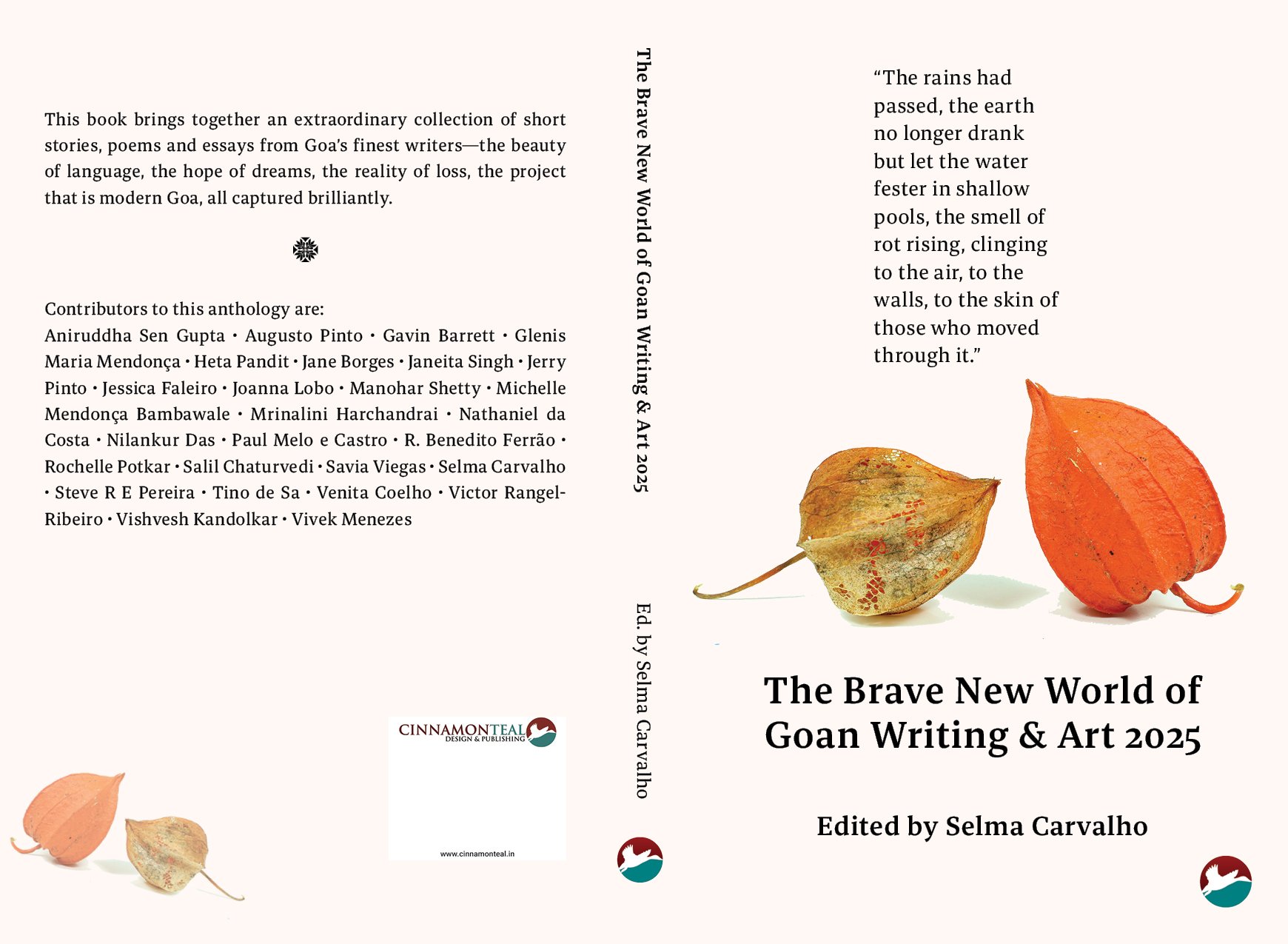
“Anna Remembers” was first published in the anthology The Brave New World of Goan Writing & Art 2025 (Cinnamon Teal, 2025) available for purchase here.
Banner image is by Annie Spratt downloaded from Unsplash.com