If you wish to receive regular short stories, poems, interviews and book reviews published on JRLJ and share your own literary journey please join The Joao Roque Literary Journal facebook group and invite others too.
By Prema Viswanathan
Savia Viegas has exhibited her quilts at several venues since the beginnning of the year. Among them at Goa Open Arts Festival, Museum of Goa, Carpe Diem and Karnataka Chitra Kala Parisath. A film featuring the works titled Tales from Carmona has been shot by noted documentary filmmakers Anjali Monteiro and K. P. Jayasankar and is slated for release next year.
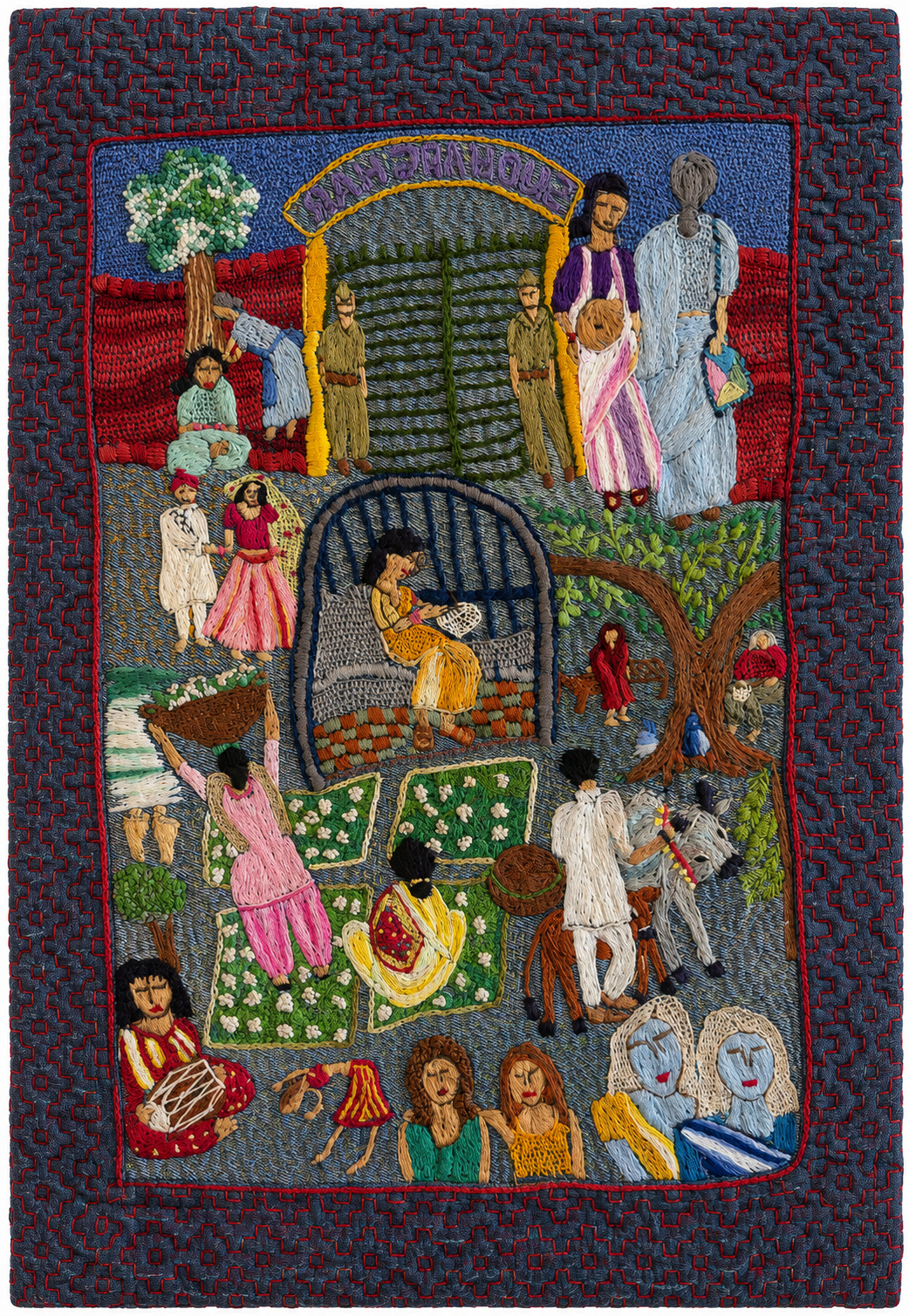
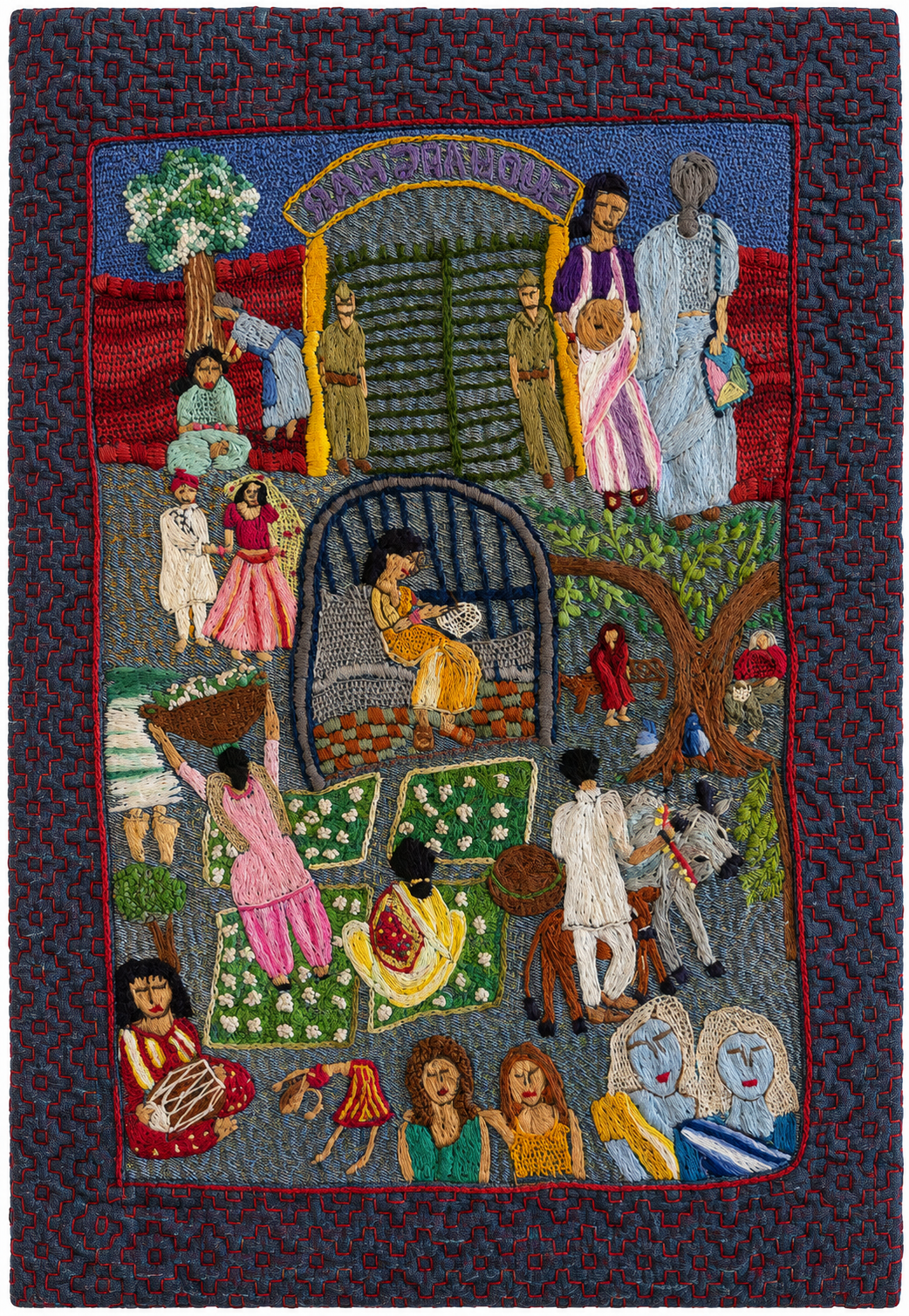
Titled “Rent a Womb”
Savia Viegas has always collected stories. They came to her in the lamplit rooms of her Goan childhood, in the voices of women talking late into the night, in village gossip, family histories and the small dramas that rarely find their way into official histories. For years she put them into fiction. Now she is stitching them into cloth.
The shift from the written page to embroidered denim might seem like a radical change of medium. For Viegas, it is not. The same impulse that made her turn an ancestral house into the living presence at the heart of Let Me Tell You About Quinta (Penguin, 2011) and explore a Goa transformed by migration and social change in Song Sung Blue, now animates Goa’s Lovetales. Her quilts are another form of narrative: stories compressed into images, fragments of memory held together by thread.
“The archive is really in my head,” she says. “My writings, paintings and quilted tapestries are merely a disgorging of that archive into public space.” For her, the privilege of being “a writer, artist, and embroiderer” is to tell “human stories of conflict, resilience and resolution”.
The language began to be crafted in childhood.
Viegas grew up in Goa when it was still under Portuguese colonial rule. Konkani was spoken at home, Sundays belonged to church, and the Catholic culture around her was markedly different from that of the rest of India. She was a child surrounded by women and stories. Her mother was a tailoring and embroidery teacher, and the family home was filled with women learning domestic skills, preparing wedding trousseaus and talking as they worked. Visiting aunts would sleep on the floor and “delve into the night with stories and laughter by lamplight”.
Her mother also gathered local stories and recited “gossipy poems of village folk”. She knew what Savia might eventually do with them. Her warning to family and friends came with a twinkle in the eye: “Don’t tell the stories to Savia — she will put it in her books.”
She eventually did.
Ironically, embroidery was not something her mother encouraged her to pursue. She wanted her daughter to be educated, perhaps sensing that needlework, however skilled, could too easily become a prescribed domestic accomplishment rather than a creative vocation. Viegas, instead, became a writer and artist, developing a visual imagination influenced by Mughal miniatures, Indian Buddhist sculpture, Konkani culture and the Goan tiatr tradition.
The needle returned much later, almost by accident.
During the pandemic, while clearing her mother’s cupboards after her death, Viegas found a quilt made from her sons’ outgrown jeans. She ripped it open and rejoined the pieces. Then something happened: “Suddenly, the cloth began speaking to me, carrying me back to my childhood and opening a vast ocean of memories and stories.” She gradually realised that “memory is not merely personal; it is also cultural”.
The discovery led first to Carmona’s Talking Quilt and then to Goa’s Lovetales.
Viegas is also quietly challenging the uneasy divide between art and craft that remains so persistent in the contemporary art world. Embroidery has historically been associated with women’s domestic labour — something made by hand, often collaboratively and anonymously, and therefore too easily dismissed as craft rather than recognised as art. Yet for Viegas the needle is not a retreat from painting or writing but another artistic tool.
Savia’s embroidered works bring together drawing, colour, narrative and textile, allowing the handmade quality of the work to remain visible rather than disguising it. In doing so, she bridges a hiatus that has long separated the supposedly serious business of art from the intimate, everyday practices of craft. The distinction, her work suggests, may have less to do with what is made than with who has traditionally been allowed to make it and how that labour has been valued.
The relationship between Viegas’s fiction and textile work becomes especially clear when one considers what she chooses to preserve. In Let Me Tell You About Quinta, an ancestral house carries the memories of generations until it seems almost to possess the people who inhabit it. In Goa’s Lovetales, a doorway, church, river or village path embroidered into denim can summon a comparable history in a single visual fragment.
Song Sung Blue shares another of the quilts’ central concerns: a Goa transformed by migration, new wealth and changing social relationships. In the novel, those changes unfold through characters and narrative time. In the quilts, they appear as fragments assembled on one surface. The method is different, but the question is the same: what happens to intimate lives when the world around them changes?
Viegas returned to Goa in 2004 after 25 years away and found the place of her childhood altered almost beyond recognition. She describes the experience as a Rip Van Winkle story. New wealth had arrived through migration and remittances; the social landscape and its power structures had shifted.
But she does not write from a desire to restore the past.
“I see the past without nostalgia,” she says. “You cannot revisit the past or live in it but you can certainly extract the good things and learn lessons from the bad.”
This refusal to indulge in nostalgia is critical to her vision. Viegas is not interested in producing a picturesque Goa for outsiders to consume. She is interested in the contradictions within the place she knows intimately — and in the people whose lives reveal them.
She describes herself as a villager, and says this gives her “an urge to protect and preserve the good values of village life which are now being eroded”. The need to “map and preserve Goan identity” has become one of her central concerns.
The stories in Goa’s Lovetales are local, but their concerns are universal.
Love is rarely sentimental. It can create and destroy, liberate and imprison. It collides with caste, religion, patriarchy, family honour, migration and social expectation. And it does not always conform to heterosexual or socially sanctioned norms.
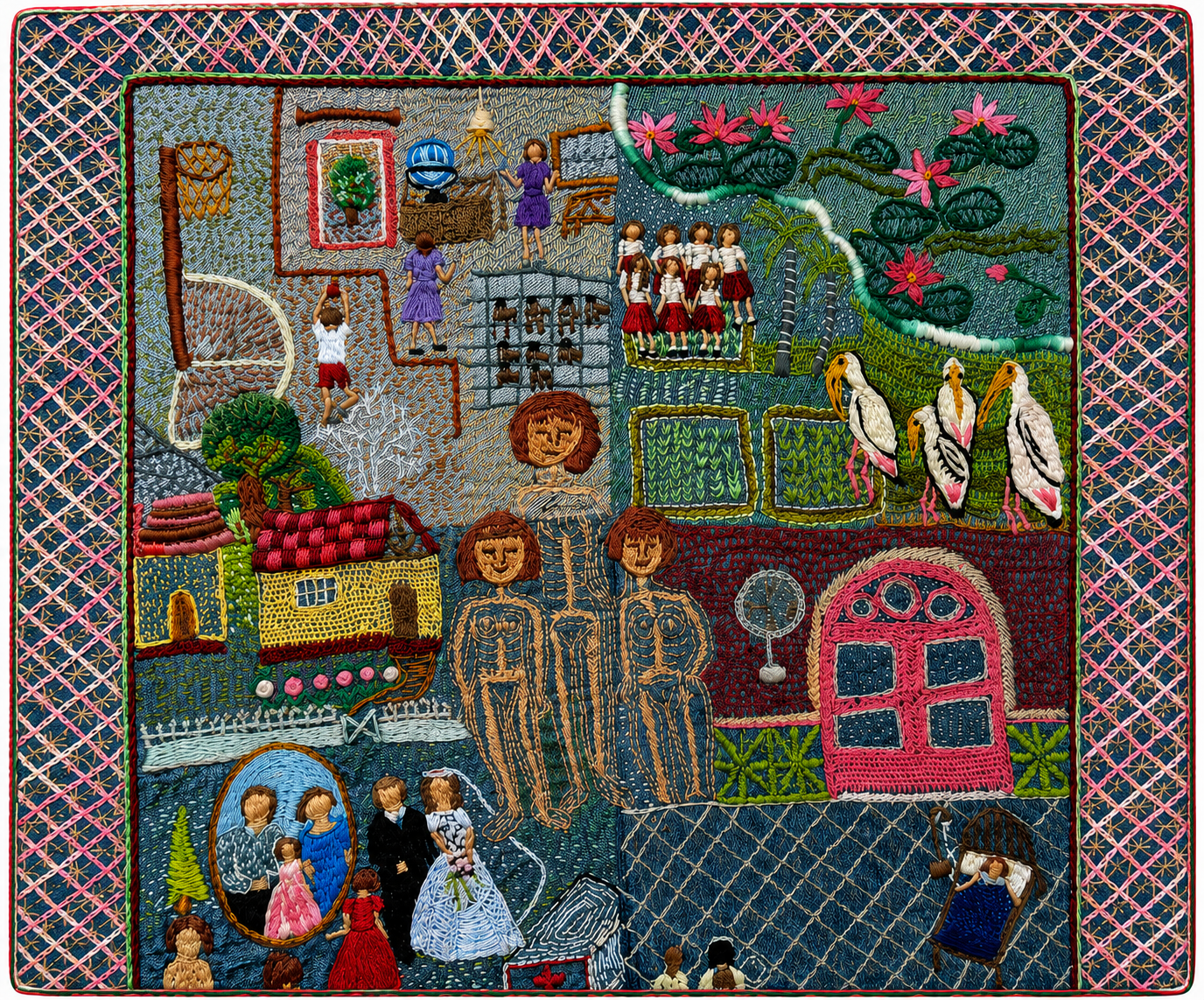
Titled “Just a Normal Girl”
Works such as Just a Normal Girl! and Trapped in My Body widen the emotional archive to include queer desire and questions of gender identity. The former approaches adolescent same-sex desire with tenderness; the latter confronts the experience of being trapped within a body that does not comfortably correspond to the identity imposed upon it.
This is not a separate political agenda attached to an exhibition about Goa. It emerges from the same curiosity that drives Viegas’s fiction: who gets to tell their story, whose desires are permitted to exist, and whose lives are pushed into silence?
Her stories also challenge the way Goan women have been represented. Viegas contrasts her own women — who “trapped tigers, dug wells, fought land sharks, and took decisions for their own lives” — with stereotypical portrayals of Goan women as decorative figures. The apparent beauty of the textiles can therefore conceal something much more disturbing. Beneath the colour and delicacy lies what Viegas calls “a quiet but seething violence”. The choice of denim adds another layer. Every pair of used jeans, Viegas observes, carries “the patina of the wearer’s experiences” — absorbing memories, journeys and moments. “What better surface could there be to write, paint and embroider stories on?” she asks.
Coming from an agricultural family, she also inherited an instinct for thrift and reuse. Denim appealed because it is durable and tactile, but also because of its particular history in India. For generations of young Indians it represented aspiration and liberation — sometimes a coveted garment arriving through a father working abroad, a visiting uncle or a wealthier friend.
Now the same fabric is routinely discarded.
There is a neat symmetry here. She is recycling fabric at the same time as she is rescuing stories.
Her description of her storytelling as “very episodic and pictorial” perhaps explains why the transition from writing to embroidery feels so natural. Her narratives, she says, often form “long before I put it down on paper”. They arrive as “fast-moving images, often gliding through nonlinear time”.
“I need to paint and embroider just as much as I need to write,” she says. “The struggle is often an act of unclogging rather than some inspirational flow.” In the final analysis, she considers them “all supportive mediums”.
That is the heart of Goa’s Lovetales. The quilts do not merely illustrate the stories; they are stories in another language.
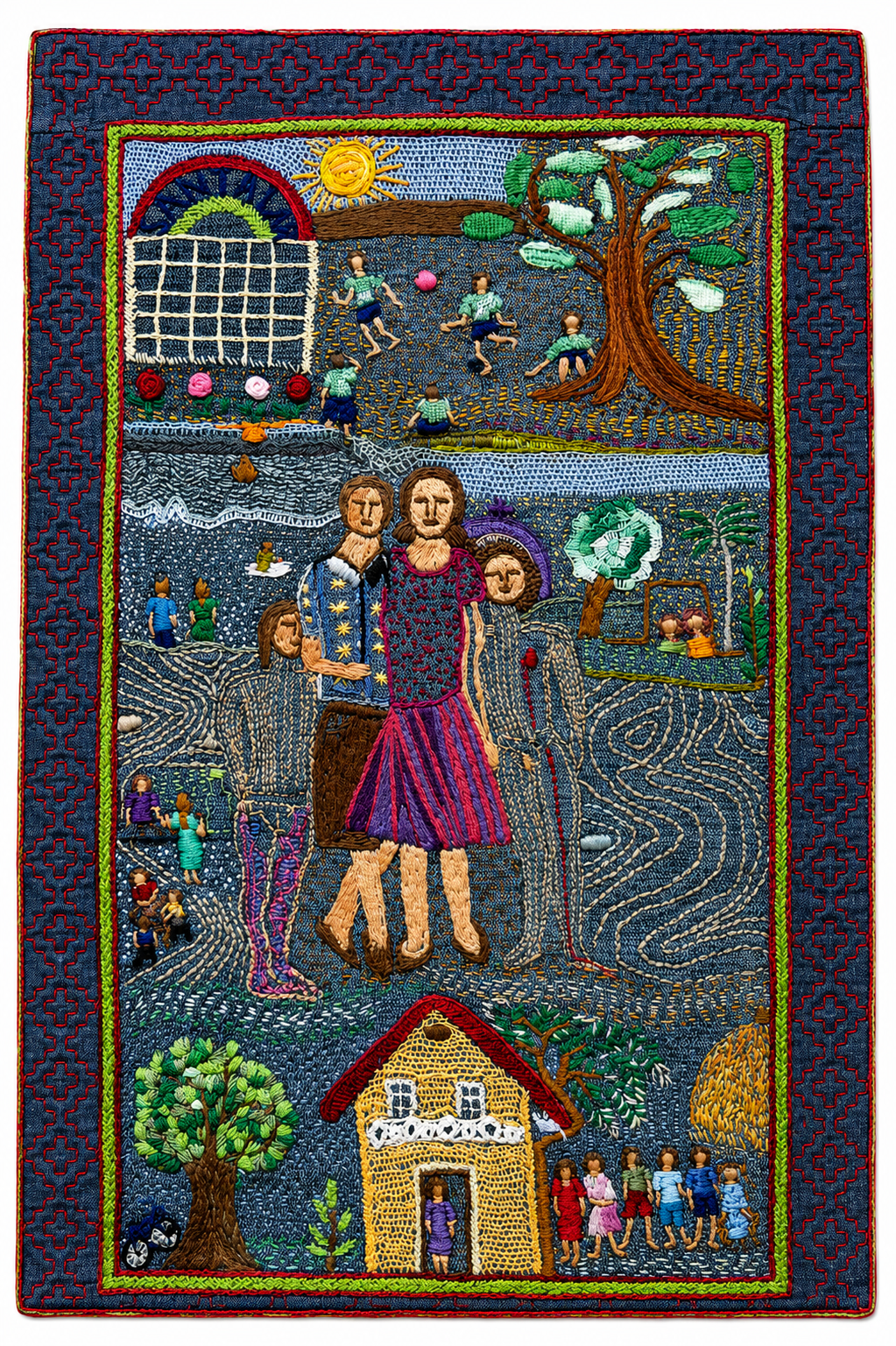
Titled “Trapped in My Body”
Fiction allows greater psychological depth and linguistic nuance. Embroidery reaches the eye first. A viewer may come for the colour and texture and then discover the more difficult meanings underneath. In that sense, the quilts are almost another kind of book — one in which pages have been replaced by pieces of cloth and sentences by stitches. Perhaps Viegas has not really moved from writing to art at all. She has simply found another way of telling. The novel gives her hundreds of pages; the quilt gives her a single surface. One allows a story to unfold through language, the other through colour, image and texture. Yet both begin with the same impulse: to hold on to something that might otherwise disappear. Houses, villages, women, desires, migrations, queer lives, family histories — the fragments accumulate. And Savia Viegas stitches them together, not to recreate a lost Goa, but to give its stories another life.
Prema Viswanathan has had a long and distinguished career in journalism and market intelligence in India and Singapore. She is an author and features writer focusing on the arts. Her first book Badri Narayan: Portrait of the Artist as Storyteller was co-published by Marg Foundation and Pundole’s in 2020. The second book is titled Iconic Encounters. She lives in Bengaluru.