Photo Essay: My Friend Shubhi

Photo Essay: My Friend Shubhi

By Shazia Shaikh

Issue no 25

In a place like Goa, known for its glitz and glamour, its parties and perversions, a family of farmers have managed to continue their quiet and dignified lifestyle. The simple pleasures of life like family and love is the driving force of their life. At the core of it is their connection with nature. This photo-essay documents the women as observed in their house and working on the plantation over a period of one month.

Footnotes on Vimala Devi's Monsoon

Footnotes on Vimala Devi's Monsoon

By Selma Carvalho

Issue no 25

Devi’s writing is an exquisite capture of mid-century Goan society, mores and landscape. The detailed descriptions of the houses and households in particular are of interest for the sheer opulence they conjure up, a gilded age indeed which faded far too soon, and it is easy to see why for so many Goans, there persists a saudade for a paradise lost.

Artist Julio D'Souza: The One Last Supper

Artist Julio D'Souza: The One Last Supper

By Jugneeta Suda

Issue no 24

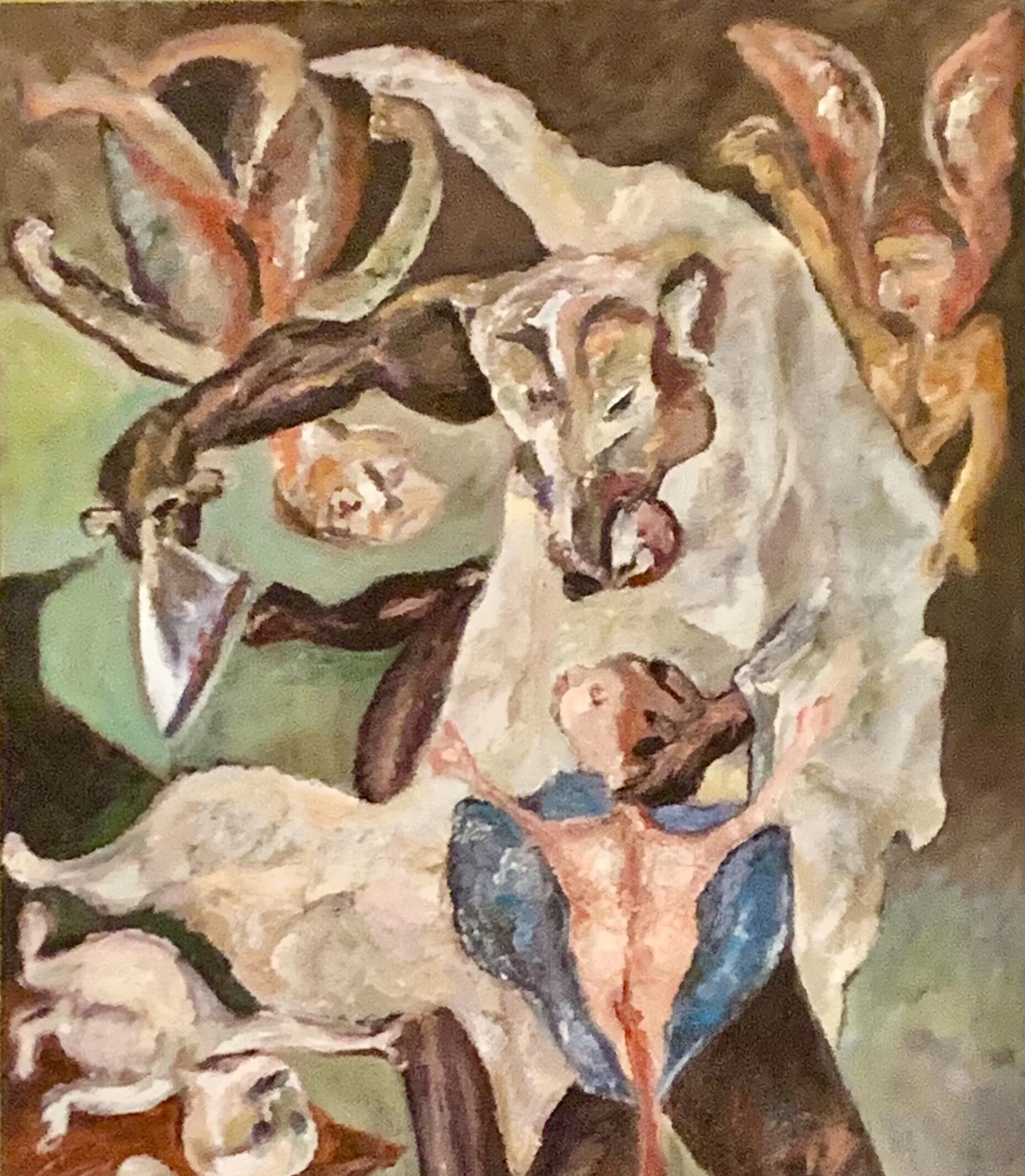
Artist Julio D’ Souza has rendered the Last Supper many times in the last 13 years. When I talked to him he said, “Irrespective of how many I have painted, when I set out to paint again, for me, it’s One Last Supper” Every-time. Without exception. The magnetic pull is the metaphor in the painting, a family/community coming together to partake of a meal at the dining table. A masterpiece embedding the dance of ‘Light & Shadow’, the polarities are palpable.

A Slice of Christmas Cheer

A Slice of Christmas Cheer

By Kavita Peter

Issue no 24

The 18th century British poet and abolitionist Helena Williams, summed the Christmas spirit brilliantly in this excerpt. Where else can the confluence of taste and memory of joyous times come true but in the baking of Christmas cake? We can all agree the “Cake” that Williams calls “Life’s calendar of bliss and pain” is a good and sweet way to round up the year. Culinary historians attribute its origins to the plum porridge in medieval Europe. After a day of fasting, this warm and nourishing meal was what people ate on Christmas.

Reshma Ruia: Healing The Wounded Self

Reshma Ruia: Healing The Wounded Self

By Selma Carvalho

Issue no 23

Reshma Ruia is an award-winning British-Asian writer. Her first novel, Something Black in the Lentil Soup was described in the Sunday Times as ‘a gem of straight-faced comedy.’ Her second novel A Mouthful of Silence was shortlisted for the SI Leeds Literary Prize. Here in conversation with Reshma, we discuss her newly released collection of short stories titled Mrs Pinto Drives to Happiness (Dahlia Press, 2021) exploring characters who are trying to heal from their wounded selves.

1991: Dispossessions - A 30th Anniversary Remembrance of the Gulf War issue no 22/2021.

1991: Dispossessions - A 30th Anniversary Remembrance of the Gulf War issue no 22/2021.

By R. Benedito Ferrao and Deborah Julia Al-Najjar

Issue no. 22

The past stays with us, this we know. But what we can be less certain of is how the future possesses us even before we arrive at it. Before 1991, India had only one television channel. That changed with the dramatic overhauling of the country’s economy in the last decade of the twentieth century.

A Late Letter, Missing Wedding Photographs, and a Phone Call from Baghdad

A Late Letter, Missing Wedding Photographs, and a Phone Call from Baghdad

By Marlon Menezes

Issue no 22

It was on the 2nd of August that I woke up to the familiar wail of Arabic on my radio, but I immediately realized that I was listening to the wrong language in the wrong country. I was in Canada and the Arabic I heard was a plea for help from Radio Kuwait that was re-broadcast by the Canadian Broadcasting Corporation (CBC) as a lead-in to their headline story that morning.

Even if My Voice Shakes

Even if My Voice Shakes

By Noor Alhuda Aljawad

Issue no 22

I was born in Southern California in late August 1991, a year and a few weeks after Saddam Hussein’s invasion of Kuwait. I say Saddam’s invasion, and not Iraq’s, because every Iraqi person I have ever known, be they family members or friends, opposed what my great aunt Raja’ described as اعتداء, an act of aggression.

Disturbance: 1990, 1980, and 2003

Disturbance: 1990, 1980, and 2003

By Dena-Al-Adeeb

Issue no 22

Disturbance is a visual and performative memoir presented as a triptych video art project. The piece is comprised of three videos, entitled 1990, 1980, and 2003 –– years in which the first Gulf War erupted, the Iraq-Iran war started, and the US invasion and occupation of Iraq took place. 1990, 1980, and 2003 correspond to the artist’s displacements due to the same events.

When the Dancing Stopped

When the Dancing Stopped

By Dina Lobo

Issue no 22

My father recalls a humbling moment three months into the Gulf War in Kuwait, in which food was scarce. He walks me through his sensorial recollections of 1991. Black skies for weeks as he was unable to distinguish morning from night due to the firing of oil wells. The background echoing with noises of rockets, explosions, and gunshots that made sleep difficult.

Souza: The Artist, His Loves & His Times

Souza: The Artist, His Loves & His Times

By Selma Carvalho

Issue no 21

In the end, F. N. Souza belongs to Goans. Apart from the Tate Gallery, London, displaying one of Souza’s most emblematic works, the ‘Crucifixion,’ and Grosvenor Gallery having the occasional retrospective, F. N Souza elicits little recognition. There are no biographies paying tribute to the artist, no English heritage plaques commemorating the places he lived in, nor are there regular references made to his work in that definitive art reviewer, the TLS; he does not seep into the British consciousness the way his contemporary Francis Bacon does or even the less distinguished and one-time boarder at Souza’s house, Keith Vaughan does.

Revisiting Goan Diasporas of Pakistan and East Africa

Revisiting Goan Diasporas of Pakistan and East Africa

By Selma Carvalho

Issue no 19

What becomes clear is that by the late 19th century, increasingly, metropolitan Bombay rather than Goa became the centripetal location from where Goan elite in the diaspora sought direction. The ambitions of Bombay-Goans like Leandro Mascarenhas, B.X. Furtado and Dr Acacio G. Viegas who were founding members of the Associacao Goanna de Mutuo Auxilio Ltd, the Uniao Goanna and the Instituto Luso-Indiano were mirrored in Pakistan and East Africa

Mona Dash: A Sensual Feast

Mona Dash: A Sensual Feast

By Selma Carvalho

Issue no 19

So begins our journey, with a touch of trepidation, into Mona Dash’s collection of short stories, titled, Let us Look Elsewhere, (Dalia Books UK, 2021). What sensual feasts await the reader? Imagine Anais Nin, imagine the writings of women, bold and untrammelled, indulgent of sexual desire, unrestrained by a moralising gaze, yet conscious of the constraints of marriage and motherhood.

Siddharth Dasgupta: A Moveable East

Siddharth Dasgupta: A Moveable East

By Selma Carvalho

Issue no 19

There is a kind of secular light which washes over Siddharth’s collection of poems titled A Moveable East (Red River, 2021), its 136 pages divided into seven sections. I say secular not because it shies away from the sacred but rather because he embraces the sacred with a purity of heart, embraces the universal goodness that lies at the core of each faith tradition, and claims as his own the unique voice of these faiths, their many moments of shadow and space.

Rochelle Potkar: Bombay Hangovers

Rochelle Potkar: Bombay Hangovers

In conversation with Rochelle Potkar

Issue no 19

As these stories organically came about, I gleaned that the common thread was Bombay, later Mumbai. As one consumes the ebb and flow, sea-breeze, buzz and bustle, march and spring, it puts you into the rhythm of its heartbeat and the city speaks to you. There is a hum that I have not felt in other cities of the world, rare like Bombay blood group. This hangover is one of memory, in and outside the city then. More so, of the joint march of its citizenry of all classes—industrious as bees and ants.

Kololo Hill: A Story of Courage

Kololo Hill: A Story of Courage

By Selma Carvalho

Issue no 19

Neema Shah joins this sparse but important canon of Asian-African literature with her debut novel Kololo Hill (Picador, 2021), the focus of which is also the interrupted and scattered lives of the Asian exodus. It has fallen largely to the sons and daughters of those who left Africa and settled in the new worlds of Canada and UK to tell this story. Shah’s mother was born in Kenya and her father in Tanzania who migrated to the UK.