“Land envy and cultural jealousy can only take a society so far.”
Review by Selma Carvalho
From Goa comes a delicious (if you’ll pardon the wordplay) anthology titled “Appetite,” from the pens of the Goawriters collective and published by Penguin, India. As I first browse through it hurriedly, other adjectives crowd my mind—profoundly moving, deeply perceptive, a triumph. Yes, this indeed is a glorious celebration of that experiment we call “Goa” –India’s smallest state, a constantly evolving experiment which like the sea that girdles it, claims diversity, divergence, and the painful debris of our lives, and renews itself at every turn.
This moveable feast of Goan writing has so many delectable offerings, each one a quiet revelation into Goa’s zeitgeist. In the first section, titled “Stories,” “The Bull,” by Gouthami was a story I was viscerally drawn to. It begins like a beacon, “Somewhere in this wide and varied land, there is the concept of the saand—the lone bull in each village, valued for its virility.” You know, without knowing how that the bull is Picasso’s metaphor, Hemingway’s catharsis. Who is this bull? How is he going to be sacrificed? In this world of internet romance scams and insatiable hook-up sex, the bull has his comeuppance in the most unexpected way.
Each story in this section is impressive, there is Clyde D’Souza’s “Sorpotel,” a hilarious take on Goan family drama (quite frankly I haven’t laughed this hard in a very long time), Shivranjana Rathore’s Kafkaesque “Netheria,” dwelling on death and the afterlife, Tino de Sa’s “The Happy Hearts Beach Resort,” a fictionalised look at the ugly underbelly of Goa’s tourism sector, the dehumanisation of people who smile and cater to the tourist’s every whim while working in sub-human conditions. Michelle Mendonça Bambawale’s “The Real Housewives of Assagao” sheds a spotlight on second-home owners from north India, who live gilded lives distanced from the economic realities and age-old traditions of Goa, oblivious to how they are displacing indigenous Goans. Pamela D’Mello’s “A Morning with God,” grapples with Goa’s Mundkar Act, which was brought in to deliver reparative justice by restoring land to the tiller, but has since become a soiled sediment of corruption. Pamela’s powerful line, “land envy and cultural jealousy can only take a society so far,” captures all that fashions Goan politics today with its myriad of communal tentacles. In Sheela Jaywant’s daring story, “The Divide,” a newly-wed female protagonist explores her sexuality within the confines of India’s emerging working class. To me, this was a standout story for its unabashed look at Indian female sexuality and its gritty portrayal of the class divide.
The “Essays” section has much to mull over. Edith Melo Furtado’s insightful and deeply moving essay “Craving for the Chic: From a Trickle to a Torrent,” opens a window to a not-too-distant past. It is now lost to collective memory that the nineteenth and twentieth century elite Goan was not just immersed in the world of Portugal, but with a closely allied culture, that of France. Private libraries were lined with French classics, including in my own in-law’s house, which Goans could read as easily as they read Portuguese. With her profound love of French, Edith’s world was immersed not just in French literature, but also in French fashion and music. All that came to a screeching halt upon Liberation. To take away language from a person is to take away a worldview.
Imagine my delight to find juxtaposed against Edith’s lost world that of Rachana Patni’s newly found world, in a piece titled “A Vegetarian Goan Wannabe Writes to Digest.” Rachana is a Jain vegetarian from Manipur encountering a Goan Catholic world. Food, as always, is not just a journey into our culinary appetites, but into our very identities. Rachana is a deft hand at navigating small spaces which open on to something large and universal. In this essay, she familiarises us with her Jain traditions and the joy of discovering Goa’s own rich vegetarian culture.
Despite the title Appetite, the anthology does not seek thematic unity—there are stories, poems and essays wide in genre which range from the comedic to the experimental, and in subject matter as disparate as Frederick Noronha’s “Why is Sex a Four-letter Word,” Brian de Souza’s “An Appetite for Stamps,” to Alisha Souza’s hilarious take on the rituals of Goan matchmaking in “I’ll Do it My Way,”—and this is a positive, the diversity of subjects lends itself to intellectual curiosity, while revealing something uniquely peculiar to the Goan experience. Writing is that endeavour which lets us enter other people’s worlds and grow from that experience. This wide and varied collection of writing from Goa’s ever changing cultural landscape, lets us do just that.
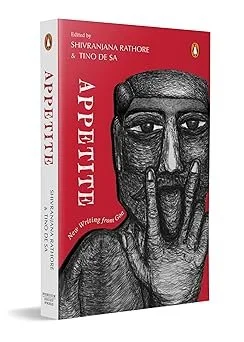
Appetite can be ordered online here and purchased in all leading bookstores across India.
Banner image courtesy Art Institute of Chicago, from Unsplash.com.