Review by Michelle Mendonça Bambawale
“This book has three authors, Antonio Rodrigo Aguiar, Marjorie Valerie Lobbo and Sharbelle Aguiar Fernandez,” these were poet, author, civil servant Tino de Sa’s opening comments at the well-attended Romance on the Airwaves (Goa 1556, 2026) book launch held at the Xavier Centre of Historical Research, Porvorim, Goa. In that beautiful back garden, on a cool January 9, 2026 evening, Sharbelle could not stop beaming with pride.
During the pandemic, Sharbelle discovered a shoe box tied in a faded red satin ribbon stuffed with a few of her parents’ letters to each other. The paper was frail, the handwriting faded, but the box had survived seventy years, shifting times and places, harsh Goan monsoons and a termite infestation. Reading them, Sharbelle learned about her parents’ lives before they had even met each other. She says in the Prologue, “of the hundreds of letters Mum Marge wrote over the span of six years, only fifty or so survived the termites’ assault. Of Dad Rodrigos’ only three.”
Sharbelle was encouraged by the pioneering publisher Frederick Noronha of Goa 1556 to document her parents’ love story. The book though deeply personal has a wider historical significance. The primary source of letters offer a personal insight into India’s economic blockade of Goa, and its struggle for freedom during the 1950s, and then the initial years of independence in the early 1960s. As in most Goan small world stories, we discover in Romance on the Airwaves, that the writer and the publisher have a family connection, Sharbelle’s mother Marge and Frederick’s mother Philomena, fondly called Felicia, were best friends in Hubli. The school friends reunited in the 1960s as neighbours in Santa Cruz, Goa.
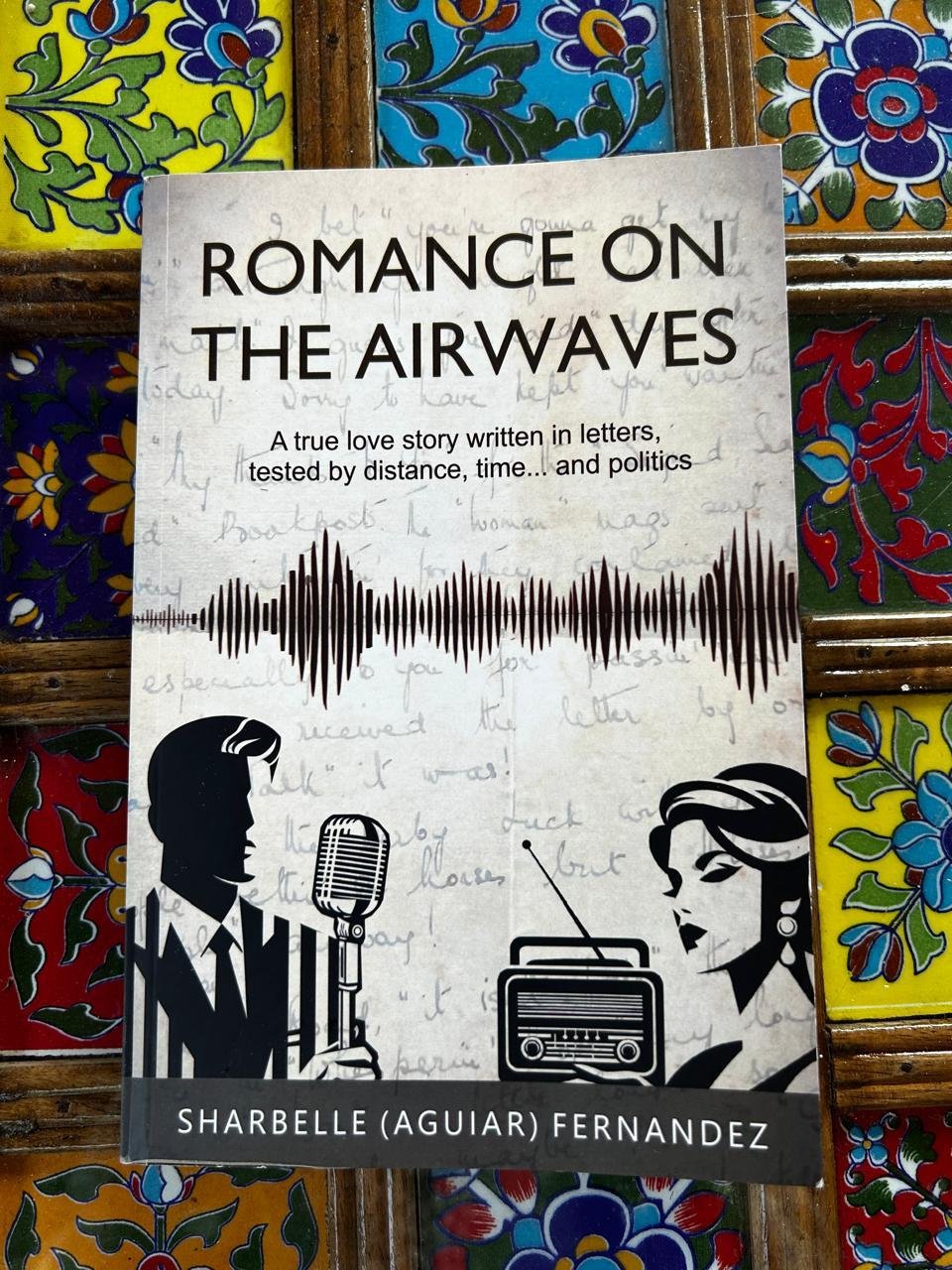
Since the pandemic, over the last five years, Sharbelle painstakingly pieced together these treasured letters to craft a book that records her parents romance. The light 204 pager is an easy, quick read, flush with family photos, anecdotes, their poems, songs and copies of the letters to support the storytelling. Every chapter has famous quotes and popular cliches, a home-grown effort, with Sharbelle’s son Bjorn, designing the cover.
In early chapters of the book, Sharbelle’s mother Marjorie Lobbo, known as Marge, is a teenager—young, vivacious, musically talented, and living in Hubli. She not only plays the piano, but sings as well in a band with her sister and composes songs. Marge is a talented writer and poet, and a determined and kind human.
Sharbelle’s father, Antonio Aguiar, popularly known as Rodrigo, is a confirmed bachelor, almost 40, living in Fontainhas, Panjim. He is a true Renaissance man, a footballer, journalist and poet. Rodrigo maintained a long, thick scrap-book to chronicle his formidable footballing accomplishments. Sharbelle refers to this as another primary source for her research. It was prominently placed for all to admire at the book launch. Rodrigo was not only ridiculously talented but also handsome with a wide fan following.
Here is an excerpt of an article reproduced in the book.
Mr. A R Aguiar creates history in Goa
Described generally as a dashing, debonair, dynamic and diplomatic worker in any field and one of the most colourful and versatile personalities of Goa today, Mr. A R Aguiar collaborated in no mean measure to launching the commercial service of Radio Goa, way back in 1949.
With his “musical cocktail” compromising of a ‘Mail–Bag–Merry-Go-Round,” and a “Personally Yours” request programme, rated as one of the best among the English programmes, he soon fascinated the radio audience and conquered the hearts of millions of radio fans on this side of the globe, rocketing overnight, as it were, to fame all over the Goan World and contributing to make the name of Radio Goa a household word.
Marge would listen to Rodrigo’s English music request programme on Emissora de Goa, the popular radio station in Portuguese Goa. History tells us that Emissora de Goa, began with an experimental broadcast on May 28, 1946, when José Ferreira Martins, a radio amateur, donated a small transmitter to a group of youngsters. Their first microphone was improvised from a coconut shell. It grew into an important cultural hub broadcasting to India and across the world.
Emissora de Goa is an important character in Romance on the Airwaves. That’s how Marge first gets Rodrigo’s attention. Her music requests and letters intrigue him. They stand out from the other 20,000 fan letters he receives regularly. Hers are witty, articulate, demonstrate her love and knowledge of music. Many are sprinkled with names and titles of songs, music trivia and poetry. She loves to write, her letters run long from two to twenty pages and sometimes more.
The early chapters, “Signed, Sealed, Delivered,” “Voice at the Gate” and “The Musical Bond,” go back and forth between Hubli and Goa. We can’t wait for them to meet in person. Those of us who have fallen in love, long distance, pre-internet, then met in person and continued the relationship through letters, are familiar with the heady days of hand-written letters, sealing them with a kiss and waiting for the postman. This long distance romance is different, Rodrigo’s voice on the radio and Marge’s requests and letters to him, make them fall in love. The political and economic blockade make their love story even more exciting. These dangerous, difficult yet exciting times are dealt with in “The Spy who Loved Me,” “The Pain of Parting” and “I’ll be Loving you Eternally.”
In his letters, Rodrigo often included paper clippings about films, books, music and recipes that he thought would interest Marge. Rodrigo’s handwriting was illegible, so poor Marge was often dragged to the police station to read them out. Her home Lily Cottage was even searched for evidence. The Indian authorities suspected he was a spy sending secret codes to Marge during the embargo. Things got worse, Rodrigo was made to resign as a radio announcer to keep his day job in a pharmacy. The saddest part was Marge going through a series of traumatic interviews in Bombay to secure a one-way visa to come to Goa to marry Rodrigo all alone.
Romance on the Airwaves moves through different settings, in rented and temporary homes, Lily Cottage in Hubli of the 1950s, the familiar Fontainhas in Panjim but in a different gentler, more picturesque era of the 1960s, Calapur (Santa Cruz) in the 1960s, St. Joseph’s home, Calangute in the 1970s, and Aldona of the 1980s.
The Aguiar family, however, is plagued with misfortune. Rodrigo dies when Marge is only 39, Marge has to sell her precious piano, a gift from Rodrigo, to pay off her debts, surgeries, an ill-timed robbery, and the knife that turns in your heart, the poisoning of their beloved dog Tokyo. We see Marge grow into a gutsy, resilient woman, finding work as a music teacher in a boy’s home and bringing up her daughters as a single parent.
Despite the innumerable, inexplicable, heart-breaking hardships, Romance on the airwaves bubbles with joy, rings loud with music and poetry, stays playful with football, and gentle and kind through their love of animals. Hope smiles through the turmoil. Lillian’s (Marge’s mother) legacy of putting on lipstick every morning to brighten her day, lives on through Marge and Sharbelle. For them, the world always looks better when you wear lipstick.
Michelle Mendonça Bambawale is the author of Becoming Goan: A Contemporary Coming Home Story (Penguin; 2023). Her recent work appears in the anthology The Brave New World of Goan Writing & Art 2025 (Cinnamon Teal, 2025) and in the anthology Appetite (Penguin, 2026). She is a frequent contributor to the Joao Roque Literary Journal.
Romance on the Airwaves can be purchased in leading bookshops in Goa.
Banner image by Alberto Bobbera downloaded from Unsplash.com