Review by Selma Carvalho
Imagine the fear that pervaded Goa in the December of 1961. At least one section of Goan society knew with absolute certainty that their lives would change forever—and they did, the erasure of the Luso identity. It sometimes amuses me when we speak of Goan identity and its imminent loss. Goa has always had a plurality of identities coexisting. The culture of the Konkani speaking agriculturist mundkar in rural Goa is as divorced from the Portuguese-speaking Goan of literary societies and leisure associations as it is from the Marathi speaking Goan of the hinterland. But the Lusophone Goan dominated the nineteenth and early twentieth century cultural and political landscape of Goa. This was a world within a world, which acknowledged Lisbon as the metropole, Portugal as the mother country and their lives as being part of the European hemisphere. All this collapsed entirely post-liberation. Many fled to Portugal, but most stayed on in Goa, switched over to English, consciously or unconsciously making English the new gate-keeping language of economic and social mobility.
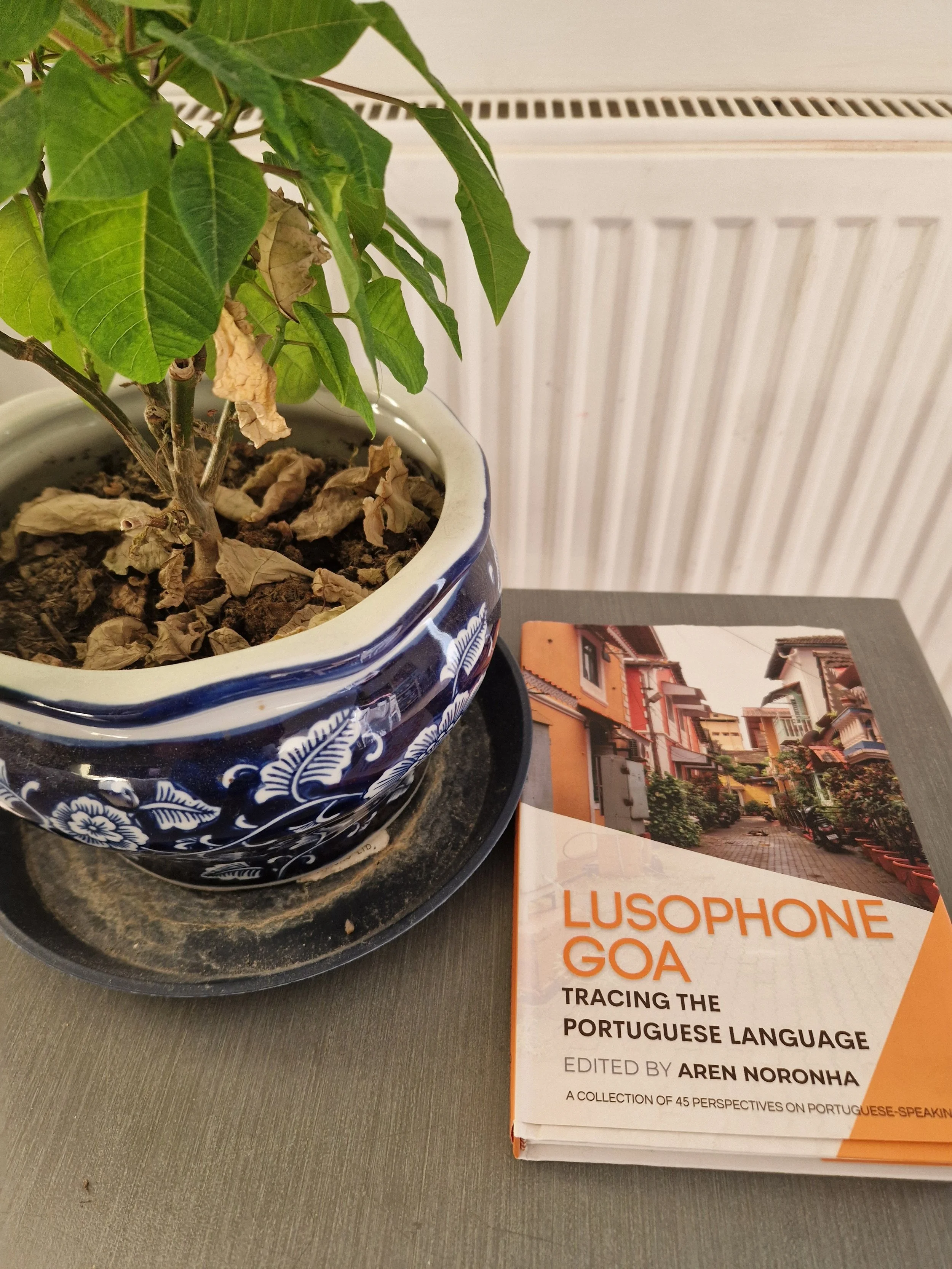
These articulations of aspiration and loss are anthologised in Aren Noronha’s Lusophone Goa: Tracing the Portuguese Language (Goa 1556, 2026). In the interests of transparency, I last saw Aren as a young boy playing with my equally young daughter at the launch of my first book, Into the Diaspora Wilderness (Goa 1556, 2010). It’s heartening, indeed, that he has now grown into a young man embarking on intellectual endeavours of his own.
Aren curates a fascinating glimpse into the Lusophone world, the lives of its inhabitants exuding a familiar sameness. If anything, the individual experiences cohere on a theme—of upper-class dominance and immersion into a culture which created an opaque, unbreachable barrier between them and the working-class population of Goa. But more importantly, this was a world of learning, of modernity, of western enculturation, and of migration.
The book consist of forty-five essays, a couple of these written by people who do not speak Portuguese, and yet even these ruminations offer an insight into lives lived in the penumbra of the Portuguese language, how those who did not know the language nonetheless imbibed loan words or came across it by way of cuss or code words. They acknowledged it as the language of their parents and grandparents, a link to their own past.
The first essay by Lisbon-based academic Sandra Ataide Lobo, titled “Claudiana’s Writings and her Generation’s” is a journey into the Ataide Lobo’s personal history. Interestingly, Sandra’s turn-of-the-century bustling family household were engaged in producing handwritten magazines, an activity which they carried into adulthood, embracing a life of literary pursuits. Sandra’s grandmother Claudiana was a subscriber of the magazine Luz do Oriente. Her father and his colleagues organised the surviving manuscript of the anticolonial democrat Adeodato Barreto, which would result in the publication of O Livro da Vida. Sandra’s own PhD. thesis was on the colonial press, and so this essay contains details about the evolution of the press in Goa.
Another interesting essay in a similar vein is that of Maria de Lourdes Bravo da Costa titled, “The Status of the Portuguese Language,” which gives us a brief history of schools in Goa. It is a trove of information for researchers from the trusted, scholarly writings of Maria de Lourdes, who played a formidable role as librarian at Goa Central Library.
Of particular interest to me were essays by diaspora Goans in Mozambique and Uganda, who had grown up in Portuguese speaking families or had to learn the language upon their return to Goa, to qualify for examinations. Being a researcher of the Goan presence in East Africa, the use of the Portuguese language in East Africa is intriguing. Spoken by a miniscule section of the diasporic community in British East Africa, nonetheless, the Portuguese-speaking Goans used language as a barrier to what constituted a political life in the satellite communities and certainly as a barrier to social mobility by making Portuguese (later English) the lingua franca in the clubs and associations they ran. To read these personal essays allows us to understand how the language flowed tenderly within their homes, and in some measure, perhaps, softens how we interpret the otherwise ruthless use of language to weild a pernicious form of Goan racism which meets at the intersection of whiteness and wealth.
One of the most fascinating essays was by Athos Fernandes, titled, “Damao, Goa, Macao: Connecting Threads.” Immediately, I learnt that the song Maria Pitache made popular by Remo, belongs to the shared cultures of Goa and Damao, and the word Pitache is a mis-transliteration of buta cher, from the archaic Portuguese word botar. Hence the chorus Maria, buta cher, actually means Maria put on perfume. But Athos’ essay is interesting for other reasons. This Goa-Damao connection is largely forgotten now but the nineteenth century saw the constant movement of Luso-descendents, mestisos and settlers, between Damao and Goa, and then into Portuguese Africa, as agents of empire. There, they were employed as army men or army doctors, and would rise to elite positions of governing local populations. Athos, through his personal journey reconnects us with the significance of Damao to Goa.
This book is well worth reading for its insight into a world now fading from our memory and yet its legacies live on, mutated perhaps, but the inherent tensions of language still very much part of our Goan lives. We wish Aren the very best in his writerly journey.
Aren Noronha is currently doing his Master’s Degree in Portuguese and Lusophone studies at Goa University. He lives in Saligao, Goa.
Lusophone Goa is available at leading bookstores.
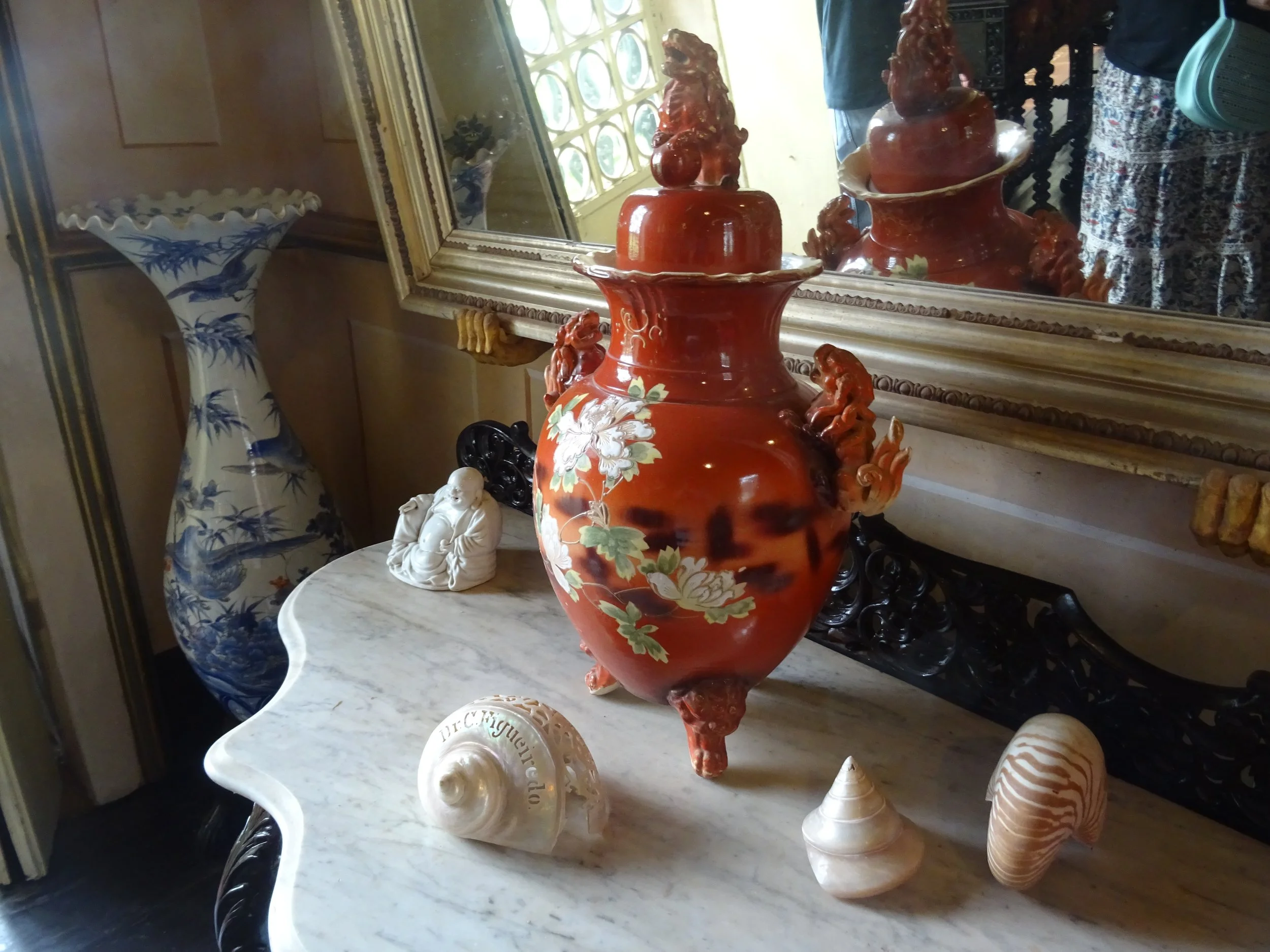
Banner and book photographs by Selma Carvalho. Banner photograph of the Figueiredo House, Loutolim, Goa.