
Review by Selma Carvalho
It seems almost banal nowadays to describe a book as stunning, profoundly moving or extraordinary. Indeed, every book published is described in such a manner by some dried-up, halfwit reviewer. Yet, this dried-up, halfwit reviewer cannot find any other words to describe Reshma Ruia’s Something Black in the Lentil Soup (Renard, 2026). I suppose I could use a thesaurus (such an old fashioned word nowadays) or better still ChatGPT (such an ugly word if you hate AI as one must) but what would be the need for either, when these words—stunning, profoundly moving and extraordinary—are such a perfect fit, and to which I should add brilliant.
Set in the Seventies, the book recreates the post-Nehruvian era with shades of Nehru still looming large in the minds of Indian Congress loyalists, with such accuracy and humour, the reader is immediately transported to that quaint period in time when artistic or otherwise societies sprouted; a quiet admiration for leftover Lutyens and the depressive monotony of a government job prevailed; an ungainly dalliance with Russia instilled itself in the socialist consciousness, and a firm sense of self-importance in an India mired in desperate poverty persisted. That is, until the Nineties rolled around and Manmohan Singh’s liberal economics lifted swathes of the population out of poverty. There emerged the newly moneyed classes, particularly in Delhi, now generally regarded as the sprouting of the crass and conceited classes.
Ruia is a novelist of rare talent. Again, I do not say this lightly; I’m aware the phrase is hackneyed. But Ruia displays such a talent for observation, one can’t help but be in awe of it. Ruia must remember the Seventies only as a blurry childhood memory. And hence it is nothing short of sheer brilliance to have captured it with such generosity of detail. The tiniest intricacies from names of sweets and newspapers to popular sentiments reminiscent of the era do not escape her cyclopean eye and almost-encyclopaedic knowledge of Delhi. This is Arundhati Roy’s Delhi of youthful dalliance, and indeed the character Sharmila Sharma in the darkened light of her barsati could easily be mistaken for Ms Roy.
The protagonist Jawahar “Kavi” Naidu, thus named by his mother, the founding-and-only enthusiastic-member of the Nehru Appreciation Society, has large boots to fill. Jawahar’s claim to fame is a poem which gets published in the Illustrated Weekly Views, guided there like a heat-seeking missile by his teacher, the lassi-guzzling Sikh Dr Anand, whose own appreciation for fine literature is suspect. Nonetheless, this single event in young Jawahar’s life thereafter propels him to all things literary including blind adoration of those who have already climbed the Olympian heights of literary stardom, like a certain Mr Seth.
Having settled for a dull, uninspiring government job even more disappointment is to follow. The brass-anklet polishing Kamala assigned the role of faithful wife and fulfiller of boudoir fantasies proves to be infinitely unsuitable. She is not interested in things literary and is not a willing disciple nor even an unwilling disciple. Jawahar shows true Nehruvian resilience and takes all failings in his stride. He returns to his literary endeavours with the sort of melancholic passion which only crushing disappoint can bring. It is almost impossible not to become deeply invested in Jawahar and to keep turning the pages to find out what arrives next in the life of our epic hero.
That next phase in the life of self-published poet Jawahar turns out to be a trip to Britain along with Mr Seth, both of them competing for a coveted prize. But fate presents many twists, not to mention temptations in the path of this tortured poet. One stormless night, he succumbs to the not-so-unwelcome charms of a Mrs Mistry. Several trysts and dalliances follow with the carnal Mrs Mistry, none of them fulfilling in any manner. Jawahar eventually returns to India, only to find wife Kamala has legged it as far from the Naidu household as possible. Nonetheless, some things remain a constant—Sharmila Sharma for instance—and life goes on.
Something Black in the Lentil Soup is a feat of comedic genius, but more than that Ruia displays a firm grasp of Indian politics and societal norms, making the novel an incisive commentary on Indian society, holding a mirror to our fragile, egotistical and in the end empty ambitions. As a minor aside, it doesn’t hurt that Ruia invariably peppers her writing with Goan characters.
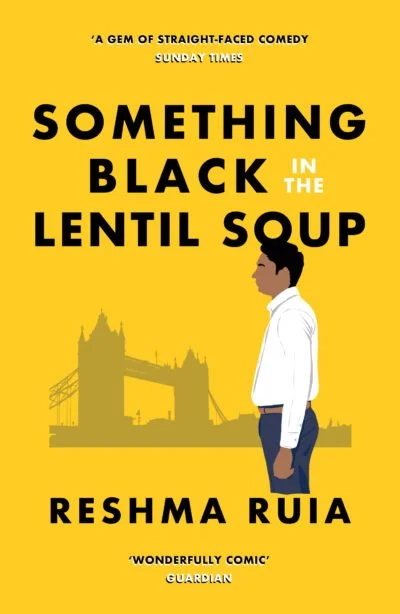
Reshma Ruia is an award-winning author and poet. She has a PhD and Master’s in Creative Writing from Manchester University. Her novel, Something Black in the Lentil Soup, was described in the Sunday Times as ‘a gem of straight-faced comedy’. Her works include a poetry collection, A Dinner Party in the Home Counties, a short story collection, Mrs Pinto Drives to Happiness; and the novel Still Lives.
Something Black in the Lentil Soup can be purchased on Amazon or from the publisher Renard Press.
Banner image by Christian downloaded from Unsplash.com