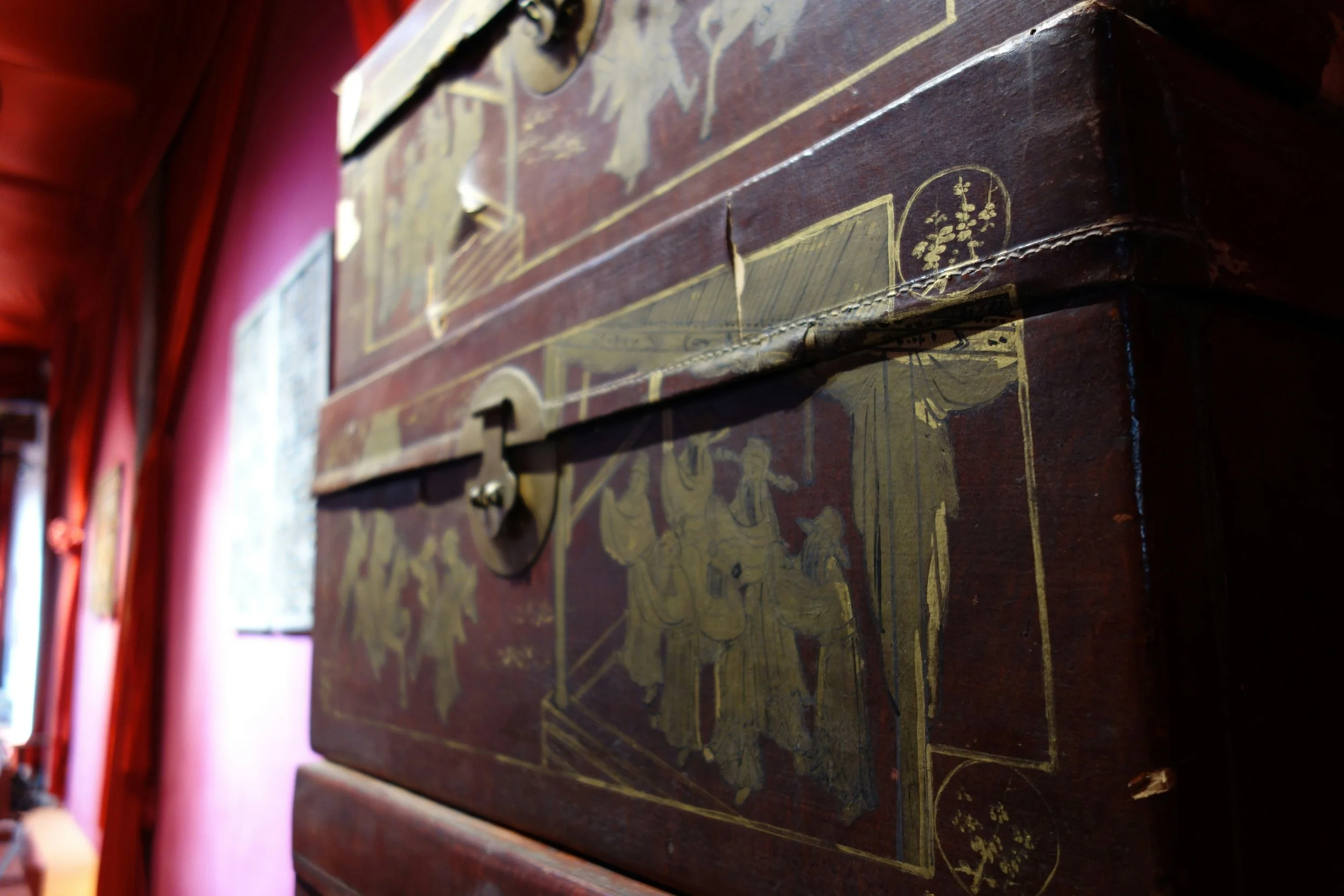
by Ava Sherry
I had been drawn to R. Benedito Ferrão and Vamona Navelcar’s The Destination is the Journey, initially because it wasn’t obvious in its positioning. It felt almost like a puzzle, except with every answer found, another layer of depth revealed itself. The Destination is The Journey forms part of R. Benedito Ferrão’s edited book, Goa/Portugal/Mozambique: The Many Lives of Vamona Navelcar (2017) which is about a Goan artist — Navelcar (1929-2021) — whose life and identity, due to colonial forces, became dispersed across the boundaries of Africa, Asia, and Europe.
The illustrations are beautiful and could almost guide the narrative by themselves, except they are not blunt nor plainly placed. The narrative itself centres around a single metaphor for postcolonial diaspora. The narrator, who takes us across Navelcar’s world, is the suitcase that he carried. I was almost in awe of this, how such a complicated and fractured story could be so neatly told and in such a way that not only maps history but pulls from political and cultural discourse. The reader is not just being told about something that happened, you are, for the duration of the novella, absorbed in it.
I decided to reach out to the work’s author and see if he might be generous enough to answer a few of my questions. Ferrão, an associate professor of English and Asian & Pacific Islander American Studies at William & Mary, not only answered my questions but gave me an insight into the process and story behind the graphic novella. Our exchange follows.
Ava Sherry: How did you first become familiar with Navelcar's work, and what compelled you to produce The Destination is the Journey?
R. Benedito Ferrão: In 2013, while I was living in Goa, I had a column in a local newspaper. I mainly wrote about culture and, so, my editor asked me to read a biography that was to be released in conjunction with an art exhibition. The book was Vamona Navelcar: An Artist of Three Continents (2013) by Anne Ketteringham and the exhibition was a retrospective of Navelcar’s art at Gallery Gitanjali in Panjim, Goa’s capital. Together, these were my first introduction to the artist and his oeuvre. I was immediately struck by Navelcar’s story and by his artistry.
A few months prior, I had just completed my PhD thesis, the focus of which was the literary representation of Goan characters in fiction that connects Asia, Africa, and the west. Ketteringham’s book chronicles how Navelcar himself followed the very trajectory as that of the fictional characters I had been writing about. As the title of the biography implies, Navelcar’s life spanned Africa, Asia, and Europe, his art the very illustration of those journeys. I also very quickly learned that despite his talent and remarkable history, the then-octogenarian artist was little known in his native Goa.
I could not tell you exactly when the inspiration to write the narrative for a graphic novella first struck, particularly because it was something I had never attempted before though I have an abiding interest in the graphic medium. What I do know is that I wanted to convey Navelcar’s story in an accessible fashion while also involving his art in the form of its telling. The genre of a graphic narrative was thus an obvious choice.
AS: Written from the perceptive of the suitcase, which I found especially moving and a brilliant way to narrate the story, was it immediately obvious that this was the perspective the novella should take?
RBF: The suitcase you mention has a rather ambiguous presence in the story, even though it functions as narrator; its ephemeral nature is meant to reflect the circumstances of that object’s mysterious disappearance when Navelcar had to leave Mozambique at the end of his incarceration there.
To me, the loss of the suitcase during the course of Navelcar’s journey to Portugal was not only emblematic of the artist’s life as one of constant displacements and losses, but also of the turbulent transitions that occurred as colonialism ended in Asia and Africa. More than a suitcase, Navelcar had lost a place he called home. And, at the time, he was one of many people who found themselves in this position.
That someone would lose the entirety of the corpus of works they had created is a deep loss, not only of the art itself but also of a record of history and of a place. Just as that loss haunted Navelcar in his return to Portugal, learning about it took a hold on me, too. I guess it is no surprise why I was then led to make the suitcase the narrator in this story.
Perhaps we will never learn what became of the suitcase, but I wanted to imagine what it would be like for it to speak of its own existence. In her book, For the Record: On Sexuality and the Colonial Archive in India (2009), Anjali Arondekar posits that even when something is absent in the archive, that very absence is markedly a presence. Accordingly, I wanted to think of the suitcase as something that, despite being lost, still occupies a significant place in art history and as a representation of Navelcar’s life story.
AS: The concept of ambiguity in the graphic novella is what I found initially drew me to the piece. Particularly, the relationship between the artwork and the story on some spreads of the novel is more obvious than others. What was your methodology for deciding which pieces of Navelcar's artwork you would include? And were there any that immediately stood out to you?
RBF: The response to this query may be a bit disappointing! But before I get to why, I must credit the wonderful team I worked with, especially for the work they did on piecing together the graphics. Vishvesh Prabhakar Kandolkar worked with me on the concept while Fernando Velho designed the book and Vanessa de Sa provided art direction. As you are aware, the graphic novella appears within the book Goa/Portugal/Mozambique: The Many Lives of Vamona Navelcar, which accompanied an art retrospective I curated of the same name in 2017-18 at Fundação Oriente in Goa.
This event differed from the exhibition (in which I first learned of Navelcar’s work) that took place in 2013 in that it brought together art created in and representative of the three continents that constituted the artist’s life journey. As I already mentioned, Destination was my first attempt at writing a graphic narrative, but the Navelcar exhibition was also the first time I had curated an art show. Producing the book and the show jointly was a difficult task, one that required raising funds, securing the rights to images and their reproduction, dealing with legalities, and more. That much of this was done while I was teaching in the States required me to depend on Kandolkar who himself was busy with teaching responsibilities in Goa.
All this to say that being constrained by time and finances, we could only employ the images that we had the rights to for use in the exhibition and associated materials. And this is what I mean by saying that my response here may seem rather disappointing as we had to be utilitarian rather than rely on inspiration! Nevertheless, the design team, and de Sa especially, did a phenomenal job of manipulating images where necessary or even abstracting them. In some places where I felt that existing images did not adequately match the storyline, we had to ask Navelcar to fill in the gaps with speedily made illustrations. He was generous and very amenable, but I was also wary of pushing him to do too much given his advanced age.
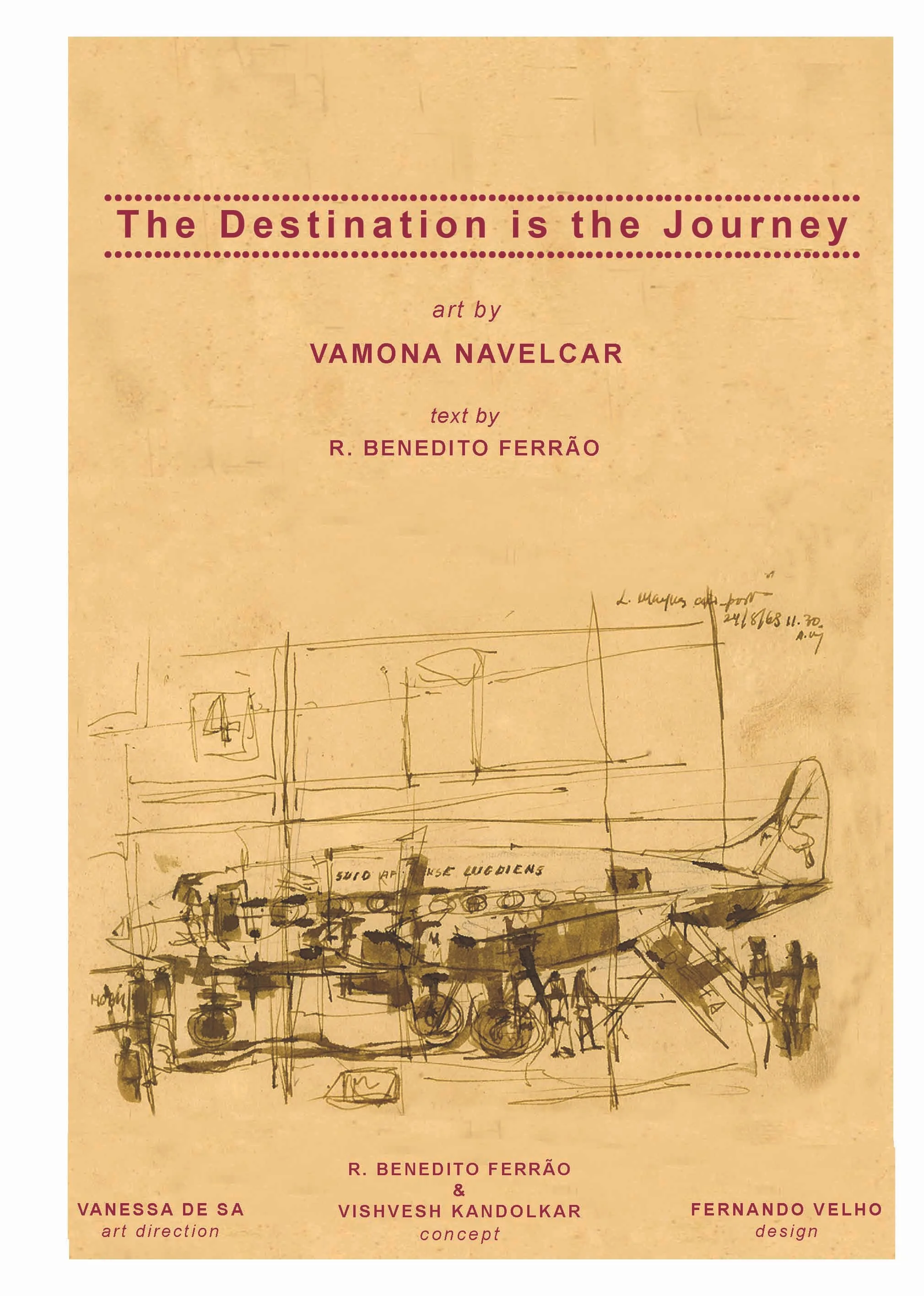
The cover image of the graphic novella is certainly one that spoke to me the most. It also appears on the cover of the book and the poster for the exhibition. Further, it was also used for the cover of the Spring 2022 issue of the journal Verge: Studies in Global Asias which carries an article I co-wrote with Kandolkar. “Canvas Adrift: Vamona Navelcar, Artist of the Unframed Ocean” is a political biography of the artist where we say this of the iconic cover image, DETA Airways (1968):
Either about to take flight or having just landed, the interim position of the plane operated by the quondam company Direcção de Exploração dos Transportes Aéreos signals transit, travel over land and sea, even exile. Ever on the verge of arriving or departing, the ironically still canvas is analogous to its creator, who is set adrift, between oceans, in the midst of political histories that are unframable by the seeming constancy of geography.
AS: How do you think the format of graphic novellas helps to aid the telling of stories like Navelcar's?
RBF: This is an important question. In responding, I recall the intent behind Destination which was created as a pedagogical tool. In “Vamona Navelcar’s Lost Suitcase: Drawing (from) the Impossibility of Nation in The Destination is the Journey,” another article by Kandolkar and I, this one appearing in the Fall 2022 issue of World History Bulletin, we write:
During the 2017-18 exhibition, The Destination is the Journey already served as a way to initiate a different kind of viewership of Navelcar’s oeuvre within and beyond the exhibition space of the gallery. At the same time as it mirrors the pieces that could be seen on the walls at Fundação Oriente, the graphic novel engages with art to challenge the very institutionality of the space of the gallery itself … In Goa, there is no state-run facility where the Goan public can see work by Goan artists … However, coloniality is also the reason that the legacy of someone as important as Navelcar borders on obscurity today in his own homeland … This is because of Goa’s status as “a colony of a postcolony” …, a once-Portuguese territory annexed by formerly British India, where the oeuvre of an artist like Navelcar, who is at once Goan, Portuguese, and Mozambiquan, cannot be recognized within the national canon … With the dearth of public venues in which Goan art can be viewed in Goa, coupled with the lack of a curriculum for the study of Goan art history or criticism in the region’s schools…, graphic novels like The Destination is the Journey may provide an alternate form through which to intervene in this void.
The graphic narrative is a creative form of cultural expression, one often not taken seriously for its educational potential. What we set out to do in making Destination was to find a creative way to tell and preserve Navelcar’s story in the midst of the limitations outlined above.
AS: How much research around Goa and Navelcar's history did you conduct in preparation for writing the novella?
RBF: Ketteringham’s book provided a lot of important information, but I also relied on research and interviews done by Savia Viegas and Margaret Mascarenhas. All three contributed material to the larger book that Destination is part of, as did other writers who were critics, art historians, collectors, and friends of Navelcar’s. In editing the book, I gained a lot of insight on the artist as a person but also his pluricontinental milieux. I then also did my own research, especially about Portugal and Mozambique between the 1950s and 1970s (a lot of which wound up in the political biography in Verge). Save for the introduction to the book, the graphic narrative was the last thing I wrote upon editing the compendium, this allowing me to benefit from the material gathered as I crafted the story.
AS: You've spoken before about also being inspired by the photography of Ricardo Rangel when producing the graphic novella. How useful a tool do you feel photography and art is in telling the history of colonialism?
RBF: Apart from being an important figure in Mozambique’s postcolonial history, Rangel was also a contemporary of Navelcar’s. In Portuguese Decolonization in the Indian Ocean World: History and Ethnography (2020), Pamila Gupta’s “focus is a remarkable set of photographs [Rangel] took during the last days of colonialism . . . in Lourenço Marques in 1975,” mostly of retornados and their things. The photographs cause Gupta to poignantly remark, “[Rangel’s] images remind me that colonialism is first and foremost an act of possession and its undoing one of dispossession.”
The retornados were those Portuguese citizens (many for whom Portugal had never been home because they were born during and as part of the colonial regime in Mozambique) who were to return to Portugal as Mozambique became independent. In several of the photographs, one can see the suitcases the retornados had packed their belongings into, their anxious faces betraying the trepidation they were experiencing in this time of uncertainty. It was these images of suitcases that I thought of as I wrote Destination, Rangel’s photographs echoing Navelcar’s plight as well, a major distinction being that unlike the retornados in the pictures, the artist – like the photographer – was not white.
Between the artists Rangel and Navelcar, both racialized subjects negotiating the end of colonialism in Mozambique, their view of history unfolding occurred, in some sense, from the margins. Watching from the sidelines, the empathy in Rangel’s portrayals of these moments is Mozambique is palpable in his work, while Navelcar lived through that period as a prisoner of the state, his sadness and resilience communicating itself through his artistic recall of that time. What artists relay to us of these historical moments are not just grand memories but the intricate and often untold complexities of “ordinary” human experience.
AS: The presentation of the novella is neat and easy to follow but doesn’t necessarily comply to a strict layout from page to page. How did you interpret the power of the presentation of the novella, and how did you go about deciding how it should be organised?
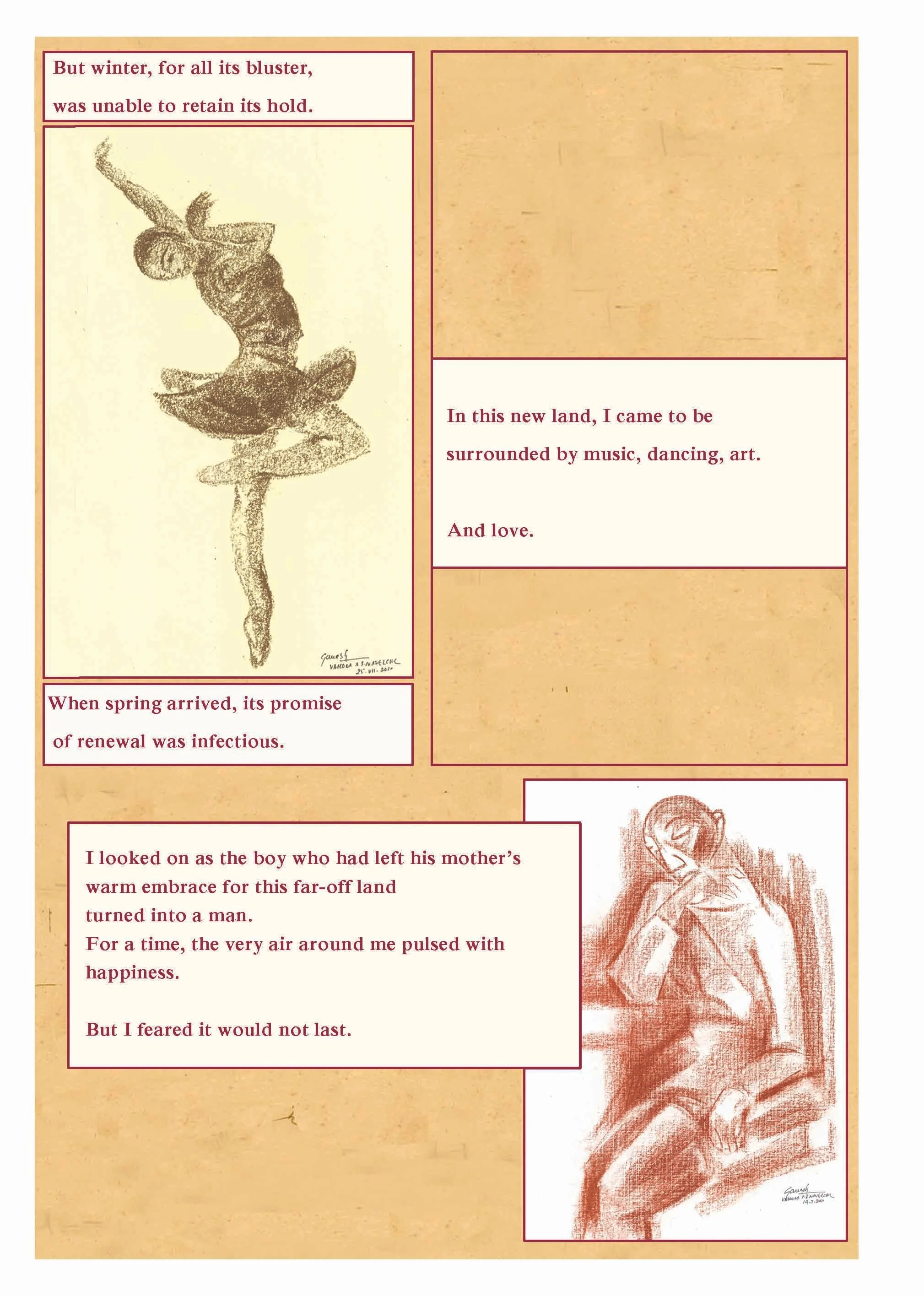
RBF: I may not be able to offer much insight here because it was the design team (Kandolkar, de Sa, and Velho) who did much of the layout, although I consulted with them extensively. One thing I may be able to add here is that I first wrote the narrative as I would any other story, but then went back and broke it up into the lines you see on the page, each “fragment” corresponding to a cell in my imagination. The next step was to ask de Sa if she could arrange the images to match my thought process. This took a little bit of back-and-forth (often on video or WhatsApp calls because we weren’t in the same country!) as we tried to work things out between my textual ideas/vision and those of the artistic/graphic team.
AS: The literary content of the novella is extremely compelling and a gripping story even when separated from all the other components. The novella uses certain devices like repetition, rhetorical questions, and personification. Would you be able to explain your use of some of these devices and how you hope they're interpreted by the reader?
RBF: The novella begins with the line, “This is the story of the most famous suitcase in Goan art history…,” but that is the last time a geographic marker identifies any of the occurrences in the narrative.
As you rightly note, the novella uses repetition, in each case a previously written line telling of an event in a different location. The three distinct places of Navelcar’s life story – Goa, Portugal, and Mozambique, are only obliquely hinted at – while the artist’s experiences in each region are brought to the fore. While maintaining some level of specificity, the delineations between places blur in the telling of the tale. I wanted to have readers think about whether the unfolding of history between the making of colonial and postcolonial regimes is really that different in the way that an ordinary person experiences loss because of political goings on beyond their control.
The novella imagines the suitcase as a companion to the artist, a confidante even. In allowing it to speak, the personification was meant to transmit the intimacy of the two having traversed the world together, sometimes with only each other as witness. We imbue objects with meaning and grow close to them. They are the recipients of our touch, even our words in moments of loneliness. These they hold like secrets. What if they could speak of what they bore witness to, we wonder, of historical objects. As a narrator, the suitcase fulfills this fantasy but then finally forecloses such desire in the last lines of the novella by shutting itself off to any query that may reveal its final destination. In so doing, the text signifies the historical mystery of what actually happened to the suitcase.
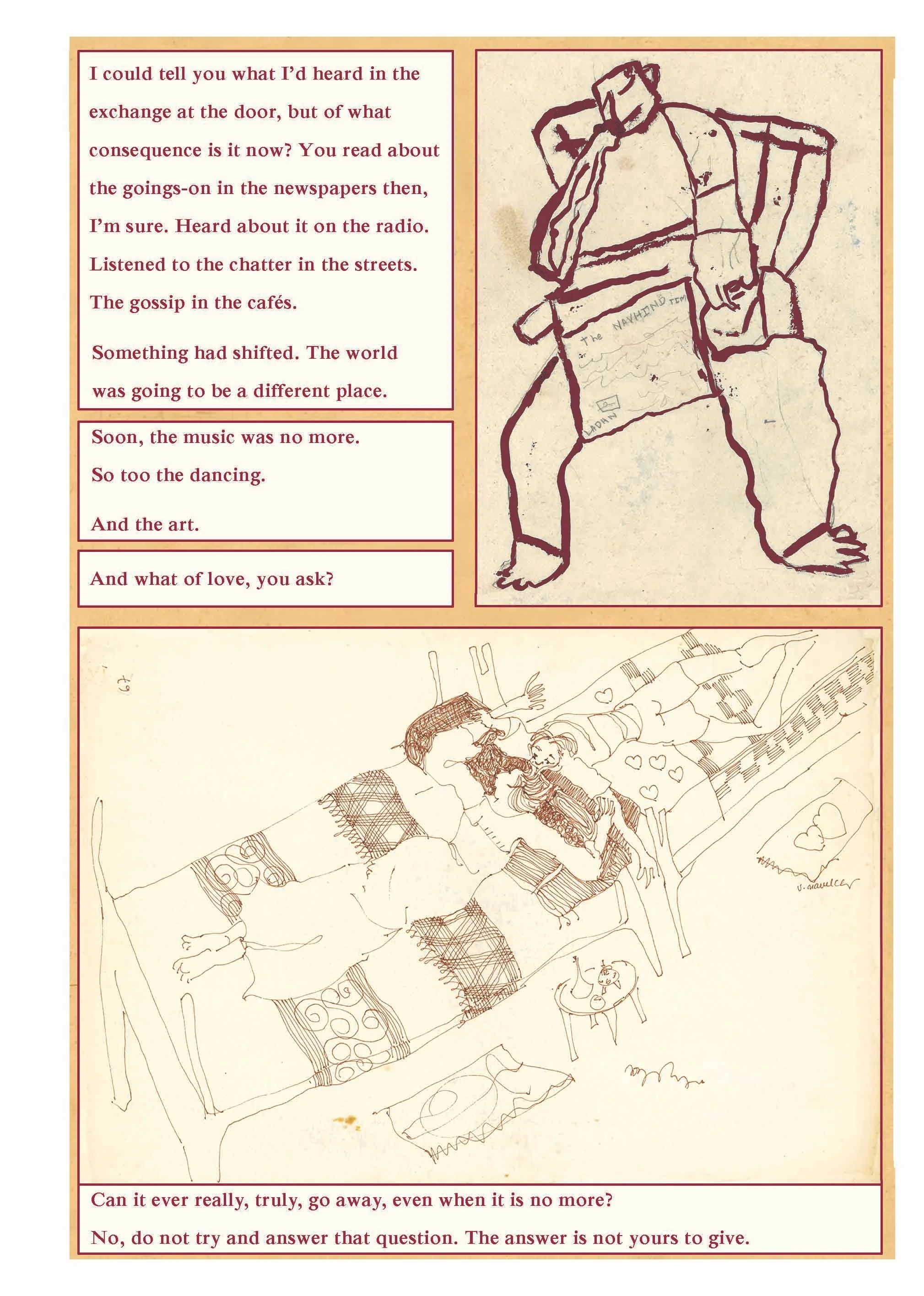
In some places, the rhetoric also deliberately shuts out readers as when the text muses:
And what of love, you ask?
Can it ever really, truly, go away, even when it is no more?
No, do not try and answer the question. The answer is not yours to give.
Here, I wanted to think about the relationship between personal and national histories, even as they are entwined. Is the private subject allowed to hold on to that most intimate to them even as they find themselves under the scrutiny of the public gaze because of their unwilling conscription to national history?
Navelcar, as I knew him, was a very private person on some subjects. And although he was vocal about the trials he faced due to national politics in three continental locations, there were things he saw as being separate from those moments and which he guarded closely.
AS: Finally, what messages do you hope readers take away from the novella?
RBF: It will always be important to me that I got to work with Navelcar and tell his story while he was alive. Never having achieved fame in his lifetime, what Navelcar really wanted was to be recognized for the duality of his talent and how it bore witness to historical moments across three continents connected by colonialism. Really, it is Navelcar’s art and his life that emblematize this legacy, one shared by many others across the lusophone world. I think that that legacy still lives on even as the connections that existed between the places Navelcar once called home appear to diminish. I think of Navelcar as a survivor of post/colonialism and in this what the artist and his art illustrate is that we need to be more mindful of the smaller stories, the ones that get obscured by grand narratives. My little novella tells such a tale which in its tininess spans continents.
Ava Sherry graduated from King’s College London with a bachelor’s degree in European Politics. Her interests include European law and public policy, with a particular focus on political institutions and decision-making processes.
Banner image by Mche Lee downloaded from Unsplash.com