By R. Benedito Ferrão
Fable horizons: framing myths, a group exhibition held at Camões Centro de Língua Portuguesa in Panjim, Goa, between 5 October to 7 November, 2026, brought together four artists with connections to Goa, China, and Portugal. Across their exhibited works, Run Jiang (RJ), Luís Almeida (LA), Ryan Francis Abreu (RFA), and Karishma D’Souza (KD) explore how ideas of place are manifested mythically but also how storytelling brings nuance to placemaking.
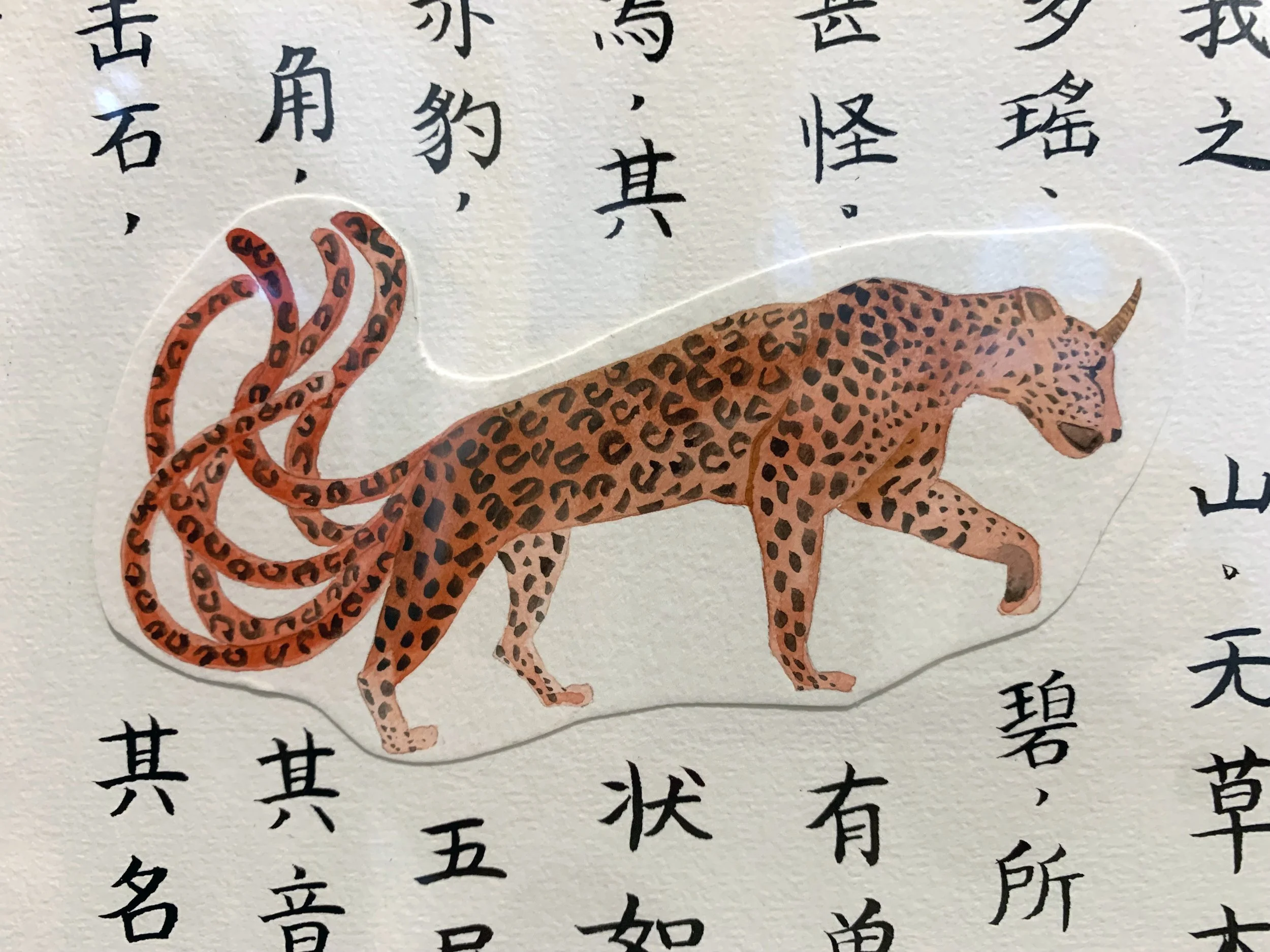
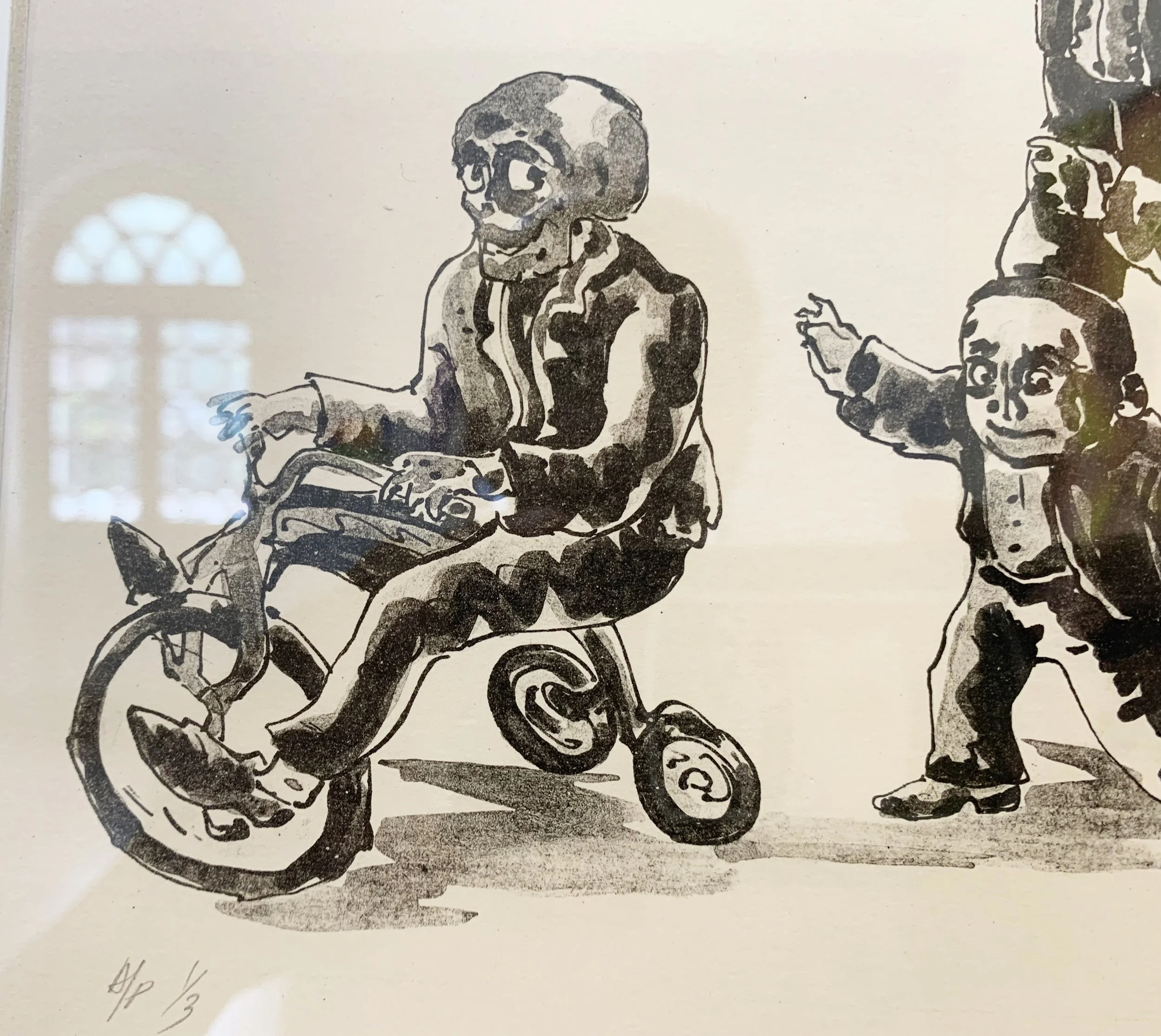
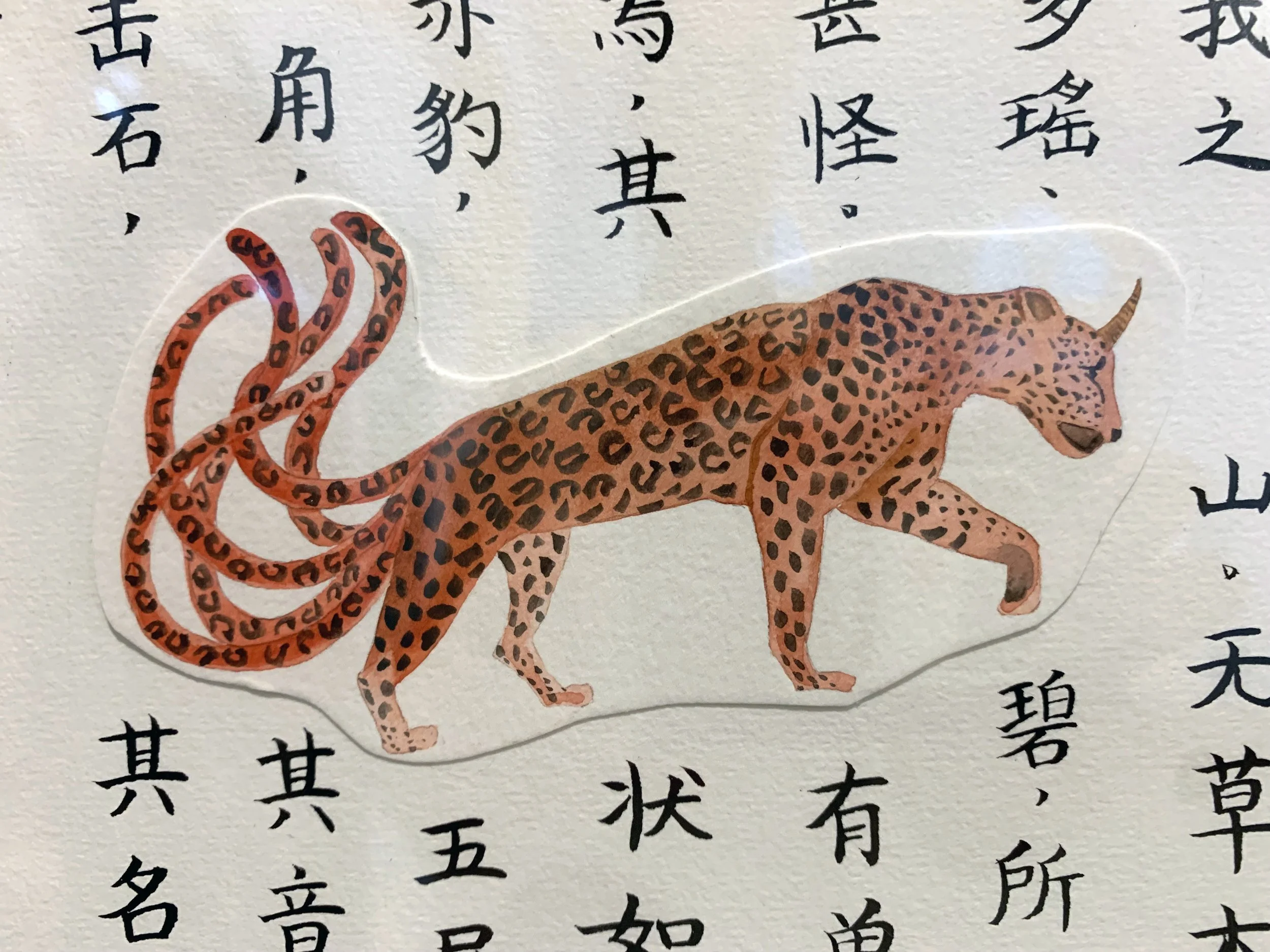
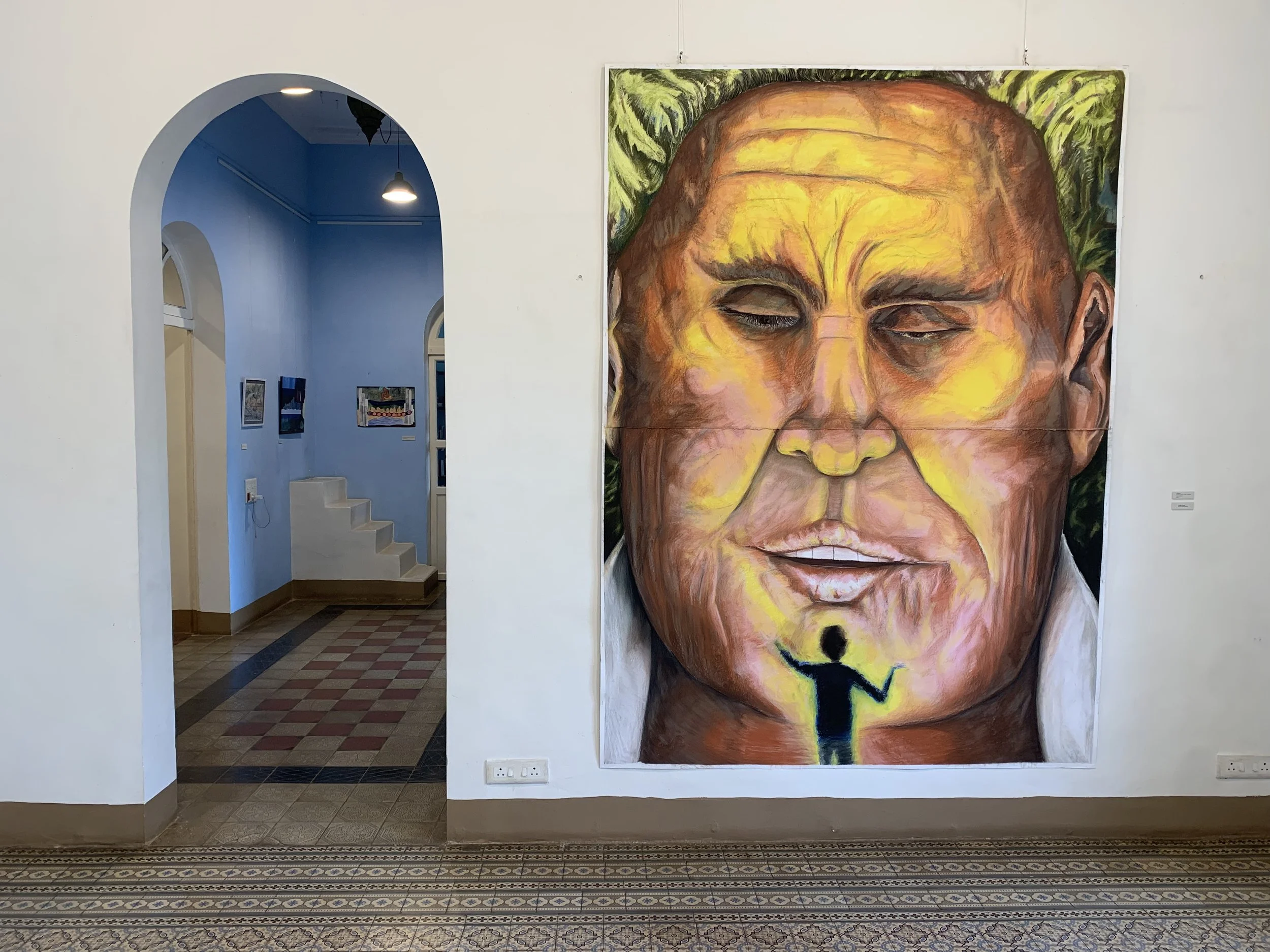
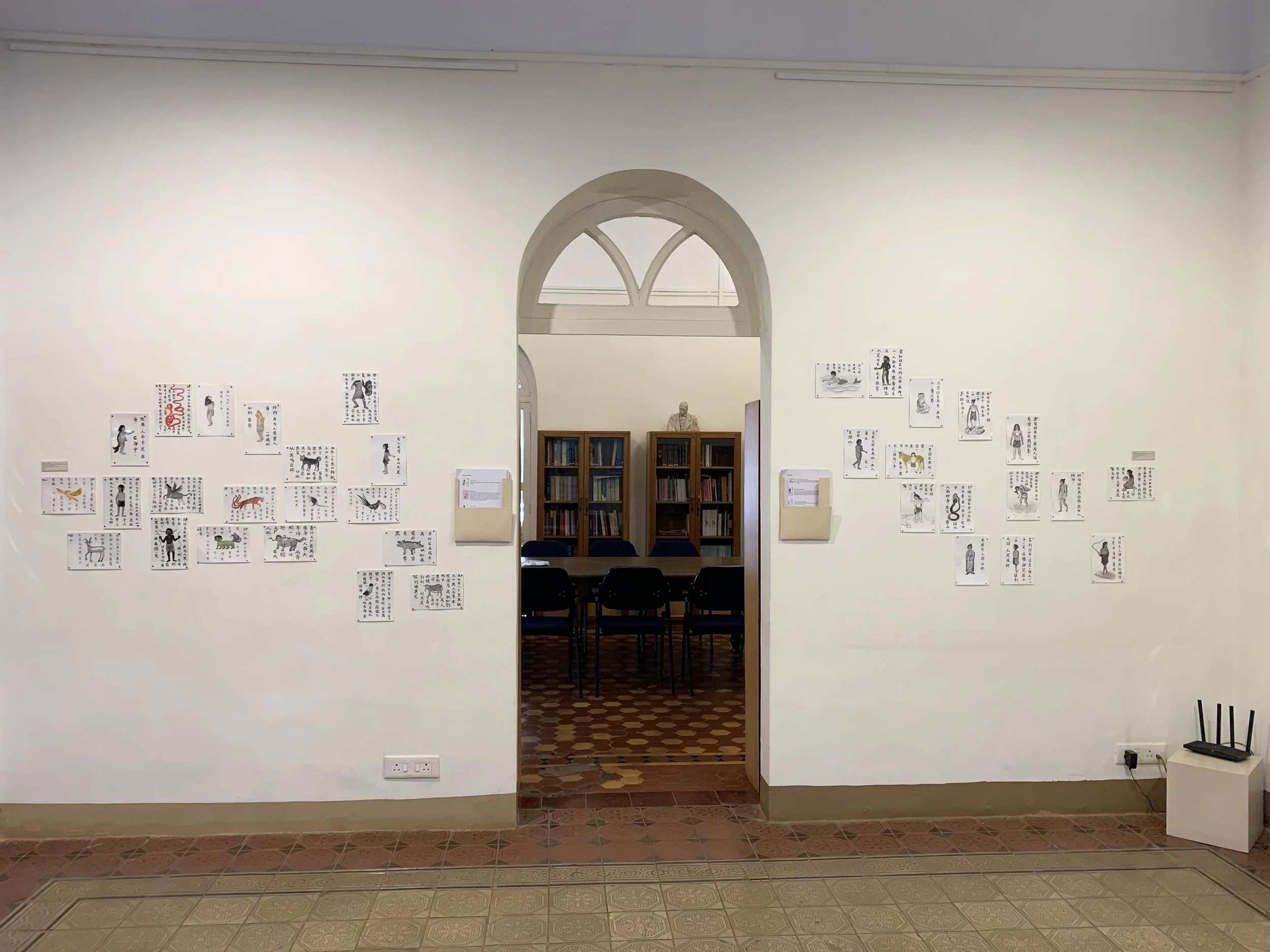
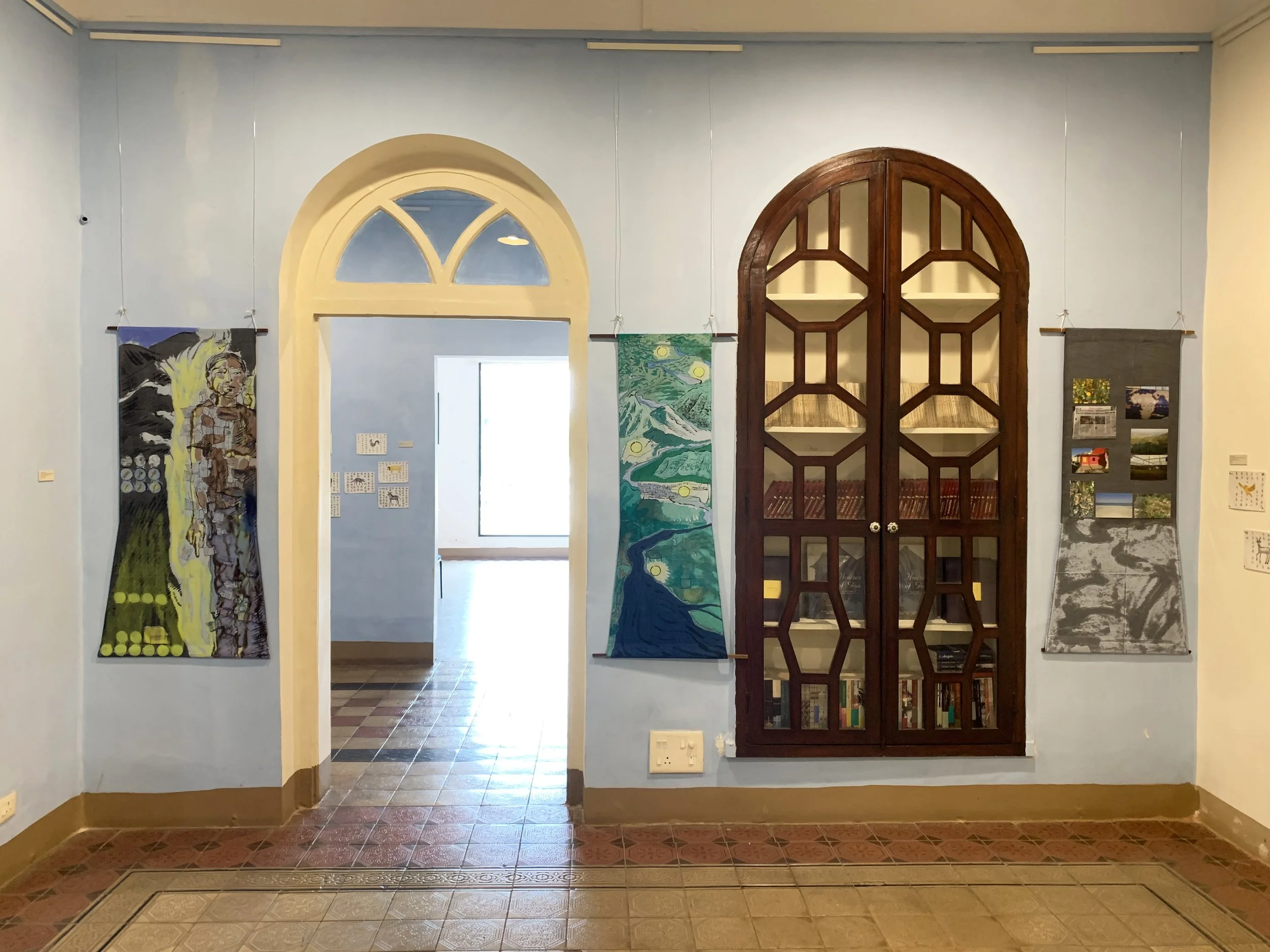
In a series of Chinese ink-on-paper works, Jiang meditates on the Shan Hai Jing (Classic of Mountain and Seas), to consider the similarities between these mythic tales from China and those from other countries. In so doing, the artist looks beyond place and history, putting multiple imaginaries in dialogue with one another. The power of storytelling is in full force in Almeida’s Shaman (2026), where the immensity of a giant’s face stretches across the large work to dwarf the silhouetted narrator in the foreground. Entranced, the usually cruel colossus is beholden to the diminutive figure whose words have cast a spell upon the behemoth. The intimacy between figures in Abreu’s lithographs is not that of familiars at ease with one another. Rather, its dangerousness is echoed in the very shadows that hang about these characters who seem to share secrets that are not to be retold. Contrastingly, the colors of D’Souza’s art are in many hues. Yet, the familial and scriptural stories and myths she paints are not pretty tales; they are fables queried anew.
In this interview, R. Benedito Ferrão (RBF) asks the artists about the themes common to their work and the dialogue created in this group exhibition despite their different aesthetics.
RBF: A group exhibition is never a straightforward process. Artists may share a vision but that does not mean their bodies of work align. So, what brought about this particular grouping and what made it work?
LA: Run Jiang is my partner and we have been exhibiting together for several years now. We met Karishma D'Souza in 2018, right when she moved to Portugal, and I even helped her find her first studio in Lisbon. We met Ryan later through Karishma, and he fit right into the group, bringing a more graphic aspect through printmaking, exploring local themes from his region of origin. I think the initial idea came from the fact that we appreciate each other's work and wanted to do something together. The theme came naturally, as our work all shares a very prominent narrative component and a need to address intimate, social, and political issues through stories.
KD: The theme of the exhibition derived from the methods already used by us in our work-practice: conversing with the world and our lives in it through a proliferation of storytelling. The exuberance and openness of imagination in Run Jiang and Luís Almeida’s work is joyful to see. The unending creation of ‘characters’ in Luís Almeida’s, Run Jiang’s and Ryan Francis Abreu’s work was interesting to me. Their artworks made me think of the lightness with which stories can be approached, instead of thinking of stories as a hardening of unquestionable texts.
RFA: I think the common thread was the theme of stories and myths. Each artist has a different way of looking at and expressing them. The works may be very different, but they come together through the ideas they explore.
RBF: Pastel, ink, lithography, watercolor, oil, and acrylic are some of the materials used in the displayed works. How did the thematic focus of the exhibition function to bring together such artistic diversity?
LA: Illustrations of folk tales are usually rendered with drawing materials, and those are the materials I routinely use in my creations and the ones I am most familiar with. Although charcoal is the dominant material in my work, pastel is similarly a very direct and spontaneous medium, where you ‘have color at your fingertips’.
KD: The narrative content in our works was a strong connecting device in the exhibition. This exhibition theme was, at first, thought of as a series, this exhibition being the first chapter of many. I hope it can be an evolving conversation through more chapters of Fable horizons: framing myths, expanding the horizons further through the work of other artists from different backgrounds.
RFA: The theme gave everyone the freedom to explore their own ideas using different materials and techniques. Stories can be told in many ways, and I think the exhibition shows how different artists interpret a theme in their own way.
RBF: Fables, myths, stories, tales. What is it about these various forms of fiction that seem to empower identity so forcefully? Conversely, how does your art engage with stories of the marginalized and especially those that may serve to challenge dominant myths?
LA: I think fables, myths, and tales carry so much power because they have been shared by so many people across generations. They are almost timeless stories and, and for that reason, they have moved beyond the realm of scrutiny or rational analysis. They are carved in stone. In my work Shaman, I intended to represent a person holding power, personified through a large face that oversees and decides the survival of a population. A people who have to uproot their lives and carry them on their backs because of the insensitive ideas of a single powerful person. In this case, through the narrative power of stories, a person representing the rest of their community stands in front of the large face and tells him his version of events.
KD: Identity seems to be anchored in the stories we tell ourselves about ourselves or the other. What do these stories or myths do to us and the environment? To how we perceive our lives in this world? Who does the story benefit? Is it a narrow benefit that is mean-spirited? Which stories are political propaganda? My refuge has been certain biblical parables and the dohas of saint Kabir, and the ‘guards at the door' more recently are the writings of B. R. Ambedkar and reading about critiques of myths related to claims over land. Through Jyotiba Phule’s book Gulamgiri, for instance, one can also re-look at biblical references to a ‘chosen land’. You have also written, about ‘origin stories with political intent’, Benedito, in your 2024 essay, ‘Goa on the Literary Atlas: Questioning Belonging.’ These writings help one recognize or decipher the ‘whys’ behind stories. How does one make visuals connecting the outcome to a certain way of seeing? For example, that the idea of land as a property to exploit and ‘fill-up’ is derived from a way of looking at land that is fortified by origin myths about how this world or land-masses came to be.
RFA: I think stories help us understand people, society and the world around us. They carry memories, beliefs and experiences. In my own work, I use storytelling, animals, and sometimes dark humour, to look at everyday situations and human behaviour. I enjoy using simple or imaginary situations to comment on things happening around us because I want to make people think a little differently.
RBF: A constant challenge in Goa is the dearth of public venues for critical engagement with the arts. This is mirrored in a lack of infrastructure: Goan art and art history exist but they are not the subject of sustained study in the Goan education system. Still, shows like Fable horizons: framing myths seek to bridge this gap by being free, open to the public, and by being accompanied by text that articulates the sociopolitical themes portrayed. What is one thing that could change in engaging the Goan public in seeing the role art plays in and as a chronicle of its cultural milieu?
KD: The infrastructure of dedicated state museums, with far-reaching programming, where the Goan population has access to seeing their own heritage and knowledge valued, is very important. Goa could have many museums, for instance, in the beautiful heritage buildings of Panjim, that are being emptied out today. There could be a modern art museum, a terracotta museum, a textile museum, a museum of music, an architecture museum, a transport museum, a museum of tools, a land museum, etc. This has been asked for by civic groups in Goa. Each taluka could have vibrant spaces like what the Kala Academy was for Panjim, albeit on a smaller scale: one mini kala academy per taluka with exhibition spaces for contemporary art, open on weekends, with funding/grants for artists to set up exhibitions.
One easier thing that could be initiated by the Directorate of Art and Culture is, as I mentioned, grants for exhibitions, but also special grants for exhibitions in villages and the smaller towns of Goa. The grant could pay for a publication to archive the exhibition project. Concurrently, it could support logistics, like the rent of a temporary space that would work for the exhibition, for instance a shop in a market. The open call could be related to artists with roots in the area, or to the particularity of why the theme of the exhibition fits that particular neighborhood, i.e. deals with the history and present realities of the location. This would diversify the audience, the artists, and the thematic milieu of the exhibitions produced in Goa. State funding could also be made available through application for registered artist associations.
Private museums do their part, but the funds and reach of public museums and community workshops would be unparalleled. Public museums and galleries, especially with programming that moves from the bigger cities of Goa to the smaller towns, have a pertinent role to play. The lacuna is gravely felt and is an ongoing loss to each generation of Goans. I would have liked to have had the chance to repeatedly revisit the paintings of Ara and Gaitonde which were on display (I think I saw them in 2014 or 2015) at the Goa State Museum before it was shut down. Those paintings just remain a memory.
RFA: I feel art should be introduced more actively in schools. Children should have opportunities to visit exhibitions, meet artists and experience different forms of art. Art is not just about making pictures; it is also a way of understanding and recording our lives, culture and surroundings. I think creating this interest at an early age can make a difference.
RBF: What lasting impact would you like this exhibition to have had?
RJ: Through our exhibition, I hope to show audiences in Goa the myths and stories of various cultures, as well as the diverse ways in which they can be expressed. I also hope that my work - featuring figures and creatures from ancient Chinese books that bear a resemblance to those found in Indian mythology - will prompt people to question the distinctions between different belief systems and civilizations: could these myths have actually taken place? Are the myths of different nations perhaps telling similar stories?
LA: All the books, music, and exhibitions that have touched me have an impact on the present in which they were experienced, influencing the near future, which in turn will influence the time ahead. Everything is linked. I would like this exhibition to have an impact (whatever it may be) on the viewers, knowing beforehand that this impact will quickly fade, but that it carries the seed of influencing the near future and creating new chains/currents of thought.
KD: This may be one of the few times a contemporary Chinese artist’s works were in a gallery exhibition in Goa. Run Jiang’s works are based on an ancient Chinese text, geographically divided into unending imaginative worlds of the unknown beyond the horizon - where the eyes cannot travel, the mind can fill in the void. This clearly conveyed the exhibition theme: highlighting the proliferation and freedom of stories, the playful, imaginary aspect of storytelling, the wonder and curiosity behind these stories of storytellers who are clearly geographically situated imagining the other. I hope this theme of framing myths is always thought about deeply, as well as the questions ‘What lies beyond the horizon of a fable?’ And ‘How many ways can one frame a myth?’ Luís Almeida’s Shaman began the show with a call to silence in order to listen, a statement to the vast power of storytelling and the storyteller.
RFA: I hope the exhibition makes people look at familiar stories a little differently and encourages them to ask questions. If someone remembers a work, thinks about it later, or starts a conversation because of it, I think that itself is meaningful.
R. Benedito Ferrão is an associate professor of English and Asian & Pacific Islander American Studies at William & Mary. He is also the Dr. Thomas Tam Professor of Asian American Studies at City University of New York. His books include Across Continents: Writing Goans, Making Worlds (2026), the edited volume Goa/Portugal/Mozambique: The Many Lives of Vamona Navelcar (2017), and with Maria Vanessa de Sa, The Girl Who was the Color of Nothing: A Children’s Story for Adults (2026).