By R. Benedito Ferrão
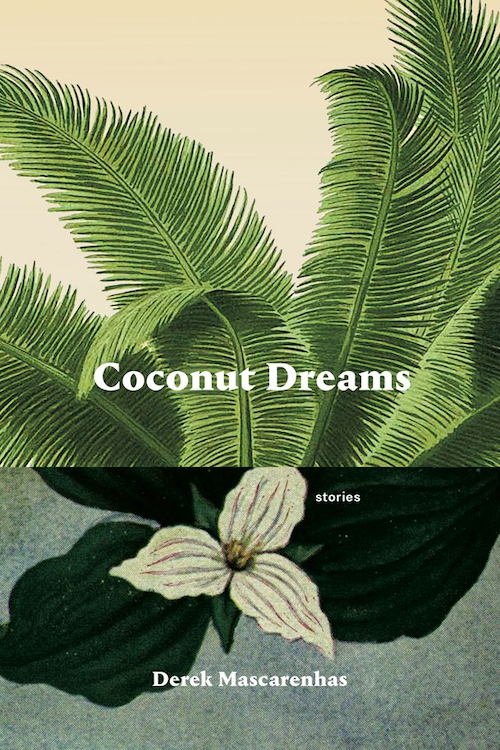
Derek Mascarenhas’ Coconut Dreams (Book*hug, 2019) unfolds in related stories that form a bildungsroman. The coming-of-age of the Pinto siblings occurs against the backdrop of their lives as Canadian-born Goans. Readers follow these characters from the time of their youth until their early adulthood. Largely set in Canada, where Mascarenhas himself lives, Coconut Dreams also has events occur in Goa and East Africa.
Coconut Dreams joins a small pool of recent works of fiction about the Goan diaspora, Canada being a country that has not been a subject of such literature so commonly. While the Goan Canadian community largely traces its origins to British East Africa, with immigration to the North American continent occurring in the wake of African decolonization, the family at the center of Mascarenhas’ stories pin their beginnings to Goa more directly. Accordingly, the tales situate Goa as a place reconceived in memory, but also as a site of “return” when one of the younger Pintos visits his ancestral village. Symbolically, Goa represents the family’s heritage in how Mascarenhas’ book recalls intrigues of the past; concurrently, Goa remains ever present even as the Pintos look to the future. Goa as yesteryear and as a time-to-come commingle, as if in reverie (like the title suggests), while the family navigate life as Canadians.
In this interview, Derek Mascarenhas discusses his writing with R. Benedito Ferrão. The exchange takes up various topics, including Canadian multiculturalism, Mascarenhas’ process as a writer, and the role childhood plays in the author’s oeuvre.
RBF: That age old riddle… What came first, the idea for a book or the stories which you then decided to link together as Coconut Dreams?
DM: The young voices of my two protagonist siblings, Ally and Aiden, definitely came first. Every scene or story I tried to write seemed to be from one of their perspectives. The title came relatively early as well, but every other aspect of writing this book took many (many!) years, as I know you’re familiar with.
RBF: The Pinto siblings who are the protagonists of this book deal with racism in overt and subtle ways. One of the things I appreciated is the nuance with which you portray the cruelties of childhood. For example, when a miscreant youth, who is white, sets fire to a house, you take care to show how the delinquency he demonstrates is the product of his environment rather than an innate quality. Nevertheless, it is also apparent that whiteness pervades the lives of the Goan characters socially, its ubiquity, privilege, and malice made evident by the actions of children who are the same age as the brother and sister. What might readers gather from this of a “multicultural” society’s unacknowledged biases, where once innocent children obviously pick up on how to weaponize difference from society and culture?
DM: Ally and Aiden have unique perspectives growing up racialized in a very white town, and a number of the stories show them struggling to navigate this reality. I appreciate you picking up on the nuance of encountering both overt and subtle racism at tender ages—to me, it shows how prevalent and deep-rooted white supremacy is in our society, including ones that are often praised for being “multicultural.” In terms of their Goan identities, other than being enrolled in a Catholic school and attending church, I feel like it wasn’t even visible to most of the people they interacted with, who only saw brown bodies. This is in some ways why I wrote this book. In all the stories I’d read, I had never seen characters like them centered; showing the depth and humanity in their experiences was important to me.
RBF: Something quite different happens in the lone encounter with a character who is Indigenous Canadian. What does Joseph represent to Ally Pinto?
DM: At that age, Ally is more confused by the shared “Indian” name, but it does speak to the historical omission of Indigenous Peoples in the Canadian education system. I know when my siblings and I were growing up, we learned very little of the many genocides that took place, and the impacts that can still be seen today. In that story, they are just two kids on summer break forced to play together. But I do feel their differences weren’t something to overcome, and didn’t divide them in the same way as some of the other children in the neighbourhood. When I look at my own friendships in real life, I feel a similar bond and kinship with other racialized or marginalized writers.
RBF: Much later in his life, Aiden Pinto tells us that he is often identified as a coconut: brown on the outside, white on the inside. One cannot escape the perhaps inadvertent allusion to the book’s title here. What is the cause of Aiden’s self-reflection and the dis-ease about assimilation he appears to experience?
DM: Can my answer be colonialism? LOL. Ally and Aiden do assimilate into their environment growing up in a very white town. It would be odd for them not to have different childhood experiences from kids raised in India, or even to those in a more diverse city in Canada for that matter. In some ways they are very privileged—they grow up in a safe home with a lot of love. In other ways, they are constantly being othered for their differences. What is lost and gained in the decision and reasons to emigrate from one country to another? For me, this is a calculus best explored in stories. For the title, the image that I always come back to is Ally as a child in her home. She’s staring up at a picture hanging on the wall, of coconut trees and the ocean, feeling a bit of warmth, before venturing out into a cold Canadian winter snow day. Culture is not a static thing to me. There’s beauty in both following tradition and forging anew.
RBF: The novel follows a timeline that begins with the year 1946 and closes with the last chapter set in 2006. Goa bookends the novel as it functions as the settings of the first and then the concluding chapter. Apart from the actual events in the stories themselves, it is noteworthy that 1946 is the year before India became independent from the British while Goa would continue to be an overseas territory of Portugal’s for more than a decade after that. Then, 2006 was the year in which the Conservatives returned to power in Canada, marking a major political and economic shift.
Although these historical events occur apart from the fiction, one feels the weight of the two places the Pinto family are associated with being on the precipice of change at either end of the book. Interestingly, this has less to do with the temporal setting of the particular chapters themselves and more so with how successive generations of the family deal with domestic matters and village life. To say this differently, you explore the lives of ordinary people who are impacted by the socioeconomic and political occurrences of their day. What did your research process in thinking of and writing about these connections involve?
DM: I love that question. I think you’ve put it perfectly in that the historical and political backdrop are ever-present, but the lens remains on the lives of ordinary people. I feel we humans are hardwired for stories. Understanding events and movements is often easier and more impactful if shown via individual and family narratives.
RBF: At the book’s end, Aiden journeys to Goa for the first time sans family. He seems to come to an understanding of himself that he was unable to achieve in Canada. This suggests an in-betweenness — an unbelonging in the diaspora potentially resolved by a “return” to the homeland. Yet, is the reader necessarily meant to take this at face value given the distance Aiden also experiences with regard to other Goans and his own family in Goa?
DM: In the title story, Coconut Dreams, I wanted to show how eager Aiden is to connect to an ancestral home that he has never been to; to a culture he’s primarily experienced through stories and his upbringing; and to a people of common blood, skin, and features. There are literal bumps and bruises on this journey, but I feel there’s also a disappointment that’s common among third-culture kids. After feeling like they have not fit in for the majority of their childhood, there’s a certain irony and cruelty in them also feeling out of place in their homeland. For Aiden, it’s the one place he believes (and has been told) that he should feel at home in, and for the majority of that story, he does not.
RBF: “The Elephant in the Mountain” is a chapter in the book that reads like a children’s story. This is a genre that you have published in yourself. How do you find the experience of moving between forms of creative expression and do you find yourself bringing from one to the other in your practice as a writer?
DM: I love writing for both adults and children. Children’s books (especially picture books) are magic to me. Other than oral storytelling, they are oftentimes children’s first introduction to stories. The marriage of text and visuals and how the book becomes a shared vision between author and illustrator is really something unique and special. It is by no means easy however—the brevity and simplicity of writing for children can mask the complexity of the genre. Writing fiction for adults is not any easier, but I feel like it’s common knowledge that writing a novel (yourself!) is difficult.
RBF: As we close, tell us about what we might expect to see from you in the future.
DM: I’m working on a speculative fiction novel and a middle-grade book. The former is tentatively called, Beyond the Banyans, and is set in a remote village in Rajasthan, but features a Goan Canadian young man who, while trying to escape a tragedy, follows a trafficked young boy through a portal to another world. The latter is set in a Goan village where the protagonist, a young girl named Soma, sees the impact that forest destruction is having. In trying to stop the development of a massive new resort, she discovers a gift linked to her nunna. The last time I visited Goa, I also had an idea for a multigenerational historical novel, but it’s still an idea at this point. If I’m fortunate enough, we’ll get to chat about it down the line! Many thanks!
For buying information, click here.
R. Benedito Ferrão is an associate professor of English and Asian & Pacific Islander American Studies at William & Mary. He is also the Dr. Thomas Tam Professor of Asian American Studies at City University of New York. His books include Across Continents: Writing Goans, Making Worlds (2026), the edited volume Goa/Portugal/Mozambique: The Many Lives of Vamona Navelcar (2017), and with Maria Vanessa de Sa, The Girl Who was the Color of Nothing: A Children’s Story for Adults (2026).
Banner image is by Brian Huynh and is downloaded from Unsplash.com